President Nicolás Maduro of Venezuela has tightened his personal security, including changing beds, and leaned on Cuba, a key ally, amid a growing threat of a U.S. military intervention in the country, according to multiple people close to the Venezuelan government.
They described an atmosphere of tension and concern gripping the president’s inner circle while adding that Mr. Maduro believed he remained in control and could ride out the latest and gravest threat to his 12-year rule.
Mr. Maduro has tried to protect himself from a potential precision strike or a special-forces raid by frequently changing sleeping locations and cellphones, the people said. Those precautions have accelerated since September, some of the people said, when the United States started amassing warships and striking boats the Trump administration claims were smuggling drugs from Venezuela.
To reduce the risk of betrayal, Mr. Maduro has also expanded the role of Cuban bodyguards in his personal security detail and attached more Cuban counterintelligence officers to Venezuela’s military, one of the people said.
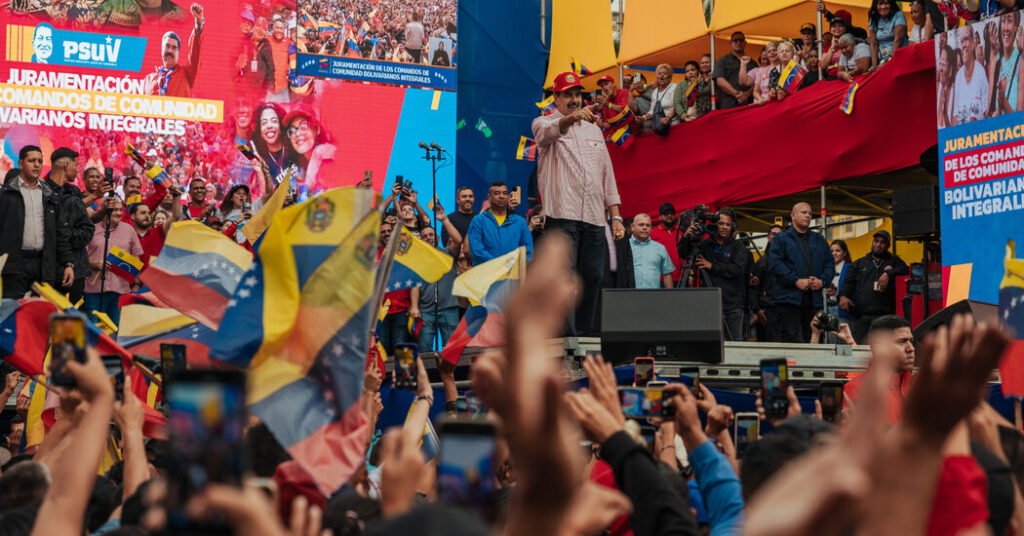
In public, however, Mr. Maduro has sought to downplay Washington’s threats by conveying a nonchalant, relaxed appearance, showing up for public events unannounced, dancing, and posting propaganda videos on TikTok.
The seven people close to the Venezuelan government who were interviewed for this article spoke on the condition of anonymity out of fear of retribution or because they were not authorized to speak publicly. Venezuela’s Communication Ministry, which handles press inquiries for the government, did not respond to a request for comment for the article.
The Trump administration has accused Mr. Maduro of running a “narcoterrorist” cartel flooding the United States with drugs, and many current and former officials in Washington say the goal of the U.S. military buildup is regime change. But Mr. Trump has combined threats against Venezuela with suggestions of a diplomatic solution, and he and Mr. Maduro spoke by phone last month to discuss a possible meeting.
The New York Times has reported that Mr. Maduro and Mr. Trump’s envoys earlier this year discussed circumstances under which the Venezuelan leader, who lost a presidential election last year but ignored the results, may leave office. Those talks did not produce an agreement, leading the Trump administration to ramp up its military pressure.
As tensions with the United States have risen, Mr. Maduro has addressed the Venezuelan public almost daily, maintaining a public relations blitz that has characterized his rule in recent years. He has, however, reduced his participation in scheduled events and live broadcasts, replacing them with spontaneous public appearances and prerecorded messages.
“Monday — party; Tuesday — party; Wednesday, Thursday, Friday — double party; Saturday — triple party; Sunday — chilled party,” Mr. Maduro said on Monday during a surprise appearance at a government rally in Caracas, which changed its scheduled route shortly before his appearance.
“Party for as long as the body can bear it!” Mr. Maduro said, and then started dancing to a fast electronic tune. “No war; peace,” his looped voice echoed over the heavy bass beat.
For Mr. Maduro, 63, the standoff against the American naval armada in the Caribbean represents merely the latest challenge to his rule. A former Communist activist, bus driver, labor organizer and foreign minister, he has lurched from crisis to crisis — most of his own making — since taking office in 2013 after the death of his mentor and immediate predecessor, Hugo Chávez.
Opposition leaders and commentators at the time said the gruff, ponderous Mr. Maduro would be out of the Presidential Palace in weeks. Mr. Maduro’s wooden communication style and civilian background, they said, made him a poor successor to Mr. Chávez, a charismatic populist and former tank commander who inspired devotion from supporters, including among soldiers and officers who have long been the ultimate arbiters of power in Venezuela.
Mr. Maduro’s critics called him “Maburro,” a play on the Spanish word for donkey. His viral bloopers have included surreptitiously pulling an empanada from his desk and biting into it on live television at the peak of a national food crisis, taking a hit on the head with a mango thrown bt a woman at a public event (immortalized in Venezuelan folklore as “Mangocide”) and reading out loud on live television a viewer comment that said “Nicolás Maduro, suck it.”
Those early public relations blunders hid a ruthless political instinct. Since taking office, Mr. Maduro has survived a 70 percent collapse of Venezuela’s per capita gross domestic product, several waves of mass national protests and various plots, coup attempts and electoral losses.
He has also weathered Mr. Trump’s previous attempt to unseat him. The first Trump administration in 2019 put in place a “maximum pressure” campaign against the Venezuelan president in an effort to curry favor among Latino voters in Florida, a crucial swing state at the time.
Mr. Trump recognized an opposition politician as Venezuela’s president and rolled out sweeping sanctions against the country’s economy.
To stay in power, Mr. Maduro has relied on lethal repression, pork barrel politics, disregard for laws, and an innate understanding of the raw essence of power, a quality even his adversaries have grudgingly come to acknowledge.
After Mr. Chávez died in 2013, Mr. Maduro used Stalinist tactics to cement his grip on Mr. Chavez’s fractious socialist movement, known as chavismo.
Mr. Maduro first sided with chavista hard-liners to topple a group of more moderate officials who supported loosening Cuban-style price and currency controls to stabilize the economy.
Several years later, amid a predicted economic collapse, he used the pretext of Mr. Trump’s sanctions to put in place those very same changes, while suppressing the chavista old guard loyal to Mr. Chávez’s socialist vision.
Mr. Maduro political survival has come at the cost of Venezuela’s democracy.
As his popularity waned, he has accelerated the dismantling started by Mr. Chávez of democratic norms, eliminating independent media, criminalizing civil society and banning competitors from public office. His security forces have turned up the repression, terrorizing poor neighborhoods with death squads and systematically arresting protesters.
Last year, he crossed the country’s last democratic red line, ignoring the results of a presidential election that he lost by nearly 40 percentage points.
Mr. Maduro’s days as an organizer at Caracas’s public transport union have helped him develop an instinctive feel for trading favors and developing coalitions based on shared interests and threats, the people who know him said.
“He is a compulsive political operator,” said Andrés Izarra, a former senior official under Mr. Chávez and a minister under Mr. Maduro, who has broken with the government and gone into exile. “He plays by the rough rules of street politics, of corrupt union politics, rules that are similar to those of a mafia.”
Mr. Maduro has overcome his weak military connections by, through the years, handing over a major part of the country’s economy to his generals, who have been allowed to run gold mines, oil services companies and import-export firms.
Mr. Maduro’s decision to trade enrichment for loyalty has led him to tolerate drug trafficking among some military officials, experts on Venezuela’s drug trade say, though there is no evidence it is a unified criminal organization controlled by the Venezuelan president, as the Trump administration claims.
Mr. Trump has in recent weeks combined belligerent rhetoric against Venezuela with suggestions that he negotiate a deal with Mr. Maduro.
During talks this past Spring, Mr. Maduro and Trump officials discussed the possibility of Mr. Maduro’s handing power over to one of his lieutenants before the end of Mr. Trump’s term in 2029, according to four other people familiar with the talks who requested anonymity out of concerns of reprisals and because they were not authorized to speak publicly.
One option included holding a referendum in Venezuela to recall the president in or after 2027, a process allowed by the country’s Constitution, they said. In the likely event of a loss, Mr. Maduro would hand over power to his vice president, who would eventually call new elections.
Those talks, which included reorienting Venezuelan economy toward American investment and trade, did not produce an agreement, the people familiar with them said. Any such deal could also easily unravel. Mr. Maduro has used his control of the courts and the electoral board to quash the opposition’s attempt to remove him through a recall referendum in 2016.
A deal with Mr. Trump would reduce the immediate pressure on Mr. Maduro, some of the people close to his government said. But it would not solve his underlying political weakness stemming from the theft of last year’s election, they added.
The scale of that loss has destroyed Mr. Maduro’s last claims to popular support, the people said.
“Their biggest crisis is the crisis of legitimacy,” said Mr. Izarra, the former minister, referring to Mr. Maduro’s government. “They are in complete denial that the country hates them.”
This crisis will remain, even if the American warships depart, he added.
Anatoly Kurmanaev covers Russia and its transformation following the invasion of Ukraine.
The post Rotating Beds and Cellphones, Maduro Plans to Outlast Trump appeared first on New York Times.