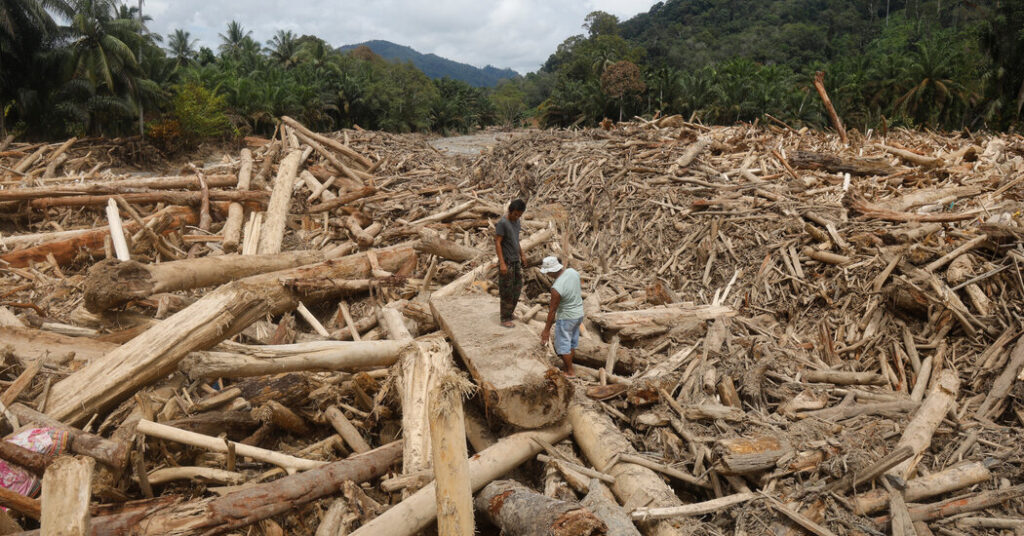
Our warming world has many ways of inflicting damage. Heat is a killer. Storms are getting more intense. And right now, floods are wreaking havoc across parts of Asia.
Floods have killed more than 1,350 people in Indonesia, Sri Lanka, Thailand and Vietnam in recent weeks. Hundreds more are missing and millions have been displaced.
Heavy rains in the region are common during this time of year, but these deluges have been particularly intense. Two powerful storms, Cyclone Ditwah and Cyclone Senyar, have pummeled vulnerable regions, swamped entire towns and overwhelmed emergency services.
In Sri Lanka, Cyclone Ditwah essentially brought the island nation to a standstill. Government offices were closed and rail service was halted. The storm is Sri Lanka’s deadliest disaster since 2017, and the country’s president called it the “largest and most challenging natural disaster in our history.”
The official death toll in Indonesia had eclipsed 700 people by Tuesday, and many areas were still unreachable, with residents relying on aid delivered by airdrops.
Indonesia’s president, Prabowo Subianto, linked the storms to global warming and said communities needed to prepare for more such floods.
“We need to confront climate change effectively,” Prabowo told reporters. “Local governments must take a significant role in safeguarding the environment and preparing for the extreme weather conditions that will arise from future climate change.”
Stronger storms
Climate change is making monsoon season in Asia more extreme and more erratic. Sometimes, that means it is dryer than usual. Korea and Japan had shorter-than-usual rainy seasons this year.
But when the rains come, they increasingly come with an overwhelming ferocity. In Pakistan, flash foods devastated the country this summer.
Whereas monsoons previously ebbed and flowed at a pace that allowed people time to respond, these days the water often comes in a great rush, leaving little chance to react.
“What we were used to in Pakistan has changed, and for now it is too much,” Maryam Ibrahim, an environmental expert and professor of environmental studies at the Lahore University of Management Sciences, told my colleagues Zia ur-Rehman and Elian Peltier.
Planet-warming emissions are making tropical storms more destructive. The Grantham Institute at Imperial College London estimates that human-caused warming increased the economic damage inflicted by Typhoon Fung-wong, which devastated the Philippines last month, by some 42 percent.
Floods were the deadliest extreme weather events in Africa last year. Economic losses from flooding amount to more than $388 billion annually, according to the United Nations.
And the toll is growing. Despite an increase in efforts to prepare for extreme weather, the number of flood-related disasters have risen by 134 percent since 2000 compared with the two previous decades.
New York City may be next
The damage from floods and storms is often particularly intense in poorer countries. Less developed regions don’t have the physical infrastructure to manage intense weather, homes are often built from less durable materials and governments don’t always have the resources to respond.
Those are some of the reasons Hurricane Melissa inflicted so much damage in Jamaica in October.
But developed countries are vulnerable, too. Last year, the remnants of Hurricane Helene unleashed catastrophic flooding in North Carolina, devastating the city of Ashville. Months later, flash floods devastated the Spanish city of Valencia.
And in New York City, torrential rains have caused chaos and taken lives this year. These downpours are just a preview of the threats that a superstorm poses to America’s largest city, as several of my colleagues described in an illuminating article last week.
In a worst-case scenario, when heavy downpours coincide with high tides and strong winds, 25 percent of New York City could be inundated by floodwaters.
Yankee Stadium would be surrounded by a moat, and the streets outside Madison Square Garden could be covered in several feet of standing water. At one point in the Cross Bronx Expressway, the road could be submerged up to 47 feet.
As my colleagues, write, “large-scale plans to protect the entire city from storms are underway, but they are years from approval.” And the cost would be tremendous, requiring the kind of commitment and coordination that can be hard for even the wealthiest cities in the world.
Short of rebuilding whole freeways or relocating neighborhoods, it’s not at all clear what kind of adaptation measures would prevent major storms from exacting a huge toll, in cities like New York or in countries like Indonesia.
“We need mobilization at the scale of World War II to really deal with this problem,” Thaddeus Pawlowski, who teaches urban design at Columbia University told my colleagues. “We’re in trouble.”
The Trump administration
In a reversal, FEMA won’t reinstate suspended workers
In August, 14 employees of the Federal Emergency Management Agency were put on administrative leave when they wrote a letter to Congress warning that President Trump was gutting disaster response in the United States.
Last week, FEMA sent notices to employees that they “are being removed from administrative leave,” according to copies of the notices reviewed by The New York Times.
But on Monday, Maxine Joselow reports, the Trump administration said that it was revoking the employees’ reinstatement.
Tricia McLaughlin, a spokeswoman for the Department of Homeland Security, the parent agency of FEMA, said in an email on Monday that rogue “bureaucrats” had sent those notices without the approval of senior department leaders.
Quote of the day
“They have succeeded at undermining climate action globally. In fact, there’s been a quite systematic campaign that’s been sophisticated and extremely well funded.”
That’s from Timmons Roberts, a researcher at Brown University, speaking in a briefing on the eve of the United Nations climate talks in Belém, Brazil, last month. Ten years after the signing of the Paris Agreement, climate activists and experts fear that they are losing the information war, Lisa Friedman and Steven Lee Myers report.
“President Trump mocks global warming as a hoax,” they write, “cheered on by a chorus of influencers online who regularly promote disinformation on social media platforms that once tried to curtail it.”
Climate data
Zillow removes climate risk scores from home listings
Zillow, the country’s largest real estate listings site, has quietly removed a feature that showed the risks from extreme weather for more than one million home sale listings on its site.
The website began publishing climate risk ratings last year using data from the risk-modeling company First Street. The scores aimed to quantify each home’s risk from floods, wildfires, wind, extreme heat and poor air quality.
But real estate agents complained the scores hurt sales. Some homeowners protested the scores and found there was no way to challenge the ratings.
In November, Zillow stopped displaying the scores after complaints from the California Regional Multiple Listing Service, which operates a private database funded by real estate brokers and agents. The organization said it had raised a number of concerns about First Street’s flood risk data. — Claire Brown
More climate news from around the web:
-
This year, the hole in the ozone layer over the Antarctic was the smallest since 2019, according to new research highlighted by The Guardian.
-
The Washington Post explores how to make the most of your climate giving this year.
-
Reuters reports that China is not just dominating the global electric vehicle market, it’s also flooding emerging economies with fossil-fuel vehicles, often undercutting local competitors.
Thanks for being a subscriber.
Read past editions of the newsletter here.
If you’re enjoying what you’re reading, please consider recommending it to others. They can sign up here. Browse all of our subscriber-only newsletters here. And follow The New York Times on Instagram, Threads, Facebook and TikTok at @nytimes.
Reach us at [email protected]. We read every message, and reply to many!
David Gelles reports on climate change and leads The Times’s Climate Forward newsletter and events series.
The post Reckoning With a New Era of Deadly Floods appeared first on New York Times.