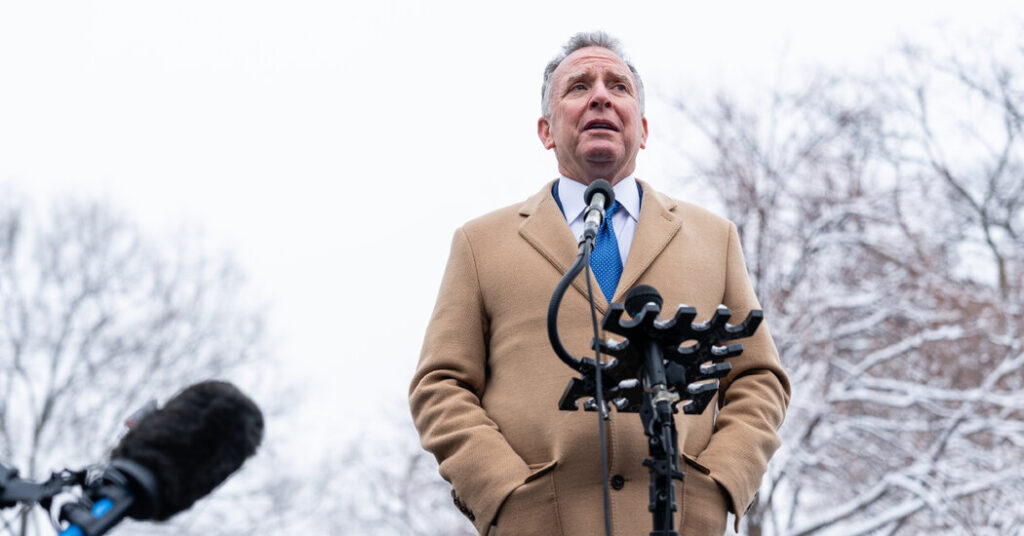
President Vladimir V. Putin of Russia is set to host Steve Witkoff, President Trump’s special envoy, in Moscow on Tuesday, as the United States pushes for an end to the war in Ukraine.
Mr. Witkoff is expected to present Mr. Putin with a U.S.-backed peace proposal that was revised by American officials after recent negotiations with Ukrainian diplomats. The initial version of the plan that emerged last month was seen by Ukraine and its European allies as echoing the maximalist demands Russia has made since its full-scale invasion of Ukraine in 2022.
Mr. Witkoff’s visit to Moscow, his sixth since January, is to take place two days after American and Ukrainian delegations met in Miami to discuss the details of the potential peace plan, parts of which Ukraine has sought to soften. Both sides called those talks constructive but said more work was needed, without detailing the unresolved issues.
President Volodymyr Zelensky of Ukraine, seeking support from European allies, met in Paris on Monday with President Emmanuel Macron of France. Mr. Zelensky is to travel to Ireland for meetings on Tuesday.
The White House has strongly pressured Ukraine to agree to a peace plan, even as Russia has signaled initial resistance to it. Emboldened by the Russian military’s steady pace of advancement and the corruption scandal that has gripped Ukraine in recent weeks, Mr. Putin has indicated that Trump administration officials must push Ukraine harder to accept Russia’s terms.
Russia insists that to halt the war, Ukraine must cede its remaining territory in the Donbas region, drop its aspirations to join NATO and secure the status of the Russian language, culture and the Russian Orthodox Church in Ukraine, thus allowing Moscow to have permanent sway over the country’s politics. Ukraine has refused to accept Russia’s demands.
Speaking at a news conference last week, Mr. Putin said that Ukraine must yield.
“We are still receiving proposals about ceasing hostilities there, there and there,” Mr. Putin told journalists. “When the Ukrainian troops leave the territories they occupy, then the hostilities will cease,” he said. “If they do not leave, we will achieve it militarily.”
Furthermore, the Kremlin announced on Monday evening that Mr. Putin had paid a visit to a battlefield command post a day earlier, apparently designed to promote Moscow’s battlefield momentum.
According to a video posted to state media, Mr. Putin grew visibly angry and emotional after a commander reported that Ukrainian soldiers were dying by the hundreds, their bodies littering the tree lines.
“This is a tragedy — a tragedy for the Ukrainian people, connected to the criminal policies of the thieving junta that seized power in Kyiv,” Mr. Putin said on the video, as he shuffled papers aggressively on a desk. He was referring to the 2014 uprising in Ukraine that ushered in a pro-Western government. Mr. Putin seized Crimea and started a war in Ukraine’s east in response.
Ilya Grashchenkov, a political analyst in Moscow, said expectations were low for a breakthrough from Mr. Witkoff’s visit, but the meeting was still significant.
“The main expectations likely boil down to maintaining a high-level communication channel during this crisis period,” he said. “This in itself is considered important for avoiding dangerous escalation.”
Mr. Grashchenkov said that with Russian growth approaching zero and the budgetary deficit widening because of soaring military expenditures, economic strain might compel the Kremlin to agree to certain compromises in the future. But, so far, Russia’s government has managed to paper over the economic cracks, he said.
Tatiana Stanovaya, a senior fellow at the Carnegie Russia Eurasia Center, said in a post on Telegram, a messaging app, that Mr. Putin had “no doubt that as Ukraine loses more territory, the number of those in the West who call for a cessation of hostilities will grow.”
In November, Russian forces almost doubled the battlefield gains they made in September, according to DeepState, a Ukrainian group that uses geolocated combat footage and tips from Ukrainian Army sources to monitor battlefield developments. While still relatively small, the Russian advances highlighted the increasing strain on Ukraine’s military.
Paul Sonne, Alina Lobzina and Cassandra Vinograd contributed reporting.
Ivan Nechepurenko covers Russia, Ukraine, Belarus, the countries of the Caucasus, and Central Asia.
The post Putin to Meet With Trump’s Envoy as U.S. Pushes for Ukraine Deal appeared first on New York Times.