ON BOARD THE PAPAL AIRCRAFT — In his first news conference as pope, Leo XIV on Tuesday called for dialogue between the United States and Venezuela, emphasized Europe’s importance in resolving the war in Ukraine and said that the church was working behind the scenes to persuade Hezbollah to “lay down” its weapons and negotiate.
Speaking aboard his aircraft returning to Rome from Beirut following his debut trip abroad — a six-day jaunt to Muslim-majority Turkey and Lebanon — Leo recounted the May conclave in which he was selected to succeed Pope Francis.
“What was it like?” the Chicago-born pontiff said, speaking for the first time to a large group of Vatican reporters. “I resigned myself to the fact when I saw how things were going that this could be a reality. I took a deep breath and said, ‘Here we go, Lord, you’re in charge, you lead the way.’”
Having cast his trip as a peace mission, Leo said that he has, “in a very small way,” already held conversations with Middle Eastern and possibly U.S. leaders over Israeli involvement in the region and that he would continue to do so. And he said that the West should be “a little less fearful” of Islam, blaming antipathy against Muslims on anti-migrant sentiment.
On Ukraine, Leo, speaking in Italian, said that President Donald Trump “thinks that a peace plan can be promoted that he would like to do, and that at least in the first instance was without Europe, but the presence of Europe is important, and the first plan was also modified because of what Europe was saying.”
Leo said that no solid plans have been made for his next trip but that it would probably be to Africa, possibly including Algeria, to follow in the footsteps of St. Augustine, the patron of his religious order.
Such a visit, he said, would also be a quest to continue his mission of building bridges between Catholicism and Islam. Latin America, too, he said, was high on his list, naming Argentina, Uruguay and his adopted homeland of Peru. He did not mention the United States.
During the news conference, Leo repeatedly touched on the theme of dismantling a culture of fear around Islam that he suggested had taken root as migrants from Muslim countries arrived in the West.
“I think the conversation that I had during my time both in Turkey and Lebanon, including with many Muslims, were precisely concentrated on the topic of peace and respect for people of different religions,” Leo said. “I know that as a matter of fact that hasn’t always been the case. I know that in Europe, there are many times fears that are present but often times generated by people who are against immigration and trying to keep out people who may be from another country, from another religion, from another race.”
He added that “in Europe and North America, we should perhaps be a little less fearful and look for ways for promoting authentic dialogue and respect.”
Leo was asked about efforts by liberal Catholics in the German church who are pushing for radical reforms — including a far greater role for women at Mass and a broader welcoming of same-sex couples.
In response, Leo said that not all Germans agree with those reforms and called for dialogue among German Catholics. He did not suggest he would personally move to shut them down, but noted a group of German bishops were meeting with Vatican cardinals to make sure the Germans “do not, if you will, break away from what needs to be considered as the pathway of the universal church.”
Leo has already taken the Trump administration to task for attacking boats off the Venezuelan coast. Asked about escalating tensions between Venezuela and the United States, Leo, speaking in Spanish, struck an optimistic chord over “conversations by phone between the two leaders” — Trump and Nicolás Maduro — but warned of the “danger” of a U.S. military operation that “invades the territory of Venezuela.”
He said “dialogue” and “economic pressure” were “better ways” to resolve the situation.
The news conference followed a trip in which the pope’s personality — and calls for unity and peace — took center stage.
“I wanted to come as a pilgrim of hope to the Middle East, imploring God for the gift of peace for this beloved land, marked by instability, wars and suffering,” Leo said following a Mass on the Beirut waterfront.
“The Middle East needs new approaches, in order to reject the mindset of revenge and violence, to overcome political, social and religious divisions, and to open new chapters in the name of reconciliation and peace,” Leo continued. “The path of mutual hostility and destruction, and the horror with the deplorable results that are before everyone’s eyes. We need to change course. We need to educate our hearts for peace.”
Throughout the trip, he stayed on point and script, speaking of unity and peace between and among faiths and nations. He took aim at “nationalism” and called capitalism, as his predecessor often did, an “economy that kills.” He heads a church that declines to ordain women, but he repeatedly highlighted their importance to audiences in Muslim-majority Turkey and Lebanon.
He spoke loftily of God’s great plan while at times appearing folksy. At one point, he extolled the virtues of olive oil, calling it a “balm for physical and spiritual wounds.”
Leo’s harshest critics might say he lacked gravitas, seemed overly scripted and strove too much not to offend. On Thursday in front of Turkey’s autocratic president, Recep Tayyip Erdogan, for instance, he criticized the notion that “might is right.” But when questioned by Turkish journalists aboard the papal flight en route to Lebanon from Turkey, he portrayed his host — who has suppressed free speech and his opposition — as a peacemaker and pointedly thanked him for loaning him his personal helicopter.
Francis, whom Leo quoted often on this trip, was known as a maverick who made constant headlines and could not be contained by the Vatican powers that be. Leo, some said, showed that he will pilot the church more steadily but perhaps not chart an ambitious course.
Leo is “a very prudent, vigilant and sober Pope, who will speak a lot, deliver many speeches, frequently answer questions from journalists and even solicit them, but without ever straying” from papal norms, said Sandro Magister, an Italian journalist and veteran Vatican watcher.
That, Magister said, “may also be the potential weakness of this pontificate.”
Leo’s defenders would argue that he walked the walk of unity, while successfully advancing his themes of human dignity and peace while introducing himself on a global stage. Rather than a lack of charisma, they saw a humble, low-key personality who, despite his often-staid delivery, was able to profoundly move the faithful. By the time he’d finished his speech to thousands of Lebanese young people on Monday night, for instance, even some local journalists were wiping tears away.
That could be due to his newness, and a faithful flock ecstatic to see their new American leader. But will they still stir in 10 years?
The new pope is no Pollyanna. He speaks bluntly of the troubles of our times, of bigotry, injustice, inequality. Yet he is infectiously optimistic, fueled by the power of positivity and kindness.
To a throng of 150,000 on the Beirut waterfront Tuesday, he asked a nation that has suffered endless cycles of war, economic hardship and disasters — including a 2020 port explosion that devastated a swath of the capital — to “disarm” their heavy hearts.
“Let us cast off the armor of our ethnic and political divisions, open our religious confessions to mutual encounter and reawaken in our hearts the dream of a united Lebanon,” he said.
If the trip was a test, Vatican officials said, he passed it, in part by covering his bases. He championed the rights of migrants and refugees, while making the point in Lebanon that it is just as important to improve quality of life so that people opt to stay in their home nations.
But his focus on refugees inspired advocates in an era when they are being increasingly shut out and targeted across the Western world.
In Turkey, which he visited from Thursday to Sunday, Leo engaged in a largely ceremonial trip in an overwhelmingly Muslim country. He commemorated the 1,700th anniversary of the Council of Nicaea, the summit of early Christians held to settle theological disputes before the fall of Asia Minor to Muslim Turks.
Leo interacted repeatedly with Patriarch Bartholomew of Constantinople, the nominal leader of the Eastern Orthodox faith.
A joint declaration between the two simply agreed to continue discussing unity, including a mutually agreed-on date for Easter, some 971 years after the denominations split. In Bartholomew’s mother church Sunday on the Istanbul waterfront, the pope entered their incense-laced Orthodox world. Clerics chanted hypnotically for roughly two hours, with the pope seated in a chair positioned at a lower height than the inlaid throne of the patriarch, who, at the end of the service, sat regally in elaborate robes and a bejeweled head piece.
In graphic displays of interfaith bonhomie with Islam, Francis in 2014 and Pope Benedict XVI in 2006 had each prayed or offered meditative silence while visiting Istanbul’s famed Blue Mosque. Some Vatican insiders privately questioned Leo’s decision not to follow suit during his tour of the same house of worship on Saturday.
Critics interpreted the move as an act of caution to avoid antagonizing church conservatives, some of whom chafed at the idea of the head of the Catholic Church praying in a mosque. “It’s incomprehensible,” said one senior Catholic cleric who sits on a Vatican board and requested anonymity to speak freely. “I chalk this up to the conditioning to which the pope is subjected to by the church’s reactionary wing.”
Church conservatives applauded his decision.
“I think Pope Leo XIV did well not to pray in the mosque so as to avoid a gesture which would be interpreted as relativizing his Christian faith or giving a message of a kind of religious syncretism,” said Bishop Athanasius Schneider, a conservative Catholic cleric in Muslim-majority Kazakhstan.
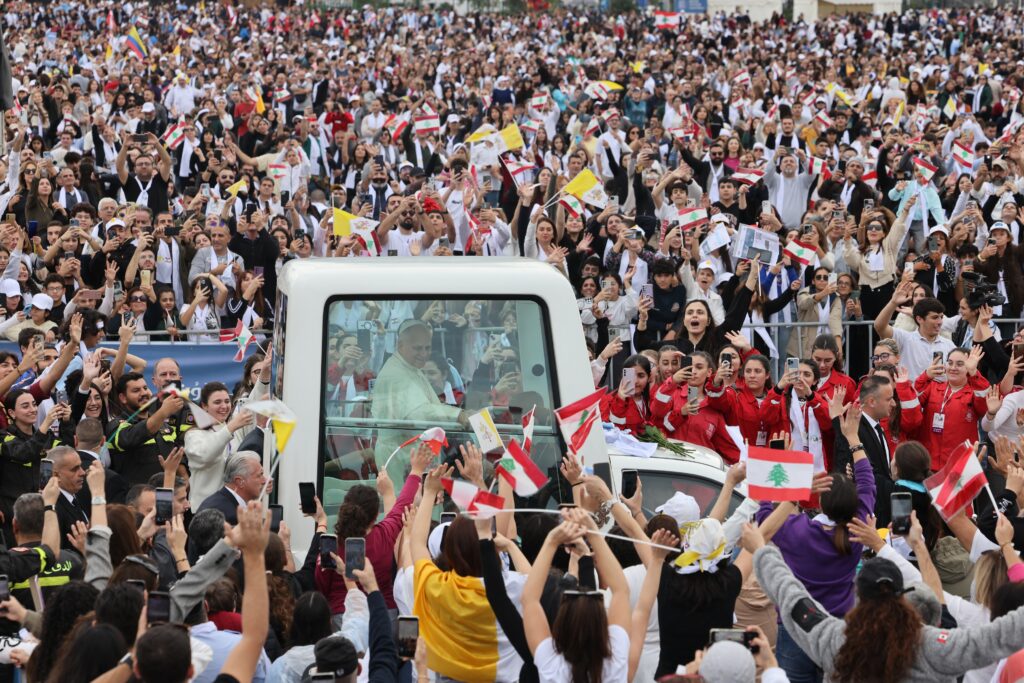
Francis drew 3 million faithful to Copacabana beach during his first international trip to Brazil, the world’s largest Catholic country. Such crowds were never envisioned on Leo’s journey to the Muslim world. But unlike in Turkey, Leo drew large, energized throngs in Lebanon from Sunday to Tuesday, with many thousands lining highways and roads and waving Vatican flags.
In a country with a large but diminishing Christian minority, the local community leveraged his trip to encourage Christians to stay. Leo offered moving tributes to a country seemingly confronted with endless tragedies — though some of the same Lebanese elites responsible for the country’s devastating banking crisis nevertheless sat in the best seats at Tuesday’s waterfront Mass.
After riding through the throng at the Beirut waterfront in the Mercedes popemobile, Leo shuffled to the stage in purple and white robes, clutching a silver staff with a crucifix.
Stefano Pitrelli in Rome contributed to this report.
The post Pope Leo, leaving Beirut, calls for peace in Middle East and Venezuela appeared first on Washington Post.