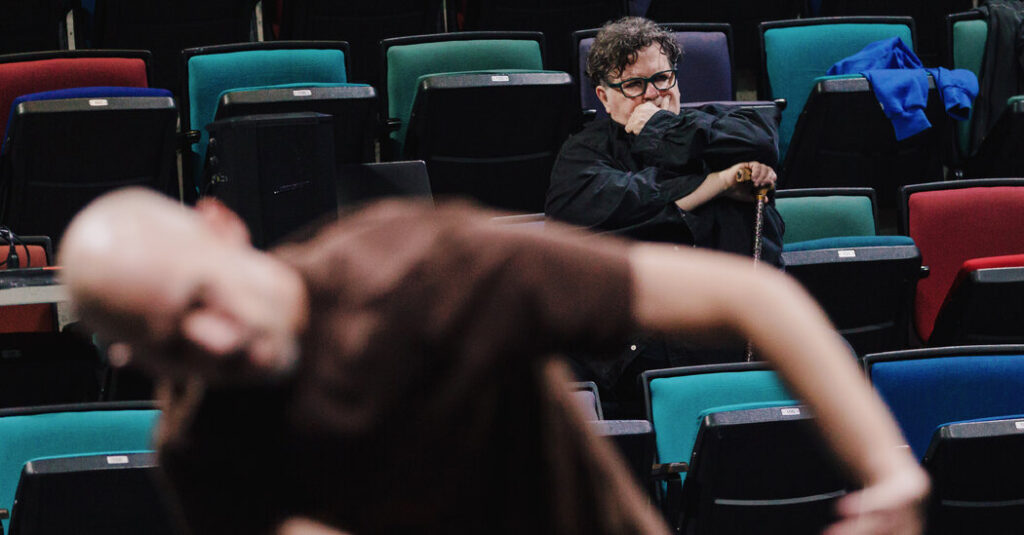
Tere O’Connor’s dance works are the kind that many people find intimidatingly cryptic. Rather than following the structure of a musical score or a story, they continually veer from one thing to another, discovering their own, often intricate forms. They can seem to contain every kind of dance, every kind of behavior, arranged without hierarchy — everything except a clear explanation of meaning.
Offstage, though, O’Connor, long a respected figure in New York dance, is an exceptionally articulate explainer. When he speaks about his choreography as an “artifact of thought” — a physicalization of how the mind moves in tangents, continually reacting to stimuli and making choices — the logic of his potentially baffling work can suddenly seem as familiar as that of dreams or your inner voice.
Across more than 40 years of making dances, O’Connor the choreographer and O’Connor the explainer have largely stayed separate. But for his coming program at New York Live Arts (Dec. 3-13), he is trying something new: going onstage and giving a little speech about what he has in mind.
“Sometimes people are perplexed by my work,” he said after a recent rehearsal. “But that’s not a goal of mine. I want people to be like, ‘Oh, I see what he means,’ then relax and enjoy it.”
Talking to the audience about his intentions isn’t the only thing O’Connor, 67, is trying for the first time. This choreographer who has made a career of always moving on to the next project, the next idea, is now reviving a work — the one he considers his first: “Construct-a-Guy,” a solo from 1984. At New York Live Arts, it will share the program with the premiere of “The Lace,” his latest group piece.
While watching footage of “Construct-a-Guy” recently, O’Connor said he was struck not only by how young he was — “I didn’t know anything,” he recalled — but also by how much of his choreographic voice was already apparent.
“I was saying no to a lot,” he said. “I was cutting up what I had been handed and also allowing a secondary voice to come out.”
In 1984, O’Connor had recently graduated from Purchase College, where he had discovered dance after a childhood in a conservative Catholic family near Rochester, N.Y.
His training was mainly in ballet, but he found the idea that dance should follow music or traditional musical structures to be imprisoning. Some of his friends were dancing in the companies of Trisha Brown and Merce Cunningham, both of whose work he admired. “But I felt something emerging from me that didn’t fit in those places,” he said.
He started making “Construct-a-Guy” by exploring the physicality of each of his five siblings. But he also heard another voice, an inner one from his childhood, one that continuously monitored him, choreographing his body not to appear too effeminate. He started to include that in his dance, too.
“I was coming out of the closet, slowly,” O’Connor recalled of that time. In the interruptive rhythms of “Construct-a-Guy,” he said, he now sees a “parrying, running mind.” He was learning to listen to his intuitions — allowing rather than judging or rejecting them — and also how to give them theatrical form.
“You don’t just stop at intuition,” he said, repeating some of the open-ended wisdom he has been sharing with students for decades. “The intuition offers a set of organizing principles that you have to come to terms with.”
Gradually, O’Connor came to recognize what he was doing, more broadly, as an understanding of consciousness. “The amount of emotional weather that people go through in a day is very complicated but never mentioned,” he said. “You leave the house in the morning thinking, ‘How am I going to pay that bill?’ Then it’s ‘Oh, look at that beautiful wrought-iron railing’ and ‘I’m hungry.’”
As with other artistic attempts to track the mind more accurately — like the stream-of-consciousness of Virginia Woolf and James Joyce — O’Connor’s coexistence-of-everything choreography can appear off-putting and abstruse. But O’Connor isn’t trying to be difficult, he said.
“I don’t see myself as saying, ‘Everybody sit down because I have something amazing to say,’” he said. “I’m just keeping myself alive by having this oasis where I don’t have to arrange thought toward winning or knowing or proving.”
In audience responses to his work, O’Connor has noticed two kinds of people: those who don’t have a problem with ambiguity and those who hate it. “And it can be very unexpected who falls into which category,” he said.
“Sometimes people tell me they see stories in my work,” he said, “and I tell them, ‘Of course you do.’ But you could be in Japan and be watching a couple across the park and see a story. You’re projecting. I want to make a projection field for people that’s porous.”
For O’Connor, the “meaning is in the selection and sequencing,” he said — in the underlying grammar, the subterranean pressures. “The central drama of choreography is the futility of trying to arrange something that’s passing by,” he added. His work tends to heighten that drama by making the artifice of arrangement highly complex.
It was this quality that first attracted the dancer Heather Olson, who has been performing in O’Connor’s work since 1997. “He makes really hard movement,” she said, “but it’s infused with this humility of human failing, embarrassment, insecurity and sadness.”
Over the years, Olson has seen O’Connor’s work change. “When I started, we were making these pieces that had a lot of text and were bitingly funny and dark,” she said. “They were really popular, but what is incredible about Tere is that he’s always going to follow where his artistic instinct is leading him rather than repeating what people like.”
Watching the dancer Tim Bendernagel perform “Construct-a-Guy” in rehearsal made Olson cry, she said: “It felt like a portal” to seethe young O’Connor “and everything he was going through.”
Reflecting on that earlier self, O’Connor said he was “a beneficiary of the amazing ’80s in New York City.” He was poor and supported himself by working in a restaurant, but he still could live in SoHo and visit all the galleries every weekend and catch what was emerging at Performance Space 122 in the East Village.
“I met so many amazing people who were doing amazing work. I don’t know if it was elitist or just rare, but it was a gift,” he said.
Forty years later, he is nervous about “big holes” in the dance field, not just a crisis of affordability but also an accelerated shrinking of grant money and intermediate steps between novice and established career phases.
“I wish that was not gone,” he said. “But at the same time, younger people tell me: ‘We’re not thinking about what you think is missing. We don’t know about that.’”
“They’re going to make their own reality,” he added. “And at my age, I don’t feel like, ‘Stop the new people.’ I am like, ‘Listen to them.’ They see what’s going on now.”
The post Perplexed by Avant-Garde Dance? Let This Choreographer Explain. appeared first on New York Times.