Juan Williams is an author, columnist and political analyst for Fox News.
Look up.
He travels around Earth in low orbit about every 90 minutes, or 16 times a day. It is easy to see him. His spaceship is often one of the brightest objects in the sky other than the sun and the moon.
Washington-area residents might know him because he grew up in Potomac, Maryland, and attended Herbert Hoover Middle School and Montgomery Blair High School in Silver Spring. He was a Cub Scout and later an Eagle Scout in Potomac’s Troop 773.
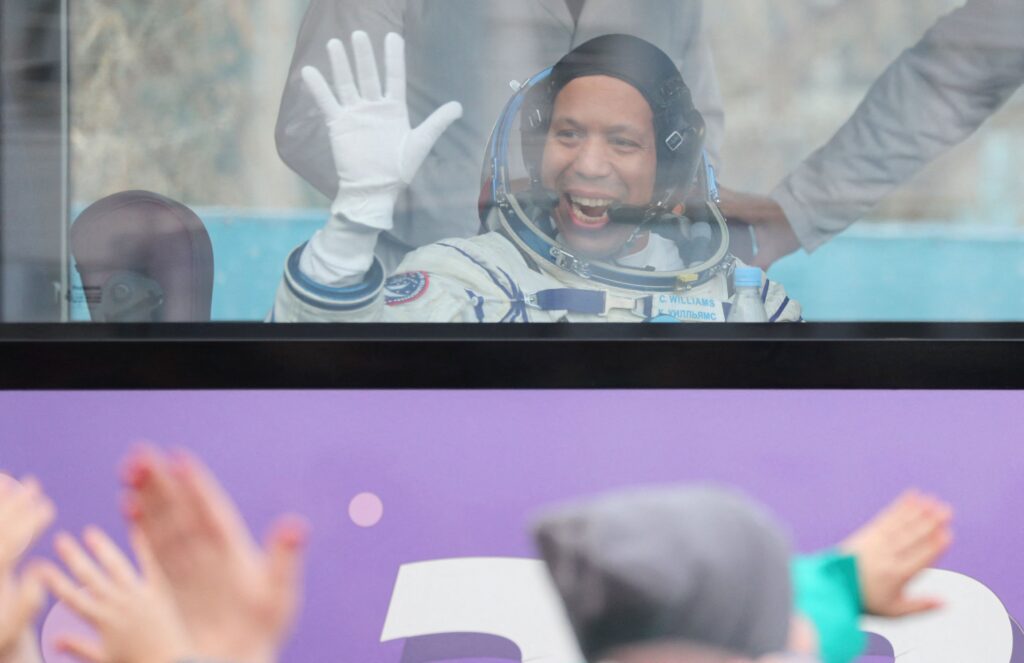
Last week, on Thanksgiving Day, that local guy, Chris Williams, blasted off from Kazakhstan as a NASA astronaut. He traveled to the International Space Station as a flight engineer on Expedition 74, with two Russian cosmonauts.
His parents, Roger and Ginger Williams, and his sister, Ashley, witnessed the blastoff of the Soyuz spacecraft in person at the Baikonur Cosmodrome. So did his wife, Aubrey, and their two daughters.
At NASA’s Johnson Space Center in Houston, former classmates from junior high as well as from Stanford University, MIT and Harvard Medical School gathered in a viewing room overlooking Mission Control to watch him lift into space.
Family joined those friends in Houston for the 3:30 a.m. liftoff. The cheering section included cousins, Antonio and Raffi, of D.C., who grew up playing basketball and video games with Chris. I was there too, moved to tears to see my nephew — who as a child loved to sleep in a onesie adorned with rocket ships and planets — achieve his fantasy, journeying to space as a genuine American astronaut.
And six hours later, when Chris was the first member of his crew to float through the hatch between the Soyuz and the ISS, there were more cheers and tears in Houston.
From Kazakhstan, my brother, Roger, had called me on a NASA official’s phone just before liftoff to share the moment. As former astronauts in Houston described the preparations, on the big screen we could see Chris holding the fetal position, knees to chest, in the capsule awaiting launch. Roger and I didn’t speak much, beyond sharing a sense of wonder at the moment. We left unsaid our concern for Chris’s safety.
Chris is an achiever, obviously, with a supportive, loving group of friends and family. But to say his story is “local kid makes good” would be an understatement.
Roger and I, along with our sister, Elena, came to the United States as immigrant children from Panama in the late 1950s. We lived through the launches of the Mercury and Apollo space programs. I watched, squinting at our mom’s black-and-white television, as Neil Armstrong and Buzz Aldrin walked on the moon in 1969. I read “The Right Stuff,” Tom Wolfe’s terrific book, later a movie, about brave U.S. test pilots and the unbelievable training and determination it took to become an astronaut.
For two Black men now in their 70s to see the next generation in their family wear the bright blue NASA jumpsuit with the large American flag on the shoulder is hard to describe. Let me just say it is improbable.
Amit Kshatriya, NASA’s associate administrator, and the top civilian at the agency, came into the Mission Control viewing room before launch. Standing next to a life-size cutout of Chris, he answered questions that revealed just how little I know about the space station — it has been in operation since November 2000 — and NASA’s push to get back to the moon and to Mars.
Kshatriya tied the space station to the forts Americans built in the 1800s, as the nation expanded westward, to support travelers and commerce. He also asked us to think of the space station as a microgravity medical laboratory. It helps develop new medicines and figure out how to keep astronauts from losing muscle and bone density while in space.
Now one of those space travelers is a kid from Potomac who grew up dreaming of rockets and planets. Here’s to him and to all those who came before, and will follow, taking us beyond the world we know.
The post My nephew wore spaceship-adorned onesies. Now he’s a real astronaut. appeared first on Washington Post.