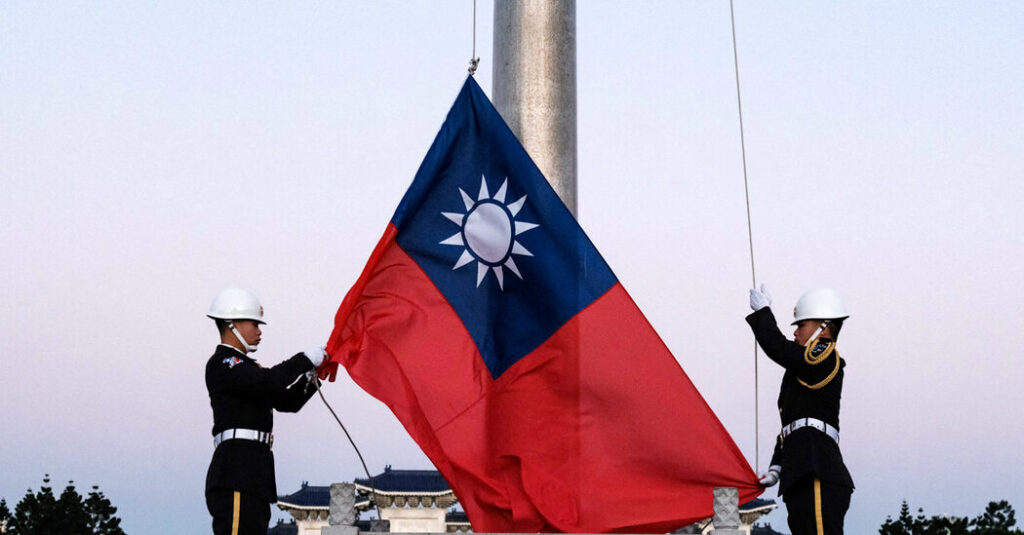
A single word can crack the facade of a great power’s confidence.
That’s what happened last month when Prime Minister Sanae Takaichi of Japan told lawmakers in Tokyo that a Chinese attack or blockade against Taiwan would constitute a threat to Japan’s “survival,” a term that, under Japanese law, would permit the country to deploy its military overseas.
Ms. Takaichi merely said aloud what has long been understood — that a crisis involving Taiwan would threaten Japan’s national security. But her comments were among the clearest public signals yet that Tokyo could help defend Taiwan from potential Chinese aggression.
Beijing reacted as if Ms. Takaichi, a conservative politician, had declared war. Chinese state media has portrayed her as reviving the militarist rhetoric used to justify Japan’s aggression during World War II, and a senior Chinese envoy posted what amounted to an online threat to behead Ms. Takaichi. China has halted some Japanese imports, discouraged Chinese tourism to Japan and stepped up coast guard patrols around islands claimed by both countries.
Beijing routinely lashes out at Tokyo because of lingering resentment over Japan’s wartime past, which included a brutal invasion and occupation of China. This time, however, the fury is rooted in something more dangerous: China’s growing anxiety that one of its bedrock goals — isolating Taiwan and forcing it to submit to unification on Chinese terms — is slipping away.
The Chinese Communist Party has long assumed that time and pressure would slowly wear Taiwan down. If President Xi Jinping of China concludes that bet has failed, he may escalate to sharper forms of pressure sooner than planned. It is vital for regional security that Tokyo and Washington stand firm and signal clearly that increased Chinese coercion of Taiwan will trigger a coordinated response.
For years, China has applied a slow diplomatic and economic squeeze on Taiwan, paired with near-daily military drills and disinformation campaigns. These hover just below red lines that might cause the United States and its allies to get involved. China’s goal is straightforward: to persuade Taiwan’s people that resistance is futile and capitulation is the only way to avoid a disastrous conflict.
Ms. Takaichi’s remark punctures that logic. Because Japan hosts U.S. bases that would be central to any response to Chinese aggression, her comment serves as a warning to Beijing that dramatically increasing pressure on Taiwan is likely to draw a joint allied response. That prospect is deeply unsettling for Beijing, which has spent decades trying to prevent Taiwan’s security from becoming viewed as a shared regional responsibility.
The timing of Ms. Takaichi’s statement compounds another, deeper worry for China.
Taiwan’s next presidential election is scheduled for early 2028. If the ruling Democratic Progressive Party — which resists Beijing’s unification ultimatums — wins again, it would extend a run that started in 2016 and, in Beijing’s eyes, entrenches a distinct Taiwanese identity and normalizes the island’s defiance. If that happens, China may feel it has no choice but to squeeze Taiwan even harder.
That does not mean an invasion would be inevitable. But it does raise the likelihood that China would restrict trade with Taiwan — which is extensive, and economically vital for the island, despite the tensions — and increase cyberattacks on critical infrastructure and military feints around Taiwan. This could significantly raise the odds of an accidental clash.
Beijing’s need to control the story with the Chinese public adds even more volatility. Whenever the Communist Party faces a foreign challenge it gins up Chinese nationalist outrage. That this involves Japan, a particularly combustible source of Chinese resentment, is especially fraught. Whipping up nationalism — as China is doing now — boxes the Communist Party into a corner where any future compromise with Japan would look like a betrayal of the public fury it had encouraged.
In a sign of Beijing’s alarm over the issue, Mr. Xi has sought to drive a wedge between Washington and Tokyo, appealing directly to Mr. Trump to rein in Japan. Mr. Trump does not appear to have taken the bait. According to the Chinese readout of the call, he offered only a polite acknowledgment that Washington “understands” how important Taiwan is to China.
Mr. Trump’s muted response and his recent approval of about $1 billion in additional arms for Taiwan seemingly dashes — for now — any hope Beijing may have had of persuading Mr. Trump to soften his support for Taiwan in exchange for Chinese cooperation on trade. Mr. Xi now faces a combination he had hoped to avoid: an American president who does not seem ready to trade away Taiwan and a Japanese leader who is willing to state plainly that a crisis could ensnare her country.
This a pivotal moment for regional stability. Japan should hold firm, and the United States should stand with it. If either backs down, Beijing will treat it as proof that pressure pays. But if Washington, Tokyo and their partners signal that continued coercion by China against Taiwan will trigger coordinated countermeasures, they can change the calculus for China, making clear that further escalation could spark a wider confrontation that Beijing may not be able to control.
Ms. Takaichi did not create this situation; years of relentless Chinese coercion did. Her remark merely made explicit what has long been implicit — that if Beijing keeps tightening the screws on Taiwan, it will inevitably pull in other democracies because the island’s fate now bears directly on their security.
Airing out the shared stakes faced by all the players in this equation, as Ms. Takaichi has done, is a surer path to stability than pretending that silence will keep the peace.
Craig Singleton is senior director of the China Program at the Foundation for Defense of Democracies, a think tank.
The Times is committed to publishing a diversity of letters to the editor. We’d like to hear what you think about this or any of our articles. Here are some tips. And here’s our email: [email protected].
Follow The New York Times Opinion section on Facebook, Instagram, TikTok, Bluesky, WhatsApp and Threads.
The post Japan Just Made Taiwan Everyone’s Business appeared first on New York Times.