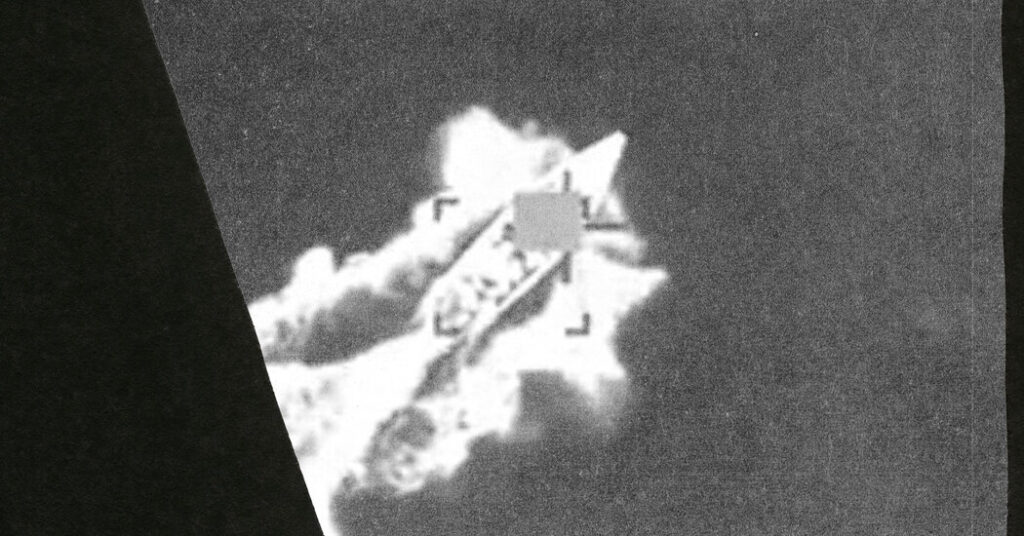
The U.S. military might be guilty of murdering civilians on the high seas. Attacks on alleged drug boats in the Caribbean Sea and the Pacific Ocean demand extraordinary public investigation into any wrongdoing, not whispered consultations in the halls outside a congressional subcommittee room.
Calling for federal lawmakers to investigate something feels almost quaint in our time of extreme partisanship and congressional ineffectiveness. But the past shows that Congress has ample powers to scrutinize, expose and end government abuse — if its members use them.
The House or Senate should start by creating a select committee to investigate any misuse of the president’s war powers. Such special panels have produced some of history’s most consequential and dramatic investigations. They can issue subpoenas, draw media attention, uncover facts and propose reforms. Creating one requires no presidential signature.
President Trump is waging his military campaign against what he has called “narcoterrorists” in international waters without congressional authorization and outside a genuine armed conflict. As survivors of one strike clung to smoldering wreckage, a second missile hit them. The Washington Post reported last week that Pete Hegseth, the defense secretary, had ordered the military to “kill everybody.” The Times has not confirmed this detail, but the “double-tap” strike has roiled Washington.
Any order to “kill everybody,” however conveyed, would be a black-and-white violation of the law. Extrajudicial killing of drug traffickers or other criminals would be considered murder. Even if the United States were at war with “narcoterrorists,” as Mr. Trump claims, military law specifically prohibits conducting “hostilities on the basis that there shall be no survivors.”
The public should know more about what legal justification White House, Justice Department or military lawyers offered for these attacks, and about why the admiral in charge of the U.S. Southern Command, who oversaw operations in Central and South America and the Caribbean, abruptly retired in October.
There are signs that military action in Venezuela, also without congressional authorization, might be coming. Mr. Trump announced over the weekend that the airspace around that country was closed — which could be seen as an act of war — though it is unclear whether this was new policy or a mere bid for attention.
These moves follow Mr. Trump’s abuse of the Alien Enemies Act, one of the laws governing presidential war powers. Presidents have used this statute only during the War of 1812, World War I and World War II. The Trump administration has invoked it to deport Venezuelans without due process, falsely claiming that drug gangs sent by their government had invaded the United States. U.S. officials appeared to ignore court instructions to halt the deportation.
Leaders of the Senate and House armed services committees — from both parties — have already begun to ask questions, as they should. But if multiple permanent committees, such as armed services, judiciary, homeland security, foreign affairs and intelligence conduct probes, jostling investigators could produce discord or miss the big picture. They might also lack the staff needed for a potentially expansive inquiry. A select committee would have one mission and be able to focus on it.
A special panel’s hearings could be riveting. In the 1940s, a committee led by Harry S. Truman, then a senator, exposed waste and profiteering by wartime military contractors. Truman’s efforts earned him such respect that President Franklin D. Roosevelt chose him to be vice president. In the 1970s, the Senate Watergate panel uncovered the Oval Office taping system that would help bring down President Richard Nixon. An investigation chaired by Senator Frank Church revealed abuses by the C.I.A. and F.B.I. and led to reforms, including a ban on foreign assassination plots. More recently, the House Jan. 6 committee revealed details of the first Trump administration’s machinations to overturn the result of the 2020 election.
Select committees do not always work. The 1987 investigation into the Reagan administration’s Iran-contra scandal included 26 lawmakers from both chambers, leading to an overstuffed rostrum and cacophonous hearings. A House look at the assassination of President John F. Kennedy stoked lurid conspiracy theories, and the Benghazi hearings of the 2010s produced little more than partisan clamor.
There is reason to doubt whether this Congress could do better. But lawmakers have grilled members of their own party before. As Truman declared, explaining why he would scrutinize fellow Democrats, there should be a “patriotic interest in seeing that it is properly carried out.” If this Congress won’t act, after next year’s midterm elections a different party might wield the gavel in at least one chamber.
Today’s issues are as fundamental and profound as they come. The branches of government always push and pull over war powers, and Americans want to be protected from enemies. But this administration has stretched its authorities far beyond any reasonable interpretation of the law. It claims extraordinary peacetime powers, and the United States is not at “war” with immigrants or drug dealers, no matter how many times officials make the claim.
This president has grabbed power not merely because he sits in gilded splendor in the Oval Office. Congress, designed by the framers to be the pre-eminent branch of government, has shirked a basic constitutional mission. A special committee focused on these abuses would be a start at reimposing the checks and balances that keep Americans free.
Michael Waldman is president and chief executive of the Brennan Center for Justice at the New York University School of Law. He is the author, most recently, of “The Supermajority: How the Supreme Court Divided America.”
The Times is committed to publishing a diversity of letters to the editor. We’d like to hear what you think about this or any of our articles. Here are some tips. And here’s our email: [email protected].
Follow the New York Times Opinion section on Facebook, Instagram, TikTok, Bluesky, WhatsApp and Threads.
The post How Congress Should Respond, Right Now, to Trump’s Boat Strikes appeared first on New York Times.