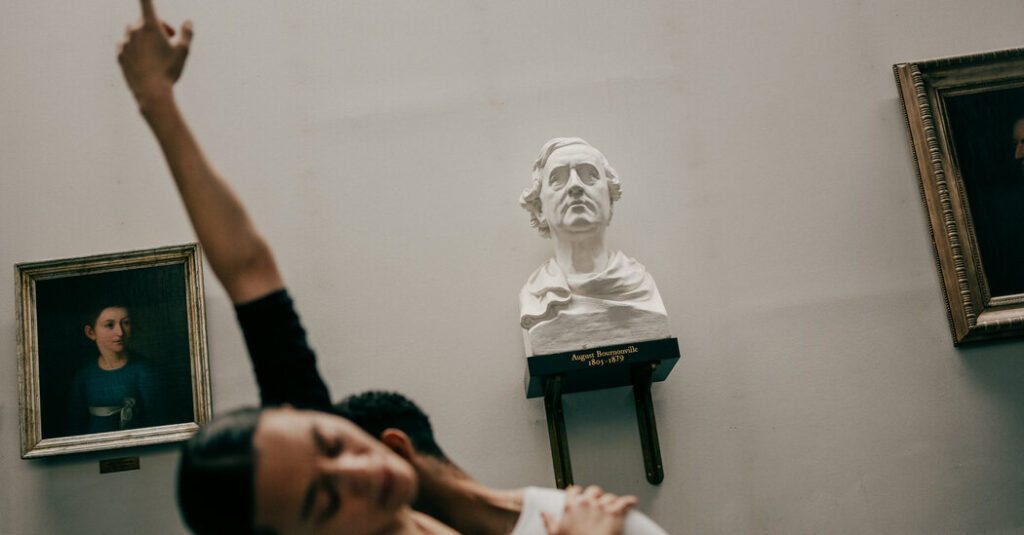
How do you preserve a style? A recent ballet class in Copenhagen was a primer in the kind of details that differentiate the Danish ballet tradition — specifically the style associated with the choreographer August Bournonville — from all others.
Henriette Muus was instructing a group of 10-year-olds in a high-ceilinged ballet studio at the Royal Danish Theater. Each suggestion underscored a particular quality she was trying to instill.
Muus, a former Royal Danish Ballet dancer, gave them an exercise in which their movements reflected the ebb and flow of the music: foot extended forward sharply to show an accent, arms closing with the final note of the phrase. Then she asked them to hum the melody, so they could get it into their bodies. She fixed the angle of their heads: “show one cheek, and then the other.” And their arms: “Bournonville is round, round, round.”
Finally, she instructed them in what the steps and gestures should communicate: “You have to include the audience, so they want to dance with you.”
Affable, warm, often joyous and always generous in spirit, Bournonville style has been synonymous with the Royal Danish Ballet since the mid-19th century, when August Bournonville was a dancer, director and choreographer at the company.
With the exception of “La Sylphide,” Bournonville’s most widely known ballet, and a few excerpts, his works are performed almost exclusively in Denmark. He belongs to the Danes. “He is,” as the director of the Royal Danish Ballet School, Anne Holm-Jensen Peyk said, “our place of belonging.”
But after years in which the company was focused on international repertory and new creations, that place had become less essential to its mission and, some have argued, obscured.
The idea of Bournonville as central to the Danish identity — like the stories of Hans Christian Andersen or the paintings of Vilhelm Hammershoi — is at the heart of a new initiative at the Royal Danish Ballet, spearheaded by Amy Watson, the company’s new director. Called the Bournonville Strategy, it is a call to arms, an acknowledgment of the need for a renewed commitment to this homegrown repertory and to the tradition that makes this Danish company Danish.
“We have to protect what we have, because we have something special,” Watson said at a recent company meeting. “We are at risk of losing some of that knowledge. So we need to find ways to keep the tradition alive.”
Bournonville made over 50 ballets, of which about a dozen full works and fragments have endured. Their detailed stories revolve around characters like trolls (“A Folk Tale,” 1854), fishermen (“Napoli,” 1842) and working people (“Kermesse in Bruges,” 1851), who behave without airs, and generally treat each other with gentleness, care and humor. “They reflect the same morals that we strive for today,” Watson said. “Kindness, forgiveness, courage.”
BOURNONVILLE WAS BORN in Copenhagen in 1805, the same year as Hans Christian Andersen (the two were close friends and frequent correspondents). The son of a French dancer and choreographer, Bournonville trained in Copenhagen and later in Paris — then the center of the ballet world — returning home to become the star dancer, and then choreographer, of the Royal Danish Ballet. At a time when ballet revolved around ballerinas, he took an interest in the particular skills and dramatic range of male dancers.
Social justice, particularly in the theater world, mattered to him. In Paris and St. Petersburg dancers were often treated as property, the women as potential mistresses. In Copenhagen, he fought for dancers’ rights, creating the first pension fund for dancers and ensuring that ballet students received an education.
In his “Choreographic Credo,” Bournonville wrote: “It is the mission of art in general, and the theater in particular, to intensify thought, elevate the mind, and refresh the senses.” But this lofty mission was expressed in movement that is musical and light and physically harmonious.
Poetry, warmth and modesty of expression: these are the qualities that define the Bournonville spirit, said the Danish dance critic Alexander Meinertz, who is writing a Bournonville biography. “He thought of himself less as a choreographer than as a ballet poet,” Meinertz said.
Watson, an American, took the reins at the Royal Ballet last fall after the departure of the previous director, Nikolaj Hübbe. She was drawn to Denmark by her early exposure to Bournonville during a tour by the Royal Danish Ballet to the United States. The company used students from local ballet schools for children’s roles, and Watson danced a role in “Folk Tale.”
“It was the storytelling,” she said of the experience. “I thought, I want to be part of this.”
THE BOURNONVILLE BALLETS, Watson said, are not “at the same level of embodiment” as they once were in the company.
Bournonville technique has its own rhythm and feel, which requires practice. It favors quicker steps and many beats; simpler, cleaner arm movements; and a relaxed use of the upper body. As part of the initiative, classes in the technique have been added to the weekly schedule for the first time in years.
This is particularly important in a troupe in which only a third of the dancers were trained in Denmark. The rest come from all over the world, including several from the United States. (The California-born Watson, a dancer in the company for 21 years, trained at the School of American Ballet in New York.)
“The problem before,” said Dinna Bjorn, a Bournonville stager, “was that even when they did Bournonville ballets, they never took classes. They had to learn the choreography like they learn any other ballet.”
To keep Bournonville in the dancers’ bodies, Watson’s initiative calls for programming a Bournonville ballet at the start of each season: First comes a new “La Sylphide” in 2026; in 2027, “Napoli,” a product of Bournonville’s love of Naples and its inhabitants: street vendors, singers, fishermen.
The hope — it’s contingent on funding — is to mount a festival of his works, in 2031. Past festivals (the last one was in 2005) created intense international attention. “People fell in love with Bournonville,” Meinertz said. “Americans fell in love, and Denmark fell back in love.”
His ballets have sometimes been seen as slightly passé in Denmark, even quaint. “Danes are the ones who seem to appreciate him the least,” Meinertz wrote on a dance site in 2018. “He’s generally viewed with affection but as perhaps a bit naïve and definitely old-fashioned.” Instead, he said in an interview, his ballets should be seen as simple, but wise.
Hübbe favored radical reinterpretations, like a stark, black and white “Sylphide” with strong psychosexual undercurrents, and an updated “Napoli” set in a kind of “La Dolce Vita” world. Both provoked intense reactions, pro and con, at least for critics. Anne Middelboe Christensen, a critic for the newspaper Dagbladet Information, wrote of the “Sylphide”: “Gone is all the warmth of Bournonville’s story of longing. The stage is as loveless as a fashion show.”
THE NEW “NAPOLI” will be staged by Watson with Alexander Staeger, a dancer at the company admired for his storytelling abilities. As part of a green initiative, many of the sets and costumes will come from the theater’s extensive collection.
It’s not the first time the theater has recycled: Elements of old costumes, like pompoms and embroidered panels sewn onto the front of the ubiquitous villager dresses, have been worn by generations of dancers. (Some of the earliest costumes, from Bournonville’s day, are held in a special storage room, both as relics and models for future costumes; many were made from castoffs donated by the Danish royal family.)
For the second act of “Napoli,” much of whose choreography has been lost, Watson tapped another dancer from the troupe, Tobias Praetorius.
Praetorius grew up dancing children’s roles in Bournonville ballets, and is widely considered one of the foremost interpreters of his style. “My first time onstage was in ‘A Folk Tale,’” Praetorius said recently. “I was one of the trolls, holding a lamp onstage, and then I climbed up a tree and watched my idols from up there.”
With “Napoli,” he, like Henriette Muus, will become part of the process of passing these ballets on to the next generation. “It is a beautiful thing, this tradition that continues on,” he said. In preparation for choreographing the second act of “Napoli,” which takes place underwater (inspired by Bournonville’s visit to the Blue Grotto in Capri), he plans to confer with Jürgensen, whose archival research is the backbone of much of what is known about Bournonville today.
“I’m trying to do as much research as possible so I can find my interpretation. I don’t want it to look like ‘Tobi’s choreography,’” he said. “It should connect with the other acts. That is the main goal, to make sure it fits that world.”
“The big question,” he added, “is really about finding the balance between tradition and keeping the work feeling fresh and relevant for today.”
It is also about preserving that special quality that makes these ballets, and the Danish style, stand apart: that elusive and special Bournonville spirit.
The post For Royal Danish Ballet, It’s Back to Bournonville appeared first on New York Times.