Just before the musician and producer Dijon kicked into the amniotic title track off his 2025 album “Baby!” at a sold-out Brooklyn show on Monday night, he played a stitched-together collage of samples featuring artists intoning that familiar word. Baby is one of popular music’s most common epithets, Dijon was suggesting, but his restlessly inventive, fragmented approach to R&B — often a suggestion of what Prince might have sounded like had he lived to hear Frank Ocean’s “Blonde” — attempts to make the familiar seem strange, fresh and deeply personal.
In every realm of his multi-hyphenate career, this has been Dijon’s breakout year. In addition to a memorable feature on the indie-folk musician Bon Iver’s tender LP “Sable, Fable” (and a small role in Paul Thomas Anderson’s Oscar contender “One Battle After Another”), he is a writer and producer on Justin Bieber’s nimble pair of “Swag” albums; those contributions earned Dijon his first two Grammy nominations, including a nod for producer of the year, non-classical. This weekend, he’ll make his debut as the musical guest on “Saturday Night Live.”
A month after “Swag” arrived, when Dijon delivered his own “Baby!,” his role in Bieber’s sonic reinvention was even more obvious. Both are records about new fatherhood and its effect on a marriage, and both forgo the traditional topcoats of pop-song polish in their attempts to present raw, intimate truths. But while Bieber’s extramusical mythos still gives “Swag” a coherent and grounded core, Dijon’s relative anonymity allowed him to push into more experimental territory, a kind of glitching, postmodern soundscape in which would-be hooks and sudden blasts of passion seem to float untethered from their creator.
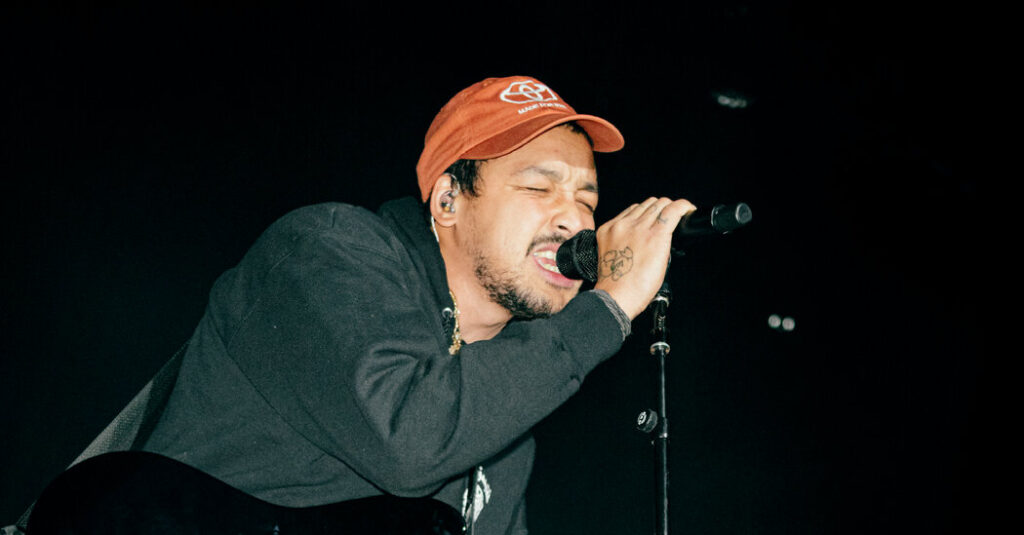
Dijon’s current tour reflects that sense of diffuseness. Even for a midsize venue, the staging at Brooklyn Paramount, where he performs again on Tuesday night, was remarkably minimal: No video effects, branding or even colored lights. Just nine musicians arranged in a casual semicircle, as if the whole show were an impromptu studio jam that happened to be witnessed by an audience of several thousand. From his early days working with the hip-hop collective Brockhampton to his more recent collaborations with the fleet-fingered guitarist Mk.gee, Dijon’s music has placed an emphasis on communality. That sensibility is evident on this tour, too, where guest musicians have been appearing with his band. Leslie Feist joined him for a recent show in Toronto, while the multi-instrumentalist Nick Hakim sat in for Monday night’s gig.
Dijon opened with “Fire!,” a funky shape-shifter from “Baby!” that he punctuated with sudden blurts of incendiary emotion, shouting to be heard over blown-out distortion. In its most thrilling moments, the song seemed to be ripping apart, as if it were shedding its skin in search of a less restrictive form.
Dijon’s music can convey a disarming intimacy, as if he is letting the listener into the most private moments of his life. On his new album’s title track, which Dijon addresses directly to his young child, he flips through a kind of homespun scrapbook of scenes: Here Dijon is meeting and falling in love with his wife, Joanie; later he is expressing apprehension but ultimately accepting his impending fatherhood. The final verse takes place in a hospital, as Dijon bears witness to the agony and ecstasy of childbirth. “Tried to laugh with my baby, then she made that face,” he coos. “I said if I could take your pain away, you know I would.”
On record, this approach can foster a strong bond with the listener. Onstage, though, a relatively reticent Dijon let his songs speak for themselves. His most personalized bit of crowd work was, appropriately enough, a well-chosen sample: He came onstage to the audio of Jalen Brunson hitting the game-winning three-pointer that propelled the Knicks to the second round of the 2025 N.B.A. playoffs. That’s one way to get a New York crowd hyped.
As the set went on, though, and slogged through a late-middle section of similar-tempo ballads, the studio-session approach fostered a distance at odds with the friendly intimacy promised by Dijon’s music. All the deconstruction, too, started to feel a little rote. Dijon is clearly a formidable presence in the studio, but perhaps not yet a practiced headliner.
Maybe he doesn’t need to be: He’s proven he can channel his unruly ideas into the familiar and more streamlined figure of a charismatic star like Bieber. Some of the most transfixing moments on Monday came during the encore, when he played two older and more straightforwardly structured tracks: the finely observed, acoustic-guitar-driven 2018 single “Nico’s Red Truck,” and then “Rodeo Clown,” a single from his lovely 2021 debut LP “Absolutely.”
He performed “Rodeo Clown” as it is on the record: a sparse arrangement consisting of little more than electric guitar, bass and Dijon’s wrenching vocal, demanding of someone who has made him feel like a fool, “Tell me, what are you so afraid of? ’Cause you’re missing out on some good, good loving.” He unfurled this musical monologue continuously, without any of his music’s characteristic hiccups and ruptures, and with the audience’s unbroken attention hanging on his every word.
Lindsay Zoladz is a pop music critic for The Times and writes the subscriber-only music newsletter The Amplifier.
The post Dijon, a Studio Maestro, Is Stepping Into the Spotlight appeared first on New York Times.