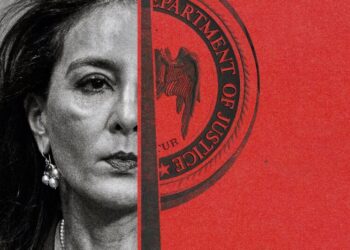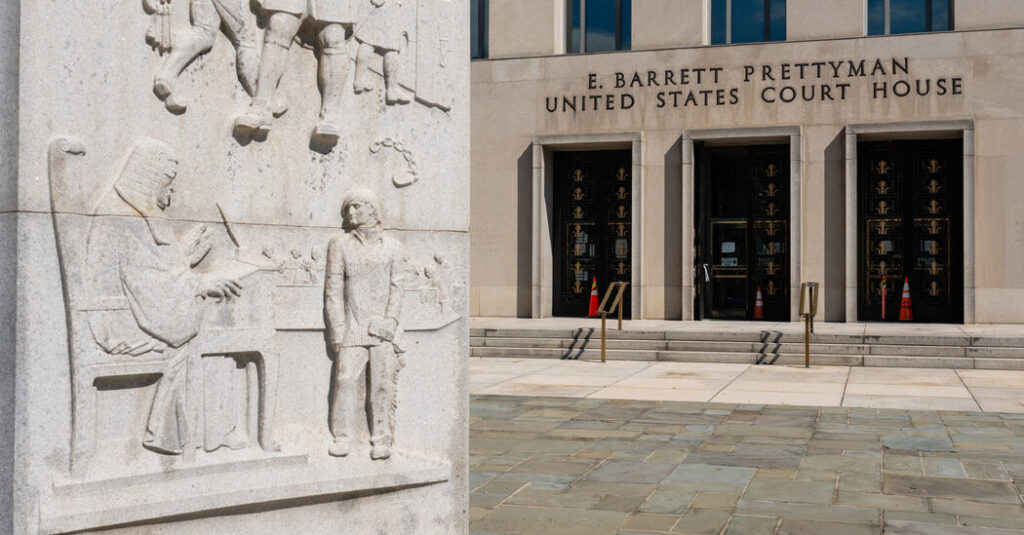
The U.S. attorney’s office in Washington said last week that it would consider, “when appropriate,” taking advantage of a judge’s order expanding its power to use local juries to charge serious federal crimes.
Federal prosecutors stumbled on the new avenue to charge crime in the nation’s capital while seeking to follow through on President Trump’s crackdown in Washington.
A federal judge ruled on Nov. 20 that because of the complexities of local laws in the District of Columbia, judges in Federal District Court in Washington must accept indictments for federal crimes that prosecutors secured from a local grand jury.
The decision appeared to grant prosecutors a new option amid an aggressive push to increase prosecutions for federal felonies.
The ruling from James E. Boasberg, the chief judge of the Federal District Court, came after federal prosecutors used a local grand jury convened in D.C. Superior Court to indict a Washington resident accused of having an illegal firearm. A federal grand jury had refused to return an indictment on the same charge.
A magistrate judge balked when prosecutors tried to proceed with the local indictment in his federal courtroom, but Judge Boasberg said in his ruling that the case — and potentially any other — should be allowed to proceed.
Now, what was once an obscure element of Washington’s judicial system — the shared role of federal and local grand juries in the hybrid federal district — could give federal prosecutors new courses of action, experts said.
In Washington, the Justice Department plays a dual role prosecuting both federal and D.C. Code offenses, unlike in states, where the district attorney and state authorities use their own grand juries to charge people with violating state laws.
But D.C. is not a state. In the nation’s capital, essentially all serious adult crime is handled by the U.S. attorney’s office, now led by Jeanine Pirro, a former Fox News host.
Congress created the local court system in 1970 to separate local and federal judicial functions. At that time, it included a provision that allowed local grand juries to hear cases involving federal crimes and return federal indictments. The D.C. law says that a grand jury in the city may “take cognizance” of any matter presented to it, “regardless of whether an indictment is returnable in the Federal or District of Columbia courts.”
Still, traditionally, prosecutors, by their own norms, almost never crossed the boundary, reserving the use of local grand juries for rare cases when they did not have ready access to a federal one.
Judge Boasberg pointed to the provision in ruling that federal prosecutors can use grand juries from either court system interchangeably.
Andrea Roth, a law professor at the University of California, Berkeley, said the law was probably designed to be a practical arrangement, giving prosecutors some flexibility on rare days when a federal grand jury was unavailable. But she said standard federal rules of criminal procedure in place for decades require that a federal judge summon the grand jury in federal criminal cases. That would appear to be in conflict with the language of the D.C. statute, but Congress never addressed the discrepancy.
“This may be one of those awkward occasions in which Congress passed a well-meaning statute that violated the Federal Rules of Criminal Procedure, even at the time, and failed to harmonize the two,” she said.
Federal prosecutors tried the local court route when they failed in September to persuade a federal grand jury to charge Kevontae Stewart with a felony weapons charge. Mr. Stewart was arrested on Sept. 17; in court filings, prosecutors said officers approached his car after smelling marijuana, after which Mr. Stewart fled, dropping a handgun.
Rather than abandon the case or try again with a different group of federal grand jurors, the Justice Department kept the case alive by securing an indictment against Mr. Stewart in a local court and then marching those charges to federal court.
Zia M. Faruqui, the magistrate judge overseeing the case, at first refused to accept the indictment, describing the move as an unheard-of workaround.
“No one has ever, after a no-bill, gone to Superior Court and then brought a case here,” Judge Faruqui, a former federal prosecutor, told lawyers, referring to the failed attempt to sway federal grand jurors.
But Judge Boasberg found “the unique grand jury arrangement in this district” allowed Pirro’s prosecutors to proceed. He warned that prosecutors could ask local grand juries that typically deal with minor cases and street crime to return indictments in cases involving charges as severe as treason and sedition. But he said only Congress could change the law that allowed the move.
Tim Lauer, a spokesman for Ms. Pirro, said the office would decide on “a case-by-case basis when appropriate” to go to a Superior Court grand jury.
“It clearly is legal pursuant to the statute and as confirmed by Judge Boasberg,” he added.
Defending the move, prosecutors in Mr. Stewart’s case asserted that using the local grand jury in this way had been done before. They pointed to several past examples, including one in which Judge Faruqui accepted an indictment from the Superior Court on Dec. 8, 2020.
But that case came on a day that fell toward the peak of a winter spike in local coronavirus cases. E-mails entered as evidence in Mr. Stewart’s case show that prosecutors told Judge Faruqui at the time that — as a matter of policy — they only used the exception in the Superior Court because they could not make the presentation to a federal grand jury.
To secure an indictment in front of both local and federal grand juries, prosecutors must establish probable cause that a federal crime was committed. And both types of grand juries in Washington draw from residents of the city.
Several experts in federal criminal procedure said prosecutors might prefer a local grand jury to a federal one.
Paul Butler, a law professor at Georgetown University, said local grand juries tend to hear a higher volume of cases, since they generally deal with a greater number of arrests for petty street crime. That raised the risk of local grand juries going into “rubber stamp mode.”
“The federal grand jury hears far fewer cases, so it’s not surprising that it’s more discerning: It literally has more time with many fewer cases,” he said.
Ms. Roth said federal prosecutors in Washington clearly believed they might gain an advantage.
“Obviously,” she said, “the U.S. attorney’s office thinks there’s a strategic reason for doing this — because they’re doing it.”
Zach Montague is a Times reporter covering the federal courts, including the legal disputes over the Trump administration’s agenda.
The post With Judge’s Ruling, a Powerful New Tool for Charging Crime in the Capital appeared first on New York Times.