Tourism in Budapest has been a bright spot in an otherwise flagging Hungarian economy. Last year, the city drew a record number of foreign visitors: nearly six million, about half of whom opted to soak themselves in the capital’s famous thermal baths.
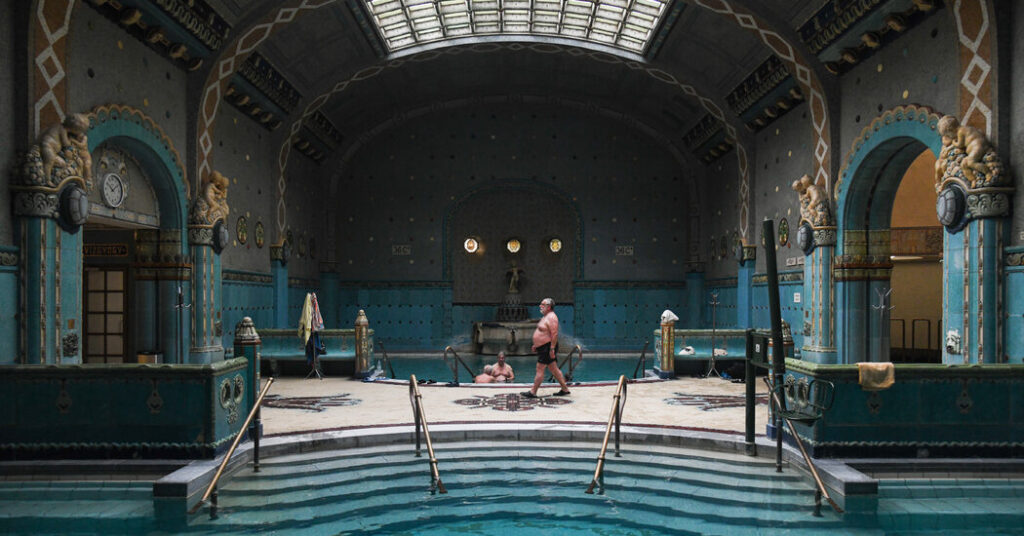
So it came as a surprise to many bathers when Gellért Bath, a grand example of Budapest’s popular baths, closed on Oct. 1 for renovations that won’t be fully completed until 2029. The problem: aging infrastructure, said Ildikó Szűts, the chief executive of the municipally owned company, BGYH, which manages six of the city’s seven historical baths. “Gellért hasn’t been renovated since the 1970s, and we struggled every day with technical problems,” she said.
The closing of Gellért, which comes amid the longtime shuttering of two other historical baths, has upended Budapest’s finely layered bathing ecosystem by diverting tourists to the smaller baths mainly used by locals, and disrupting single-sex bathing schedules. It has also raised tensions between regular bathers and tourists, who sometimes defy unwritten customs, bringing their phones inside the bathing halls, for example, or wearing inappropriate attire.
“We can really feel it,” said Diána Dani, the bathing director of Veli Bej, a small 16th-century bath near the Danube. On a recent Monday evening, a sign that read “the bath is full” blocked Veli Bej’s entrance, with around a dozen bathers, both tourists and locals, waiting patiently beside it.
Things got more heated at Rudas Bath, near Gellért. To absorb some of Gellért’s nearly half a million annual bathers, BGYH drastically curbed single-sex bathing hours at Rudas, the only Budapest bath that isn’t fully coed.
The regulars revolted, and a group of women circulated a petition to restore the old system. They argued that single-sex bathing fosters a carefree, relaxed bathing experience and helps preclude unwanted attention from men. “If I go alone to a normal bath, sooner or later, even at my age, somebody will come up to me and say, ‘Hey, how are you?’,” said Judit Pecák, 45, a bookstore owner and a regular visitor to Rudas for the past five years.
The changes have left many regulars feeling let down by the city leaders and BGYH, believing they prioritize tourists and profits at the expense of local bathing communities. “They started looking only at the numbers, not seeing that there is a culture here,” Ms. Pecák said.
BGYH issued a statement saying that their goal is to meet the dual challenge of “preserving our centuries-long bathing traditions while keeping in mind the sales and profit considerations that enable the operation of the baths.” As a result of the protests, the company recently reinstated two of the four single-sex bathing days at Rudas.
Budapest has long enjoyed the mineral-rich thermal water that flows below its surface, as evidenced by the remains of the city’s Roman-era Thermae Maiores. Until the turn of the 20th century, the baths were typically simple buildings intended for local people. It was István Bárczy, the mayor from 1906 to 1918, who transformed Budapest into the city of thermal baths in order to attract more tourists.
“Gellért was so important for Bárczy that he pushed its construction to completion despite insurmountable challenges during World War I,” said András Sipos, a scholar and a department head at the Budapest City Archives. Gellért opened in 1918, just weeks before the war ended. It quickly became a city landmark, attracting tourists with its spectacular Art Nouveau bathing halls and Danube-facing hotel rooms. The bath hall remained a pillar of Budapest’s tourism even under the Communist regime, which relied on precious Western visitors to boost the state-run economy.
In recent years, to capitalize on the rising number of tourists, BGYH has raised ticket prices significantly. A weekend visitor now pays 14,000 Hungarian forint (about $42) to enter Széchenyi, the city’s biggest and most popular bath.
Last year, BGYH made $20 million in operating profits and is broadly viewed as Budapest’s golden goose.
The fate of the two other shuttered baths, Király and Rác, is less certain. Király Bath was built by the same pasha, Sokollu Mustafa, who commissioned Rudas and Veli Bej in the 16th century, when much of today’s Hungary was part of Ottoman Turkey. It closed in 2020, for renovations that are yet to begin. The building is owned by the Hungarian National Asset Management Company, a national government agency, but operated by BGYH.
Ms. Szűts, who runs BGYH, said that the company’s plans to move forward with renovations have been blocked by the agency. The government agency did not return emails seeking comment.
Relations between Budapest and the Hungarian government soured when the governing Fidesz party, led by Viktor Orbán, the country’s longtime prime minister, lost its majority in the City Council in 2019 to a center-left coalition led by the current mayor, Gergely Karácsony. Since then the government has demanded that the city drastically increase its “solidarity contributions” to other regions in Hungary, an escalation of a program that forces wealthier municipalities to help support poorer ones. While the municipality of Budapest was a net beneficiary of state funds under the previous mayor, this year it is required to contribute about $270 million to the central government, which accounts for about 20 percent of the city’s annual budget.
“It’s a political punishment,” said Ambrus Kiss, the director general of the Mayor’s Office.
Márton Nagy, Hungary’s economy minister, disagrees. In a recent Facebook post, he said that Budapest’s financial troubles are caused not by the solidarity contributions but by the mayor’s “catastrophic” leadership, and that well-off cities have to support less developed regions in Hungary. “The catch-up of the countryside is our common interest,” he wrote.
A few years ago, BGYH bought Rác, a historical bath that has been out of service since 2002, with the intent to finally reopen it. To do so, BGYH requires a loan — but as of 2012, only the government can decide whether a municipality is permitted to take one out. “These decisions aren’t based on professional considerations; they are political,” Mr. Kiss said. If the loans aren’t approved, Gellért and Rác will not be renovated, he added. The Ministry for National Economy did not respond to questions about BGYH’s pending loan application.
Outside Budapest, the government has generously supported bath-related investments in places such as Gyula, a town near the border with Romania, and Lakitelek, a village in the Great Hungarian Plain. The city of Győr, for example, received $65 million for a state-of-the-art thermal bath project, which is now struggling to attract customers. While Budapest accounts for more than half the visitors to Hungary, comparable investments are not being made in the capital’s thermal baths. Ms. Szűts believes that the government’s approach defies the tourism strategy advocated by the economy minister. “Gellért is an icon of Budapest and Hungary, but nobody in the government wants to give us some money,” she said.
The hotel abutting Gellért Bath was recently purchased by BDPST Group, an investment company run by the prime minister’s son-in-law, István Tiborcz. He has accumulated a portfolio of upscale hotels within Budapest’s city center, often financed by loans from government-friendly banks. Gellért Hotel is currently undergoing a gut renovation and is expected to reopen in 2027 as a luxury Mandarin Oriental, targeting wealthy tourists.
Péter Magyar, the opposition leader and a contender with Mr. Orbán in next year’s national election, has speculated that the bath may ultimately land in the hands of the prime minister’s son-in-law. (Márk Németh, the head of public relations for BDPST, said in an email that the company has no intentions on the bath.)
Mr. Kiss refuses even to entertain such an idea. “It makes no sense to sell Budapest’s greatest assets,” he said. “What would be next, Széchenyi Bath?”
Tas Tóbiás is a Budapest-based journalist and the author of Offbeat Budapest & Vienna.
Follow New York Times Travel on Instagram and sign up for our Travel Dispatch newsletter to get expert tips on traveling smarter and inspiration for your next vacation. Dreaming up a future getaway or just armchair traveling? Check out our 52 Places to Go in 2025.
The post Why Is the ‘City of Baths’ Running Out of Bathhouses? appeared first on New York Times.