You’d be forgiven for being completely lost amid the flurry of diplomatic meetings and plans to try to end the war in Ukraine that have taken place over the last few weeks — another, between Ukrainian and U.S. delegations, took place in Florida last weekend; on Monday, President Volodymyr Zelensky of Ukraine was in Paris to meet with President Emmanuel Macron of France; and Steve Witkoff, President Trump’s special envoy, was scheduled to travel to Moscow, where the Kremlin said he would meet with President Vladimir Putin of Russia.
But there is a quick way to catch up. Because whichever multiple-point plan emerges next, the takeaway remains the same: Hope is being allowed to stand in for strategy.
Ukraine hopes that Mr. Trump’s support and circumstances on the battlefield will somehow improve enough that it can secure a better deal. Europe hopes that the United States will stay on board and that the war in Ukraine will not come closer to its own borders, and stop short of crossing them. And the Trump administration hopes that Mr. Zelensky will be unpopular enough, his country exhausted enough, to accept any deal and allow Mr. Trump to claim that peace has been achieved.
Many have tried to define the war in Ukraine as one of attrition. It is not. It is a war of will. Victory will belong not to the side with more resources (the West being demonstrably more resource-rich than Russia), but to the side with the stronger, more adaptive and unyielding will to win. Today, neither Ukraine nor Europe nor the United States can claim that advantage.
In Kyiv, a large and growing embezzlement scandal threatens to destroy public trust in Mr. Zelensky’s presidency. The scandal has already claimed two of Mr. Zelensky’s cabinet ministers, and on Friday Mr. Zelensky’s closest aide and longtime ally, Andriy Yermak, was fired after investigators from Ukraine’s corruption agencies searched his home in the capital. Mr. Yermak, who had been a key part of peace negotiations, was replaced by Rustem Umerov, the head of Ukraine’s National Security and Defense Council and a skilled negotiator, at the talks in Florida on Sunday.
At this critical moment in the war, Ukrainians are suspended in uncertainty. They wait to see whether Mr. Zelensky is really moving away from the centralized decision-making that has defined his government and toward a more efficient wartime state, or simply making gestures to try to quickly quell public anger. Ukraine is still facing a military shortage because its politicians are torn between the imperative to fight the war and the temptation to start fighting the next election. Scaling up domestic weapons production is necessary, but will require funding that, for now, simply isn’t there.
Washington has demonstrated its will again and again. The United States, which has drastically shifted course since the 2024 election, seeks an end to the war that will allow the Trump administration to move on — regardless of whether a real peace has been achieved.
Europe is lagging in implementing its rearmament agenda, unable to resolve the question of frozen Russian assets and dragging its feet on Ukraine’s accession to the European Union.
Russia, on the other hand, has spent all this time learning the lessons. The first year of the war dealt Mr. Putin a humiliation that Russia has seldom known. Ukraine survived when the world expected it to fall, pushed Russian forces away from Kyiv and reclaimed vast stretches of territory. But in the subsequent years, Russia has meaningfully scaled up production and use of cruise and ballistic missiles and one-way attack drones, eroding Ukraine’s drone advantage. By offering outsize bonuses and salaries, it has sustained troop numbers despite staggering casualties.
Ukraine and key European partners may have successfully pushed back against some of the recent peace plans. But no one should be deceived: Unless the underlying balance of power changes, future peace plans will probably look much the same.
In war, circumstances are changed only by force — military, economic and political. If the situation on the battlefield and inside Russia remains roughly what it is today, then by next year Ukraine is likely to find itself in the same position: the heroism of Ukraine’s army and the resilience of its people, while extraordinary, will not prevent Russia from inching forward, seizing more lives and territory. We’ll return, most likely, to some version of the same deal. In neither this year nor the next should anyone expect Russia to propose a deal that is meaningfully different from what it has already.
How do we change the circumstances? There are two main levers. The first deteriorates conditions inside Russia to the point that Mr. Putin is forced to consider ending the war as the lesser evil, and it is achieved by imposing sanctions that would be powerful and smart enough to erode Russia’s capacity to wage war and significantly increase the cost of continuing it. That would mean closing the myriad loopholes that allow Russian oil and technology imports to flow through third countries, and securing understandings with China and Saudi Arabia that Russia must halt its war. China is now the only power on which Russia remains critically dependent — its voice carries real weight. Saudi Arabia, meanwhile, is the key to managing supply in the global oil market, the main source of revenue funding Russia’s war machine.
The second lever is stopping Russia on the front line, which would require Europe to stop treating defense production as a bureaucratic necessity and start treating it as a continental emergency.
Mr. Zelensky, as well as changing his approach to governance, must define what a feasible victory for Ukrainians looks like. The departure of Mr. Yermak might signal the beginning of a new chapter, and Mr. Zelensky’s willingness to embrace the real change the people of Ukraine crave.
Ukraine and its allies have been telling themselves for almost four years that they will do enough, just in time, to turn the tide of the war. They have acted, but they have never done enough. Russia has always outpaced them, and each year the tide has failed to turn.
Each of them can continue to reiterate the same promises, hoping for better circumstances while dooming us all to the current trajectory — a slow, grinding war that erodes Ukraine and fatigues its partners until a bad peace becomes inevitable. Or each can decide, together, to change the trajectory.
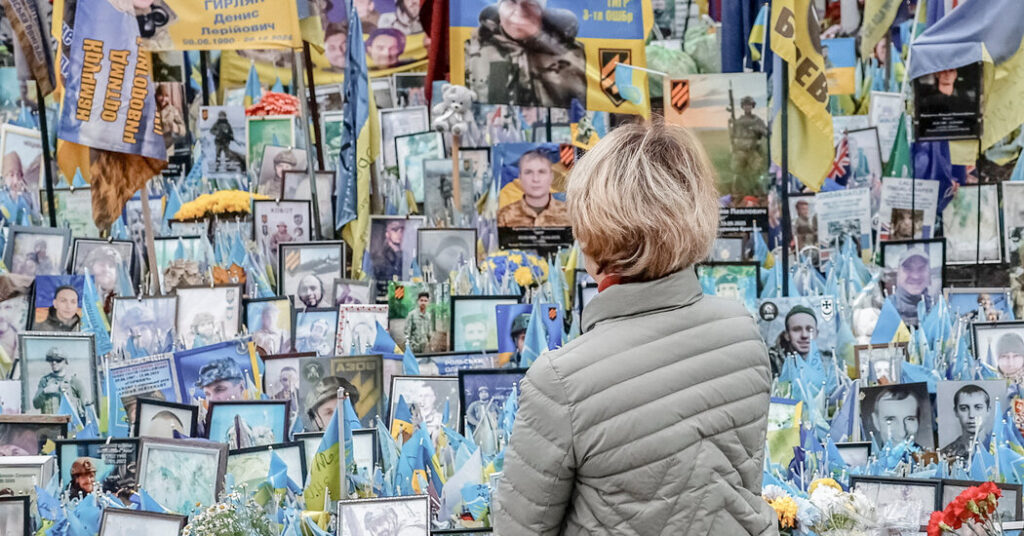
This is not an argument against hope. Hope has its place. Ukrainians live by it every day: They hope that their families will be safe, their country will survive and that Europe will finally treat their country as its own.
But hope cannot be a strategy. In today’s wartime politics, it is doing far too much of the work that weapons, sanctions and hard political choices should be doing instead.
Dmytro Kuleba was the foreign minister of Ukraine from 2020 to 2024. He is a senior fellow at the Harvard Belfer Center.
The Times is committed to publishing a diversity of letters to the editor. We’d like to hear what you think about this or any of our articles. Here are some tips. And here’s our email: [email protected].
Follow the New York Times Opinion section on Facebook, Instagram, TikTok, Bluesky, WhatsApp and Threads.
The post Ukraine Is Not a War of Attrition. It Is a War of Will. appeared first on New York Times.