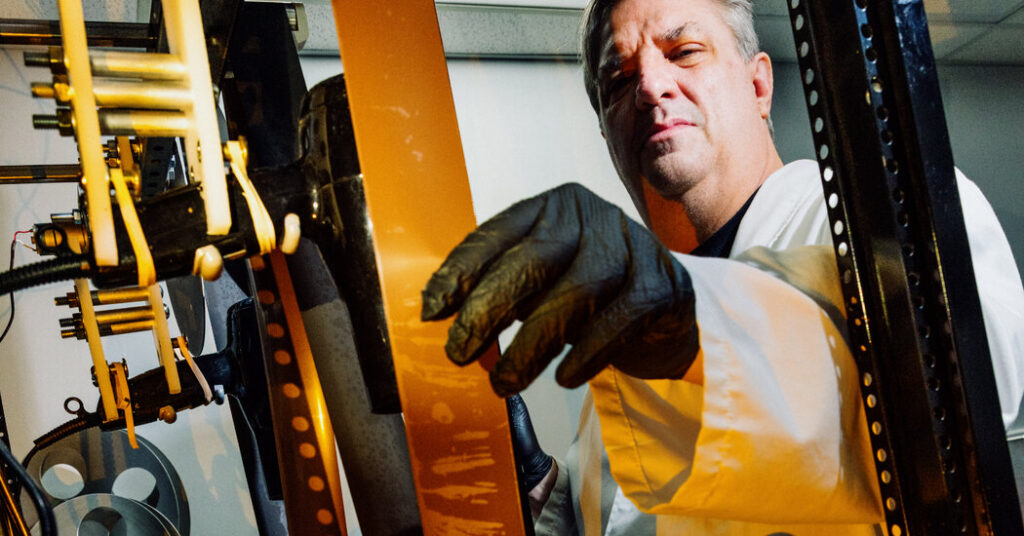
Sitting at his studio console in New Jersey one afternoon this past spring, Kelly Pribble opened a yellowed cardboard box and pulled out a master audio tape by the jazz saxophonist Cannonball Adderley from 1975.
“A horrible year for tape,” he groaned.
Holding his eye close to the quarter-inch reel as he rolled it through a playback machine, Pribble noticed telltale signs of what he called “adhesion syndrome”: Parts of the tape were stuck together on their spool. Without special treatment, this studio recording of “Lovers” — a slice of funky jazz fusion recorded shortly before Adderley’s death — would be unplayable, the original music lost.
A huge portion of the world’s recorded musical heritage is stored on magnetic tape, used regularly from the 1940s into the digital age to capture musicians’ sounds in the studio. But as analog tape ages, it grows more fragile and vulnerable, posing a challenge for engineers like Pribble, 60, an audio preservation expert with the giant storage company Iron Mountain. For 15 years, he has been at the forefront of an obscure but vital industrywide effort to save old tapes — for which he employs an assortment of handmade tools and Rube Goldberg-worthy machines in a cramped workshop.
According to more than a dozen archivists and audio engineers, the problems facing tape have become more pronounced in recent years. Some of the most jeopardized recordings are from the 1970s and ’80s, after manufacturing changes introduced problems that became evident only with time. Unless the tapes are properly preserved, their slow decay will threaten the survival of original recordings from vast swaths of music history.
“It’s a race against time,” Pribble said more than once during a series of interviews over the last year.
The soft-spoken Pribble, who has the pale physique of a man who has spent his career in the electronic caves that are recording studios, has become a leading figure in audio restoration, a field of lone tinkerers operating somewhere between hard science and garage alchemy. He has patented techniques he has developed to repair severely compromised tapes from hundreds of artists, among them icons like Bob Dylan and Bruce Springsteen. Pribble is often the audio repair man of last resort, working on tapes that have left other engineers stumped.
“We call him the magician,” said Robert Friedrich, the supervisor of the Library of Congress’s audio preservation lab.
IRON MOUNTAIN IS a $25 billion company that specializes in “information management.” With more than 1,200 facilities around the world — including a 315-acre underground complex in a former limestone mine in western Pennsylvania — it offers secure storage for corporate records, as well as for media assets from Hollywood studios, record companies and prestige clients like the Grammys and the Prince estate. Within its vaults lie seemingly endless shelves of film, videotape and audio reels.
In 2011, the company sent Pribble to examine problems among a cache of thousands of audiotapes in Brazil. Many had been affected by mold, a common hazard plaguing tapes not held in a climate-controlled environment.
Another routine problem among tapes of 1970s and ’80s vintage is “sticky shed syndrome.” Also known as hydrolysis, it is a deterioration in the material that holds together a tape’s oxide — the magnetic compound that contains its audio information — resulting in a residue that can destroy the tape if it is played. The fix, long established, involves “baking” tapes in an oven to release trapped moisture.
But what Pribble saw in Brazil, he said, was far worse. More than a thousand tapes were bound together so tightly on their reels that they seemed like a solid mass. With others, an oily lubricant had leached to the surface.
Pribble experimented with solutions and built prototypes to repair the tapes, a process that took three years.
“I was making calls to the Library of Congress and all kinds of people,” Pribble recalled. “And people were like, ‘I’ve never seen that before.’”
In 2018, after Pribble had given a presentation to the Audio Engineering Society, an attendee named Kevin Przybylowski reached out. He said that some of the problems Pribble had described resembled those he had come across from one of his highest-profile clients: Bob Dylan. A batch of 63 multitrack masters for two of Dylan’s 1980s albums, “Empire Burlesque” and “Knocked Out Loaded,” showed evidence of adhesion that Przybylowski felt were beyond his ability to repair.
He referred Dylan’s representatives to Pribble. “Even if I lost the job,” Przybylowski said, “it was right for the tapes.”
Pribble’s unbinding process involves soaking tapes in a solution of deionized water — he declined to specify the formula, calling it a trade secret — for as long as a month. He then places the tapes in a tub with an ultrasonic cleaner, which sends an army of tiny bubbles to penetrate between the tape’s layers.
To dry the tape, Pribble spools it through a device roughly the size of a door frame, which he calls a “wet rewind machine.” Pribble built it from an audio equipment rack, standard at any recording studio. The tape meanders up and down the frame, passing a store-bought fan and four Revlon hair dryers angled on adjustable stands that Pribble also built.
I asked how he had chosen that specific model of hair dryer. “Price,” Pribble answered with a shrug, as he poked his head around the wet rewind machine, checking the progress of a reel winding its way through.
EVEN AMONG ITS OWN CLIENTS, Iron Mountain maintains a level of discretion that borders on secrecy.
“They said, ‘Yes, we can treat these,’” recalled Mark A. Davidson, the curator of the Bob Dylan Archive. “And when we asked what it was, they said that’s a proprietary Iron Mountain thing.”
But the proof was in the pudding. Pribble’s work saved Dylan’s recordings, allowing “Empire Burlesque” outtakes to appear on his next archival release, “Springtime in New York: The Bootleg Series, Vol. 16.”
Pribble, who wears a white lab coat over his jeans and T-shirt when cleaning tape, grew up in Southern Illinois and got his start in Nashville recording studios in the 1980s. By 2010, with studio employment slowing down, a casualty of the music industry’s digital disruption, Pribble joined Iron Mountain. To his surprise, he found himself exhilarated by archival work.
“I was dealing with records I had been listening to my entire life,” Pribble recalled, “and all of a sudden I’ve got their masters in my hands.”
His eyes lit up telling war stories of bringing old tapes back from the dead, only to stop himself from naming names. Those clients hadn’t approved the disclosure.
Scientists and engineers have put forth various theories for why tapes from the 1970s and ’80s have developed these problems, but a single, definitive answer has remained elusive.
“What is happening chemically has never been established,” said George Blood, another specialist in tape and video preservation. (Blood competes directly with Iron Mountain but was diplomatic in describing their mutual pursuit: “We’re all going about it on our own, trying to figure out recipes that work.”)
Pribble and others point to a decision by manufacturers in the early ’70s to replace an organic lubricant with a synthetic one. Various complications have ensued — first sticky shed, now more severe issues like adhesion. (Tapes made before this change, engineers say, can be immune from such problems.)
A couple of years before the Dylan project, Pribble was sent about 350 tapes of live recordings from Springsteen’s archive. More than 100 exhibited what Pribble calls “loss of lubricant syndrome,” in which a gooey, beige material collects on the tape head when played, distorting the audio and possibly damaging the equipment.
Pribble’s weapon to attack this problem is a humble roll of pellon — the white adhesive used in waxing salons — which he affixes to a paintbrush-size handle made from PVC plumbing pipes. He removes the excess lubricant by rotating the pellon back and forth against the tape as it rolls through a decommissioned deck, one song at a time. Its clean state may last only 30 days — long enough to transfer its contents to another format, usually digital.
“This is nobody’s fault,” Pribble said of the state of Springsteen’s tapes. “This is natural degradation. This is something that’s happening even while the tape is stored in great condition.”
HOW MUCH LANDMARK MUSIC is at risk is not clear. The kinds of issues Pribble specializes in, some engineers and archivists said, are relative rarities; Przybylowski encounters them in perhaps half of the tapes he sees, he said.
When these problems do appear, they can force difficult choices. Kevin Gray, an experienced mastering engineer, said that when he was recently working on a reissue of Fleetwood Mac’s 1975 self-titled album — the one with “Rhiannon” and “Landslide” — some of the original masters had been fused on their reels. For two of the album’s 11 tracks, Gray said, he and the label decided to use a safety copy, a generation removed from the original.
Is there a perceptible difference between the sound of the original and the copies? “It’s very subtle,” Gray told me — but it is there.
Another question is expense. Big record companies control thousands of tapes, and they must weigh the costs of restoring a tape against the income it is expected bring in from sales or licensing. Iron Mountain declined to disclose what it charges for remediation services. But Chris Clough, an executive at the independent music company Concord, which has an extensive catalog of old recordings — including the Adderley tape — said that to address his company’s entire vault, “you’re looking at millions of dollars.”
And finished masters — the finalized version of an artist’s work, which is then duplicated and sold to the public — are just the tip of the iceberg. Adria Petty, who is part of a team that runs the estate of her father, Tom Petty, said she was sometimes contacted about a new batch of rehearsal tapes or studio sessions that may have languished in a closet for decades. Scanning through all those tapes, even just to determine what is on them, can be a daunting financial decision.
“How fragile is history?” Petty said. “Everything should be transferred, right? But at what cost?”
Iron Mountain is keen to portray itself as part of a honeycomb of archivists engaged in a shared effort to preserve the world’s musical heritage.
“When it comes to these really wonky ways of making sure that we can save materials,” said Andrea Kalas, the company’s vice president of media and archives services, “in the end, I don’t think it is much of a competition. We’re all interested in making sure they get saved.”
But in the scattered, freelance-heavy world of audio archivists, Iron Mountain is seen more as the big gorilla of the business than as a collaborative partner. “If they have some magic formula,” said Dan Johnson of Audio Archiving Services, a one-man shop in Burbank, Calif., “it’d be nice for the rest of us to find out what it is so we can help other people’s tapes.”
Johnson points out that Pribble is not the only engineer to perform miracles on hopeless reels of ancient tape. He described restoring masters for SS Decontrol, a 1980s hardcore band from Boston. Nine reels for their classic album “The Kids Will Have Their Say,” he said, had been kept for decades in a band member’s flood-prone basement, and were caked in layers of mold. Johnson spent over 100 hours cleaning the tapes with lighter fluid.
“We all have our certain methods and techniques,” Johnson said.
Pribble’s colleagues at Iron Mountain say their biggest challenge has been finding a way to scale his time-consuming work of restoring tape. Pribble has a solution for that, too: a new set of machines that would automate his processes, allowing him to establish satellite workshops around the world.
“They’ve always been saying they can’t clone Kelly,” he said. “This is kind of cloning me.”
Ben Sisario, a reporter covering music and the music industry, has been writing for The Times for more than 20 years.
The post The ‘Race Against Time’ to Save Music Legends’ Decaying Tapes appeared first on New York Times.