The Supreme Court will hear arguments on Monday in a closely watched copyright clash testing whether internet providers can be held liable for the piracy of thousands of songs online.
Leading music labels and publishers who represent artists ranging from Bob Dylan to Beyoncé sued Cox Communications in 2018, saying it had failed to terminate the internet connections of subscribers who had been repeatedly flagged for illegally downloading and distributing copyrighted music.
At issue is whether providers like Cox can be held legally responsible and be required to pay steep damages — a billion dollars or more — if it knows that customers are pirating the music but does not take sufficient steps to terminate their internet access.
The arguments kick off a busy December for the Supreme Court, which is scheduled to hear a series of major cases over the next two weeks, including one that will test President Trump’s power to fire independent regulators.
Courts have long held that people can be liable for providing another person or entity the tools to commit copyright infringement. Two decades ago, the Supreme Court unanimously ruled that the file-sharing company Grokster could be held responsible for the violations of its users.
But in a pair of more recent cases unrelated to copyright law, the justices declined to hold technology platforms liable for problematic content posted by their users. The rulings in 2023 did not resolve the question of what responsibility platforms should have for content posted on their sites. In the rulings, the justices were not divided along ideological lines.
Free speech advocates, including the ACLU, have urged the Supreme Court to side with Cox in the case being heard on Monday, warning of a chilling effect on free expression if internet companies could be on the hook for hefty penalties for the actions of their users. They have argued that such a ruling could result in speech-related lawsuits against other kinds of intermediaries, including bookstores and social media platforms.
While music piracy is not the existential threat to the industry it was when the internet was newer, and before paid streaming services became popular, illegal uploading and downloading of music has become faster than ever, and continues to rob artists of their exclusive rights, their lawyers told the court. They said that Cox ignored bad actors, helping 60,000 users distribute more than 10,000 copyrighted songs for free in order to keep subscriber payments flowing.
“Cox made a deliberate and egregious decision to elevate its own profits over compliance with the law, supplying the means for massive copyright infringement to specific users that it knew were ‘habitual offenders,’” Paul D. Clement, a former solicitor general, said in court filings on behalf of the music industry, led by Sony Music Entertainment.
After a 12-day trial in 2019, a jury found Cox liable for all 10,017 songs at issue, and awarded Sony $1 billion in damages. The company appealed.
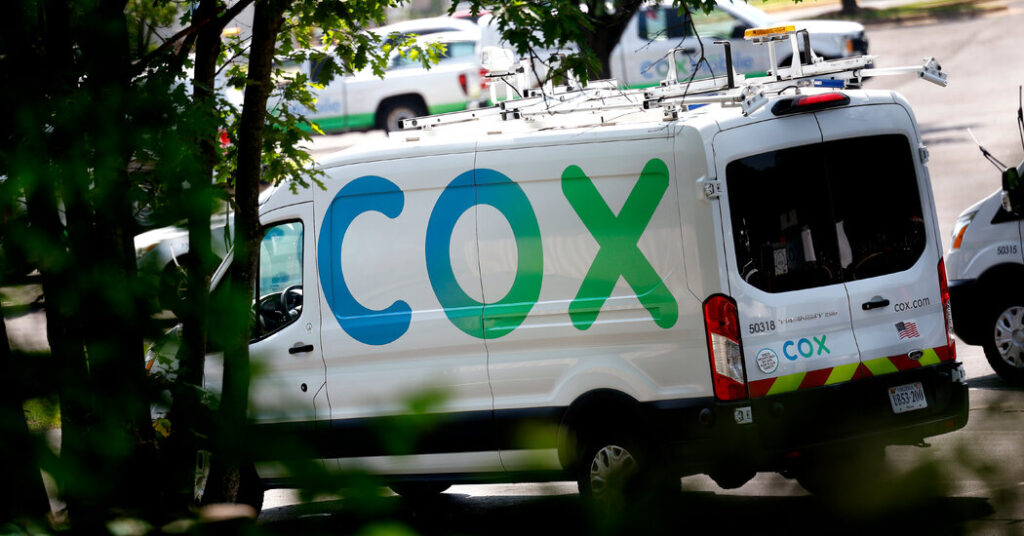
Cox Communications provides internet service to more than six million homes and businesses in more than a dozen states. The company warned of widespread disruptions in access if the justices ruled against it.
Cox said it could be required to terminate access for households, hospitals, universities and coffee shops based on a “couple accusations of infringement.”
“Innocent users could lose their internet lifelines merely because a guest downloaded a couple of songs,” the company’s lawyers, led by E. Joshua Rosenkranz, said in court filings.
Decades ago, Congress offered service providers some protection from liability while trying to preserve copyrights in the digital age. The Digital Millennium Copyright Act shields providers from some lawsuits, but only if the companies carry out anti-piracy policies.
Cox requires users to electronically sign an agreement acknowledging the risk of suspension or termination if they illegally download copyrighted works. Under its policy, Cox can cut off service after a user receives a total of 13 notices for infringement, according to court filings.
In its lawsuit, the music industry argued that Cox should be held liable for not cutting off service to subscribers who received three or more notices. Cox terminated just 32 users for repeated copyright infringement, the industry said. On the other hand, it had “no qualms” about terminating nearly 620,000 subscribers for nonpayment during the same period.
“While Cox stokes fears of innocent grandmothers and hospitals being tossed off the internet for someone else’s infringement,” the industry said, it had continued to provide service for those “habitual offenders” flagged for illegal downloads.
The company argues that courts have said that it has to be aware of bad behavior and purposefully act to further the illegal activity in order to be held liable. Failing to take steps to prevent the infringement, the company said, is not enough.
For instance, in a case involving the social media platform then known as Twitter, the Supreme Court said in its 2023 ruling that it did not generally think “internet or cell service providers incur culpability merely for providing their services to the public writ large.”
The U.S. Court of Appeals for the Fourth Circuit upheld the jury’s finding of “willful contributory infringement” by Cox, saying there was sufficient evidence that the company was to blame for copyright infringement on its network.
But the court ordered a new trial on a separate issue and vacated the $1 billion judgment, saying Cox did not profit from subscribers downloading and distributing the copyrighted songs.
The Trump administration is backing Cox’s position, citing the government’s interest in ensuring broad availability of communications services online.
Ann Marimow covers the Supreme Court for The Times from Washington.
The post Supreme Court to Hear Copyright Battle Over Online Music Piracy appeared first on New York Times.