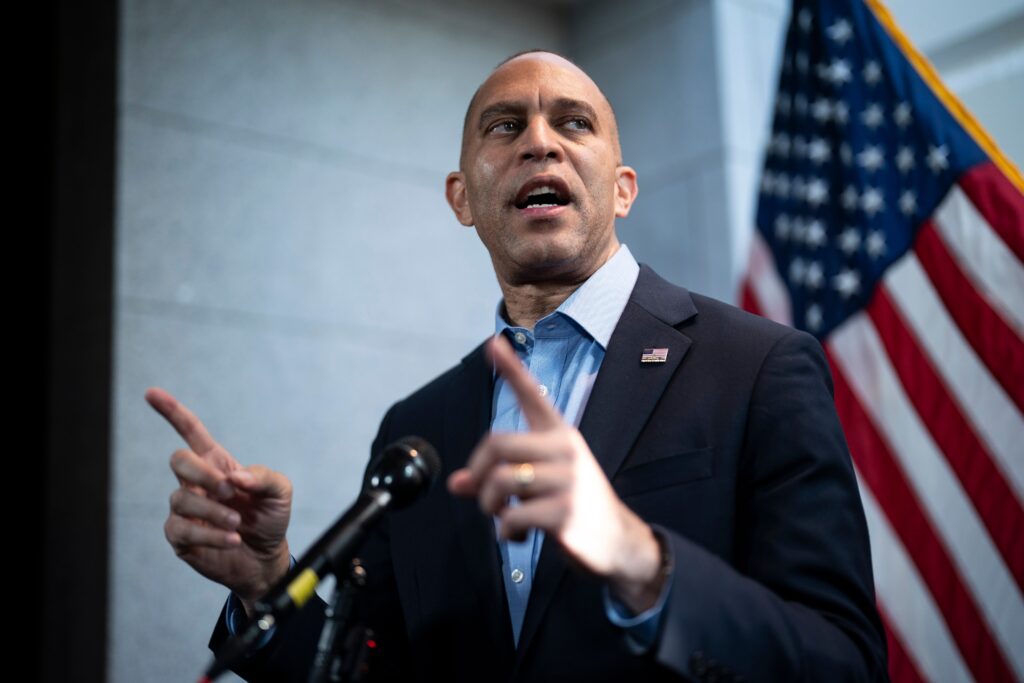
House Minority Leader Hakeem Jeffries (D-New York) thinks he’s onto something clever with a new catchphrase to describe the Democratic agenda: “Strong floor, no ceiling.” If that sounds like a hokey phrase copied from a venture capitalist, that’s because it is. The mantra is the title of a book by Democratic donor Oliver Libby.
Even if it turns out to be marketable in the midterms, “strong floor, no ceiling” is a poor descriptor for Jeffries’s platform. It’s true that he doesn’t seem to believe in ceilings on government spending or national debt, but Democrats have settled on an income ceiling of $400,000, above which they clamor for large tax increases.
While Democrats at the federal level have so far failed to raise taxes on the rich, they’ve succeeded at the state level. California’s income tax raises about half its total revenue from people earning over $500,000. The Golden State’s treasury is so reliant on the ultrarich that there are budget problems whenever the stock market has an off year.
The state of New York’s Department of Taxation and Finance bragsthat 41 percent of its income tax revenue comes from millionaires and half comes from just 200,000 of the state’s 11 million taxpayers. If Jeffries really wants Democrats to embrace “no ceilings” for people’s success, he could tell his Empire State compatriots to stop gloating about confiscating the most successful people’s money. Instead, he endorsed New York Mayor-elect Zohran Mamdani, a self-described socialist.
For the “strong floor” component, Democrats don’t offer much better. Jeffries’s main example is his party’s commitment to Social Security, no doubt an important source of income for many, but the floor under the largest entitlement program is getting shakier, and Democrats aren’t offering a substantive plan to strengthen the system. Nor is President Donald Trump.
According to this year’s trustees report, Social Security will be unable to pay beneficiaries full benefits in just nine years. Maintaining long-term solvency under current law would require a 34 percent increase in the payroll tax rate or a 26 percent reduction in benefits starting in 2034. Democrats pushed through a law last year, joinedby then-Sen. JD Vance (R-Ohio), that made this problem worse by increasing benefits for retired government employees.
Management consultant speak is not going to change fiscal reality, and the structure that best fits the description of “strong floor, no ceiling” is a parking lot.
The post Shaky floor, some ceilings appeared first on Washington Post.