I’ve reviewed art in a tuxedo.
I’ve reviewed it in shorts and sneakers.
I’ve reviewed it in a fur hat and snow boots.
But I’ve never before done my critic’s job in wetsuit and flippers.
I’d be tempted to make a habit of it, now, if only I could get our museums to flood.
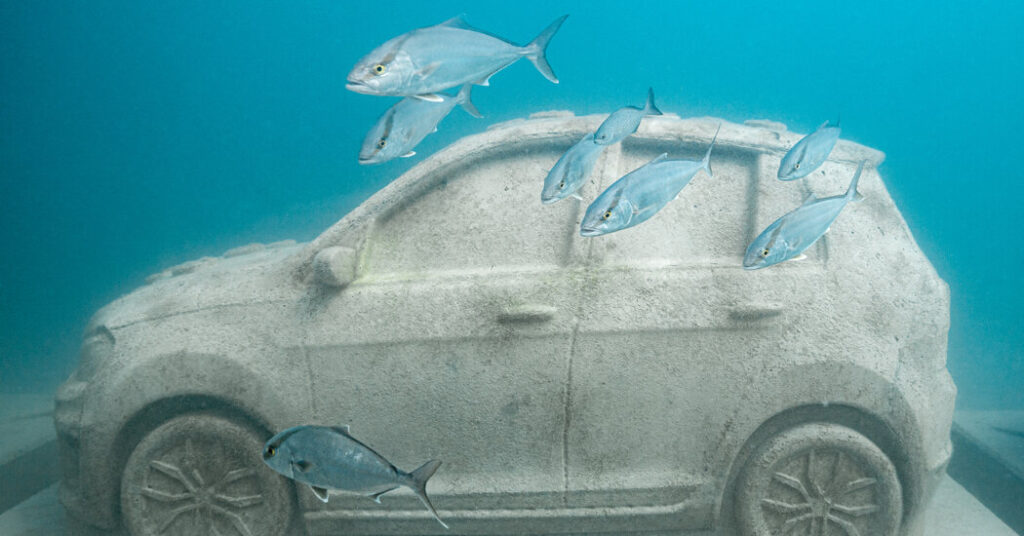
On a sunny November day off Miami Beach, I went aquatic for the first time to take in Reefline, a new program of underwater public art that has sunk its first project 20 feet below the waves, some 800 feet from shore. For “Concrete Coral,” the Argentine artist Leandro Erlich produced 22 sculptures of automobiles, made from concrete at life size, then had them lined up on the sea floor in a traffic jam 90 feet long.
Floating above those “cars,” diving among them, felt like an almost ideal art experience (minus the occasional gulp of seawater, for this neophyte snorkeler).
Without the distractions of terrestrial art-looking — nearby selfie-takers, grumpy tweens or your own pinging phone — your concentration on the art seems almost automatic. Hardly any sounds reach your ears; the buoyancy of salt water and wet suit makes your physical self nearly disappear. With the surrounding ocean remote and dark, Erlich’s sculptures, seeming spotlighted by the Florida sun, become just about the only thing to take in, letting you contemplate their aesthetics and meanings at leisure.
Do those cars portray a near future when nearby coastal roads get submerged from sea-level rise?
Or a postapocalyptic water-world that has left humans quite behind?
Or maybe a post-car U.S.A. that has seen us drown our rides in favor of less noxious transportation? On my dive, Erlich’s traffic jam seemed already on its way to being reclaimed by nature, with spadefish, angelfish, trigger fish and shark-loving remoras beginning to find a home there.
And all those experiences and readings might be almost irrelevant to the true, full mission of Reefline.
“These artworks are performative,” said Ximena Caminos, Reefline’s founder and artistic director. Not performative in the Marina Abramovic sense, she explained, but in the sense that they are meant to perform a function beyond just being eye-teasing art.
Caminos and I met after my Reefline dive, at a cafe near the shoreline. “Our structures are a platform for nature to actually grab onto and thrive,” she said.
Reefline’s plans call for submerging a series of concrete sculptures along Miami Beach over at least the rest of this decade — after Erlich’s, another two are ready to go, a third is in planning, others are still wishful thinking — to function as artificial reefs, providing habitat for every kind of marine life, from algae to fish to corals.
The corals are getting a leg up. Early in 2026, once a permit comes through, divers will begin planting the roof and trunk and hood of each concrete car with up to 100 lab-grown gorgonians — “soft” corals that look more like drab seaweed than like the better known, more colorful “stony” corals whose skeletons form reefs. On Erlich’s cars, the gorgonians should grow several feet high, swaying in the currents as fish swim in for protection and food.
“We’re going to have a forest growing on a traffic jam,” said Colin Foord, the 43-year-old director of science for Reefline. He is so obsessed with corals, he styles his hair to look like them. In an old warehouse just north of the Miami River, Foord tends the project’s 2,200 soft corals, growing in tanks from snippets he collected in the wild. (Unlike stony corals, which are protected, all it takes to harvest gorgonians is the right license.)
Like Caminos, Foord talked a lot about the benefits of Florida’s corals, which stretch for 350 miles along the state’s coast, forming the world’s third-largest reef: It’s worth something like a billion dollars a year, in damage it prevents from waves and flooding. And he described the mass bleaching and die-offs those corals have suffered because of climate change. “As a coral scientist, I’m terrified by the summers now — you start crying for overcast days,” he said.
But start digging into the science, and Reefline’s talk about the benefits can sound a bit excessive: The benefits of corals, and the risks they now face, are really all about the stony, reef-building corals that protect the shore. The soft-bodied gorgonians used by Reefline are at less risk from global warming, according to scientists I spoke to. And even if Reefline someday extended for the full length of Miami Beach — the next two projects, planned for submersion next summer beside Erlich’s, are a concrete whale heart, 17 feet long, by the London artist Petroc Sesti, and a seafloor constellation of concrete stars, designed by the Floridians Carlos Betancourt and Alberto Latorre — any practical benefits would go more to fish than to humans.
Projects like Reefline are part of “a global growth industry, putting stuff out there on a degraded coral reef that gives the tourists something to look at,” said Terry Hughes, an eminent coral scientist who is now professor emeritus at James Cook University, in Australia. He cites mermaid sculptures, off Hollywood, Fla., and a concrete cyclist in the Caribbean waters off Grenada. A few “concrete cars with coral stuck on them,” he said, is at best a distraction from the reefs decaying off the Florida coast. “Its ecological relevance or utility is pretty close to zero.”
Foord disagrees. He suggests that Reefline’s sculptures might draw tourists away from natural reefs so those can recover. And he said Erlich’s traffic jam might be a kind of test-bed for how corals grow, and maybe die, on a man-made structure. Diego Lirman, a coral scientist at the University of Miami and sometimes adviser to Reefline, told me he might study the sculptures for just that reason.
But above all, Foord said, Reefline has set itself the real-world task of getting the public to care about an organism that has no place in the lives of most Americans. “How do you build empathy between humans and these organisms that aren’t cute and cuddly and don’t even have faces?,” he said.
Caminos herself admits that the real work performed by her concrete cars, with their coral updo, is mostly about the effect they might have on human minds, not our oceans.
And that’s totally fine, said Joshua Shannon, 53, an art historian at the University of Maryland in the emerging field of eco-criticism. His forthcoming book is called “How and Why to Look at Art in the Time of Climate Change.”
To actually protect the planet, action has to happen at a scale that only states can manage, Shannon said. But people working at the scale of art can change the culture so those larger actions take place. “You don’t get rid of slavery without a culture that finds it intolerable; you don’t get rid of monarchy without a culture that writes about these really weird, abstract things called human rights and civil rights” — and you don’t start recasting our place in nature until there’s a culture that wants it recast. Shannon pointed to Reefline’s public funding — $5 million, approved by Miami Beach taxpayers — as a sign of the project’s place in our changing culture.
And Reefline’s message, he said, gets conveyed with an immediacy that most art can’t provide: “You don’t just see a video in your basement of coral being restored, but you swim in it with your own body.” This art is about humans actually in nature, as part of it, not looking at it from afar in some Ansel Adams photo.
But Shannon also pointed out the irony that Erlich’s sunken cars are made of concrete — 300 tons of it — a material thought to contribute about 8 percent of the world’s coral-killing emissions. (Caminos said she is hoping to get permission to use a new, lower-carbon concrete for future projects.)
Hughes, the Australian professor (and skeptic), said that simply as an artistic image, dumping cars into the sea doesn’t scream “ocean stewardship.”
It also seems unlikely to have the deep, unending complexity we look for in a great Cézanne or Warhol, art that “gives you mixed feelings and engages you on several different levels,” Shannon said.
Just as sculpture, Erlich’s cars are not particularly compelling — this is hardly the first art of everyday objects — and their messaging seems fairly predictable, about cars and their downsides. The project risks offering nothing more than “a simple, didactic, political take away,” as Shannon put it.
But maybe Reefline’s art, by Erlich or the artists coming next, isn’t really in its objects, but in the ocean setting they plunge a viewer into, as just another creature among nature’s many. Art-looking, an ultimately human activity, gets forced to take place in a context that reads as unhuman. Floating among Erlich’s sculptures, you feel like an interloper taking in art made for fish-eye consumption. And over time, if the project’s gorgonians really do grow and cover its cars — there’s some chance they may get ripped off in a storm — nature may take over entirely. The final success of this art may come when there’s hardly any trace of it left. “It’s designed for nature; it’s not even for people,” Foord said. “It’s post-humanist.”
Or maybe none of the details of Reefline’s sculptures, freshly cast or overgrown, installed and still to come, really matter at all. Whether shaped like cars or stars or a whale’s heart, their worth, as art, just depends on their success or failure in surviving as ecosystems. In their “performance” as reefs, however artificial, they paint a fine picture of the predicament corals find themselves in.
In the end, Reefline’s art is not aesthetic, but “relational” — the kind of art that stages a dinner, to look at how humans relate to each other. But with Reefline, the relationship is with the natural world, and the art lets us look at how we might stop abusing it.
How to Experience Reefline
ART: Phase 1 of Reefline consists of “Concrete Coral” by Leandro Erlich, 22 car sculptures sunk in 20 feet of water off Miami Beach, near Fourth Street. Next summer, at a nearby spot, Phase 2 of Reefline plans to sink Petroc Sesti’s concrete whale heart and the seafloor stars of Carlos Betancourt and Alberto Latorre. In 2026, Reefline will begin refining Phase 3 proposals from a shortlist of artists, choosing one to produce an underwater installation that has yet to be permitted.
ACCESS: Visitors can experience “Concrete Coral” from the beach — by swimming, paddleboard, etc. — or from the water by private boat. Electric paddleboards are available for rent from Reefline.
Four times a week starting Dec. 8, Reefline’s “Art & Science Discovery Dives” will take visitors out to “Concrete Coral” on boats run by a local firm, Diver’s Paradise, at a cost of $149 to $425 per person. Once a month from December through May, access to the dive boat’s trips will be free. (Excursions to the site will be offered Dec. 1-5, during Miami Art Week. Reefline’s electric paddleboards will be free for those days.)
FUNDING: Seed money of $85,000 came in 2019 as a Knight Arts Challenge Award. In 2022, Reefline received $5 million in capital funding from a cultural bond offering approved by the taxpayers of Miami Beach.
PERMITS: Reefline’s projects are permitted as part of an effort by Miami-Dade County to increase the number of artificial reefs — artistic or not — in the waters offshore. Reefline currently has permission to install works in a small zone north of Fourth Street.
THE FUTURE: In collaboration with Reefline, Shohei Shigematsu, a partner in OMA architects, based in New York, and his team have produced a master plan that imagines underwater projects stretching seven miles along Miami Beach, through the end of this decade and beyond at an anticipated cost of $40 million. — BLAKE GOPNIK
Information: www.thereefline.org
The post Miami Beach’s New Traffic Jam Frolics With the Fishes appeared first on New York Times.