movie review
MARTY SUPREME
.review-block-star { –review-block-star–empty-color: #585858; –review-block-star–fill-color: #000; }
.review-block-star { –review-block-star–empty-color: #585858; –review-block-star–fill-color: #000; }
.review-block-star { –review-block-star–empty-color: #585858; –review-block-star–fill-color: #000; }
.review-block-star { –review-block-star–empty-color: #585858; –review-block-star–fill-color: #000; }
Running time: 150 minutes. Rated R (language throughout, sexual content, some violent content/bloody images and nudity). In theaters Dec. 19.
Ping pong tends to be grouped with smaller, niche sports like bowling and badminton; built for basements and ESPN3 at 2 a.m.
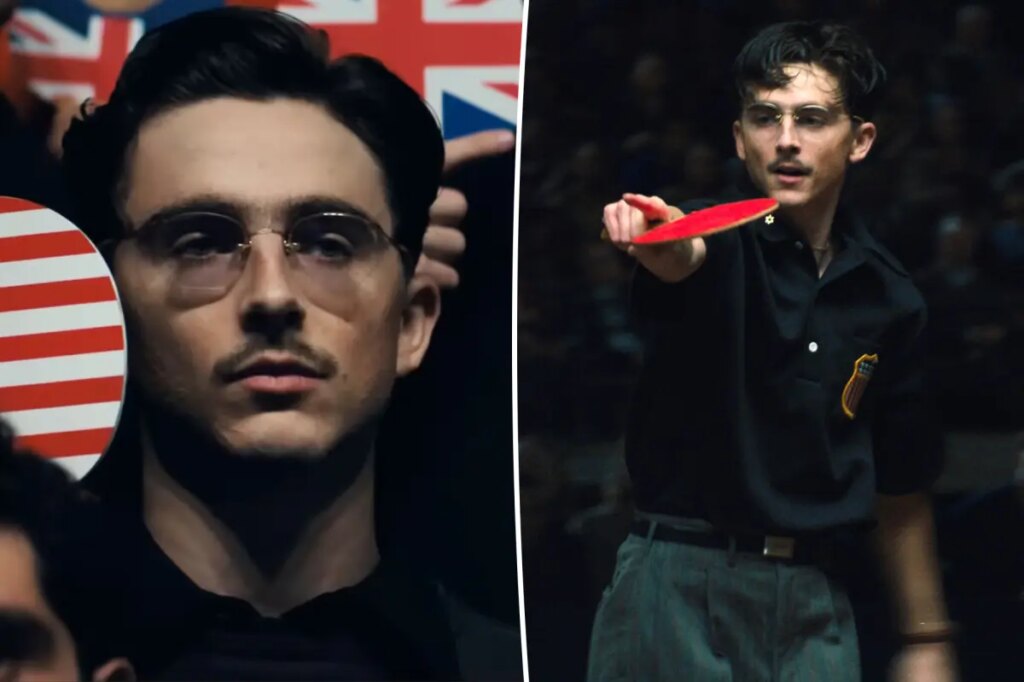
But tiny table tennis is part of one big piledriver of a movie called “Marty Supreme,” starring a career-best Timothée Chalamet.
It’s cinematic Mountain Dew. You’ll be wired for the entire two and a half hours.
Not only does his striving New York paddler Marty Mauser exhilaratingly beat the bejesus out of little plastic balls. Bones break, tempers flare, there’s sex, police chases and a whoopsie incineration.
Yet for all the coursing adrenaline and cortisol that immediately bring to mind writer-director Josh Safdie’s previous breakneck film, “Uncut Gems” with Adam Sandler, “Marty Supreme” is also a charmer and a shameless flirt.
It makes you laugh hard and often, and even blush a bit. There’s ample heart and passion in Marty’s messy race to the top. And the 1950s Big Apple ensemble is so authentic it’s as if the filmmakers kidnapped a downtown deli.
What a winner “Marty Supreme: is. Safdie, his team and especially his ace star are serving the best movie of the year.
The speed-demon film follows the 2025 trend of sports flicks that aren’t really sports flicks, including “Christy” with Sydney Sweeney and Benny Safdie’s “Smashing Machine.”
This story, however, is fictional — although the title character is loosely inspired by ping pong champ Marty Reisman. So it’s not burdened by the familiar and dusty path of biopics. The zigzagging plot is wildly unpredictable.

So is the brilliant Chalamet. His neurotic, uncomfortably direct, “Fake it till you make it” Marty is right up there with Leonardo DiCaprio’s fraudster in “Catch Me If You Can,” only with the danger of Matt Damon’s Tom in “The Talented Mr. Ripley.” He has a hint of bogus heiress Anna Delvey to him. It’s a sensational, next-level performance.
Spitfire Marty is actually among the world’s best table tennis players from the start. Even so, as the sport is exploding in popularity in Japan, it earns crickets Stateside. He makes zilch doing what he’s best at, and works in his uncle’s shoe store to get by. But it’s not enough.
To bankroll his lofty dreams, he’s forced to lie, coerce, threaten, schmooze and sneak his way to hopefully becoming the Michael Jordan of table tennis.
And he won’t let anyone or anything disturb his plan, including people he ostensibly loves. There’s Rachel, the married woman he’s sleeping with, stunningly played by Odessa A’Zion.

Later, the unibrowed Casanova gets involved with Kay Stone, the married starlet he’s, um, also sleeping with, who Gwyneth Paltrow lends Hollywood gravitas, curiosity and that unmistakable Goop sternness.
Safdie has really ingeniously cast this thing. There are plenty of famous faces with Five Boroughs credi, such as Fran Drescher as Marty’s mom and Sandra Bernhard as her sister. Blink and you’ll miss David Mamet as a Broadway director.
What’s cool is that Safdie has also creatively snapped up non-actors who are all ideal for larger-than-life New Yorkers. Billionaire Gristedes owner John Catsimatidis is — I kid you not — a revelation as Marty’s best friend’s annoyed dad.
And “Shark Tank”’s Kevin O’Leary makes a memorably snarling villain as Milton Rockwell, a pen manufacturer CEO that offers Marty the chance to sell out for big bucks.
For expert dribbling, Safdie has real basketball players Tracy McGrady and Kemba Walker play Harlem Globetrotters.

On the subject of globetrotting, for a ping pong player, Marty jet-sets like he’s James Bond. The film goes from the Lower East Side, to the Ritz in London, to a Parisian cafe and a Tokyo amphitheater. Ambition reigns supreme.
One of Safdie’s most inspired flourishes, though, is his incongruous use of 1980s music in a 1950s movie. There’s no soothing “Earth Angel” or jukebox “Tutti Frutti” here. Instead we get “Forever Young” and Tears For Fears.
That’s still nostalgic, for sure, but in a completely different way. Those sounds perfectly evoke John Hughes, “Ferris Bueller,” “The Breakfast Club” and fond memories of teenage rebellion.
Spot on.

Because, at its core, “Marty Supreme” is a film about youth, and how dumb, impulsive and euphoric it can be.
Of course, there’s more to the message than recklessness rules. In the end, Marty faces facts that carefree, consequences-be-damned spontaneity has an expiration date. It stops being cute. Chalamet’s last shot brought me back to his breakout role in “Call Me By Your Name” just seven years ago.
Last year at the SAG Awards, the star gave a controversial victory speech in which he boldly announced, “I want to be one of the greats.”
Really, Chalamet is a dreamer a lot like Marty. Only there is one important difference. As is obvious from this extraordinary movie, he’s well on his way to making it happen for real.
The post ‘Marty Supreme’ review: Timothée Chalamet wins in the best movie of the year appeared first on New York Post.