They were twin election surprises.
About 36 hours before presidential polls opened in Honduras, President Trump warned that if his preferred candidate didn’t win, the United States would “not be throwing good money after bad” to the country.
In the same online post on Friday, Mr. Trump announced he would pardon a notorious former president of Honduras, Juan Orlando Hernández, who was convicted last year of working with cartels to flood the United States with cocaine. Mr. Hernández hails from the same political party as Mr. Trump’s favored candidate.
On Monday morning, Hondurans awoke to the news that Mr. Trump appears to have made an impact.
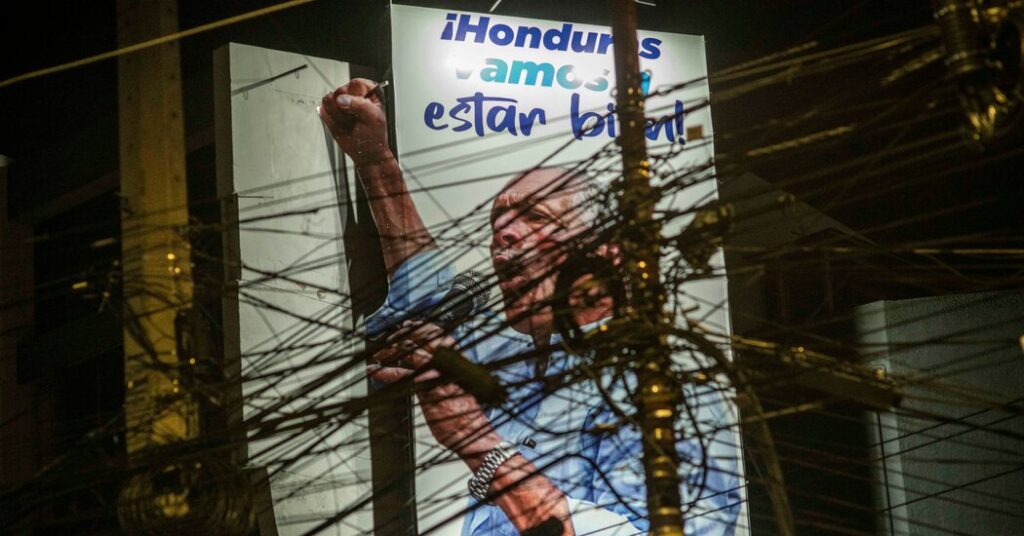
His preferred candidate, a right-wing former mayor, Nasry Asfura, 67, was in a virtual tie with Salvador Nasralla, 72, a sportscaster from another right-wing party, according to early and partial results. With 57 percent of the ballots counted by Monday afternoon, each candidate had 40 percent of the vote, with just 515 ballots separating them. The candidate from the leftist governing party trailed far behind.
“The race isn’t over,” said Ricardo Zúñiga, a native Honduran who was a top U.S. State Department official in the Americas until recently. “But I think the endorsement clearly tilted the undecideds toward Asfura.”
Many Hondurans were disillusioned with the governing left-wing party known as Libre and seeking an alternative, but were split between Mr. Asfura and Mr. Nasralla, Honduran political analysts said.
Then came Mr. Trump’s endorsement of Mr. Asfura, his criticism of Mr. Nasralla as a “borderline Communist” and his threat to pull support for Honduras if his pick lost. His comments were plastered across the news in the days ahead of the vote.
“Hondurans as a society do not want conflict with the United States,” Mr. Zúñiga said. “I think that’s a factor.”
Polls varied, but some, taken days before the election, showed large numbers of undecided voters, with Mr. Nasralla holding a lead over Mr. Asfura.
Analysts said Mr. Trump likely helped narrow that gap. “The scenario was clear: Nasralla was ahead,” said Carlos Hernández, head of the Honduran chapter of Transparency International, an anticorruption group. “It changed in the last four days. You know the reason why.”
Joaquín Mejía, a Honduran analyst, said the endorsement “awakened a dead man.”
Both Mr. Asfura and Mr. Nasralla saw the potential in a Trump endorsement. Each traveled to Washington and met with Trump-aligned Republicans. Mr. Nasralla’s wife also wore a Make American Great Again hat and his campaign featured a Tesla Cybertruck.
But for Mr. Nasralla, those efforts were for naught. In an online post, Mr. Trump called him “no friend of Freedom” and an ally of the left-wing party, who was introduced to split the vote. Mr. Nasralla ended an alliance with that party some years ago.
All three candidates had been warning of fraud and rigged results for weeks, though many of those accusations had focused on the governing left-wing party. Now, the tight race suggests the Central American nation of 10 million could be heading to a dispute over power between the two right-wing candidates.
The question then would be: Will the White House be a stabilizing force — or fan the flames?
For the past several decades, U.S. foreign policy in Latin America focused largely on promoting free trade and free elections. Washington supported election observer missions in nations across the region, and American diplomats consistently endorsed fair and transparent elections over any one candidate.
Mr. Trump has upended that approach. He has overhauled U.S. policy to try to make the United States the dominant world power in the Western Hemisphere, employing military, economic and political might to do so.
Part of the strategy has been assembling a roster of allied heads of state across Latin America, including Nayib Bukele in El Salvador, Javier Milei in Argentina and Luis Abinader in the Dominican Republic, among others. In October, the Trump administration’s $20 billion bailout of Argentina helped Mr. Milei’s party take control of the country’s Congress in midterm elections, and U.S. officials celebrated when Bolivia ended two decades of leftist rule.
Honduras was the next election on the map, and Mr. Trump did not sit on the sidelines.
On Wednesday, he gave a full-throated endorsement to Mr. Asfura, touting his résumé as mayor of the capital, Tegucigalpa, and calling him “the man who is standing up for Democracy, and fighting against Maduro,” referring to Venezuela’s authoritarian leader, Nicolás Maduro.
Mr. Zúñiga, the former State Department official, said it was highly unusual for the United States to formally pick a candidate in a foreign election. Indeed, the U.S. Embassy in Honduras had been neutral for weeks, posting only about the need for a transparent and clean vote.
“Like everything else, it wasn’t until Trump became personally involved that the policy changed dramatically,” he said. “The policy is whatever the president decides it is.”
It was unclear how Mr. Asfura was able to win Mr. Trump’s endorsement. But his National Party had succeeded in getting the U.S. president’s attention, because at the same time, Mr. Trump pardoned another party member, Mr. Hernández, the former president.
That was a double-edged sword of sorts for Mr. Asfura. The pardon reminded voters of his party’s deep ties to drug cartels that have operated across Honduras.
Opponents rushed to connect Mr. Asfura to Mr. Hernández. One comic strip showed Mr. Asfura’s would-be supporters running the other way after the Trump pardon. Mr. Asfura’s response was muted; he posted online that the pardon spelled the end of Mr. Hernández’s family’s suffering.
Known by his nicknames Tito and Papi, Mr. Asfura was Tegucigalpa’s mayor from 2014 to 2022. During the campaign, he danced with supporters in jeans and delivered fiery speeches that accused the governing party of plans to steal the election.
Mr. Nasralla presented himself to voters as the anticorruption candidate, pushing allegations that the governing party was also linked to drug traffickers, which President Xiomara Castro has denied.
But he struggled to shed his image as a political opportunist. He had served as Ms. Castro’s vice president, and then switched to a right-wing party to run for president for a fourth time.
Still, he is one of the nation’s best known faces, as a sportscaster and host of a popular cash-prize television show. The septuagenarian sought to project a youthful image on the campaign trail, wearing sports jerseys and sunglasses and strutting around with his beauty-queen wife on his arm. (She is also a congresswoman.)
In an interview shortly before the election, Mr. Nasralla projected total confidence in his victory, perhaps undergirded by a sense he had nothing to lose. “It’s now or never,” he said.
Days later, Mr. Trump intervened.
Jeff Ernst contributed reporting from Tegucigalpa, Honduras, and David C. Adams from Miami.
Jack Nicas is The Times’s Mexico City bureau chief, leading coverage of Mexico, Central America and the Caribbean.
The post In Razor-Thin Honduras Election, Trump Becomes the Wild Card appeared first on New York Times.