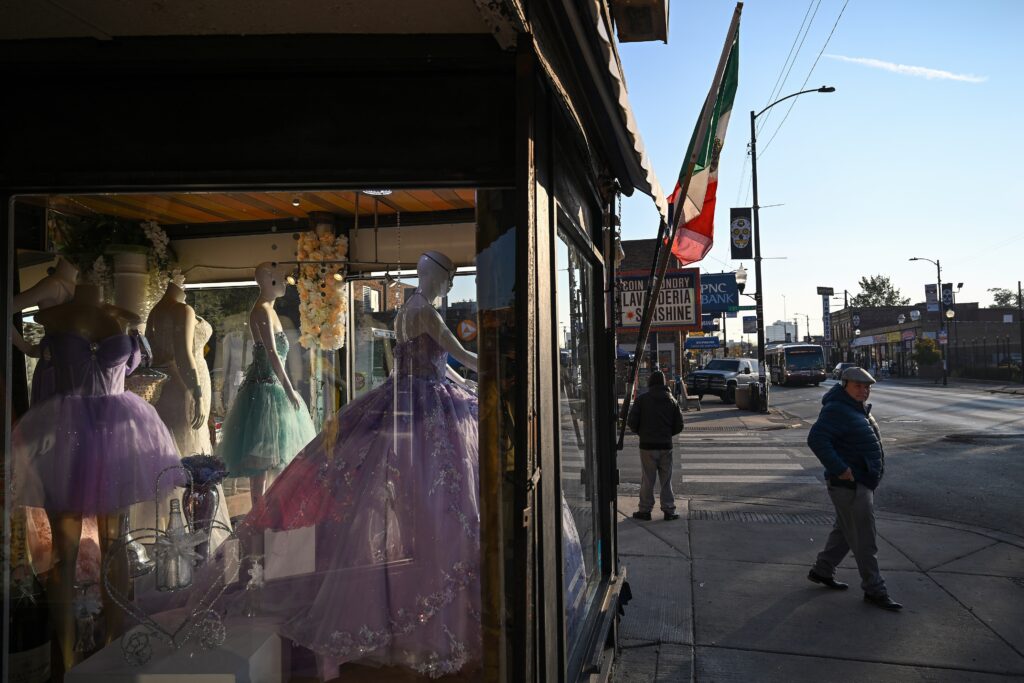
CHICAGO — When customers walk in to Taquerias Atotonilco, a fixture in the Little Village neighborhood that has been in Raul Muñoz Jr.’s family since the 1970s, he hears a common refrain: “It’s dead out there.”
The observation has echoed in Little Village and Chicago’s other predominantly Latino neighborhoods since September when the Trump administration launched “Operation Midway Blitz,” which has led to more than 3,000 arrests throughout the Chicago area and northwest Indiana, according to the Department of Homeland Security. President Donald Trump has said immigration sweeps would target the “worst of the worst,” while court documents show that few of those apprehended in raids here had criminal histories.
The business district generates more than $900 million in annual sales, according to the Little Village Chamber of Commerce. Fear of arrest has chilled activity in the neighborhood, where businesses report their sales have dropped anywhere from 20 to 70 percent. Some owners still see strong weekend sales, but there’s less foot traffic on weekdays as customers weigh the risks of going to school, work or a store. And while many of the decades-old businesses along 26th Street have been bolstered by a loyal customer base, newer stores and restaurants are more vulnerable, said Jennifer Aguilar, executive director of the Little Village Chamber of Commerce.
The effects of the Trump administration’s immigration enforcement campaigns are being felt among Latino-owned businesses across the country — a sector of primarily small businesses that contributes more than $800 billion to the economy annually, according to the U.S. Hispanic Chamber of Commerce.
“Enforcement actions have disrupted operations, caused staff to fear coming to work, and created ripple effects through local economies,” Juanita Guzman, a spokesperson for the chamber, said in a statement. Businesses are responding by cutting staffing and operating hours, she said.
In Chicago, Little Village ranks among the city’s highest tax-revenue-generating commercial districts, second only to the Magnificent Mile. On a typical Sunday, bumper-to-bumper traffic slows to a crawl, with cars filled with shoppers coming to buy homemade comfort food from street vendors, holiday decor, and special purchases like baptism gowns and quinceañera dresses. Longtime residents and new arrivals visit the neighborhood near Midway Airport to find a lawyer, get a cellphone plan or buy insurance.
Small business owners like Muñoz were already facing headwinds from tariffs, inflation and rising labor costs. Now, they say, the immigration crackdown is decimating sales in the shopping district long considered the Latino economic capital of the Midwest.
ICE appears and ‘the day is shot’
Unlike Chicago’s better-known Michigan Avenue shopping district, there are no big box stores or retail chains in “La Villita,” as it’s known to locals. Many restaurants and shops operate like it’s still the 1990s — no OpenTable platforms or e-commerce and a common preference for cash only. It’s an economy that runs on in-person patronage.
Illinois state Sen. Celina Villanueva (D), who grew up in the neighborhood and still lives there, said Little Village has weathered past economic hardships — the Great Recession, the global pandemic — and always bounced back. But the wide-ranging, and at times violent, immigration operation has crept into all aspects of life, Villanueva said. Latino residents are afraid to shop and dine public, especially when federal agents are spotted nearby.
“The day is shot after [agents] show up here. Businesses are empty because people lock in for the day and they won’t come out until the next day,” said Aguilar, who was among the Little Village Chamber of Commerce members to visit local businesses to check on owners and learn how the raids are affecting them. Aguilar said three out of every five business owners she’s spoken to said if the downturn persists through year’s end, they fear they won’t be able to pay their rent.
This time last year, Lilia Barragan had four employees at her Gente Bella Beauty Salon. Now Barragan runs the shop alone. She gets at most two appointments a day, she said. On days that there’s federal activity nearby, every appointment gets canceled. Barragan has started making jewelry to bring in extra income.
Tariffs have pushed Veronica Perez’s flower shop to sell a dozen roses for $50, and nobody’s buying, she said. Perez has tried to innovate by creating “eternal roses,” a process that preserves the color and texture of flowers at their peak, and has also turned to selling tamales.
For gift shop owners like Luz Ortiz, innovation won’t help when budget-conscious shoppers are only buying the essentials.
Since early September, Ortiz estimates sales at Regalos y Creaciones Lucy are down at least 60 percent. Normally she’d have sold most of her Día de Muertos merchandise by late October, with plenty of room to start setting up the Christmas displays. But on the penultimate day of the festival, the shop was still stuffed with tissue paper banners, wooden altars and garlands of silk marigolds.
“Muchas, muchas muchas — y ahora, nada,” Ortiz said of her customers. So many, and now nothing.
Missing neighbors
From an empty table in the dining room, Muñoz, the restaurant owner, works from his laptop with a clear view of the cash register, which he said is ringing up about one-third fewer sales on their busiest days compared to last year.
“People increasingly ask to pay over the phone — phone orders are high,” Muñoz said. “It’s more kids and teens coming in and doing the shopping. We’ve definitely noticed a difference.”
Muñoz chats with other Little Village business owners on a text thread where they share leads — who needs a catering job, who can host a group of visiting students. Now, he said, they’re also sharing immigration alerts.
Federal patrols have so far not dented the Sunday brunch and lunchtime crowds, but he said weaker sales overall — and the spike in carryout orders — have cut “drastically” into servers’ tips.
“I haven’t got to the point where I keep staff home, but it’s at the point where I have to watch how many hours I’m staffing,” he said.
José López, who owns Los Candiles restaurant down the street, keeps a small calendar in the restaurant kitchen to track tickets.
Last October, he tallied 40 to 50 tickets each weekday. This October, the daily total was usually in the 20s. The first week of the month he was counting just nine or 10 tickets — days marked on the calendar with a frowning face. The weekend rush of 100 tickets has dropped to 40 or 50, and with them, the size of the parties.
“Those big tables of six, seven, eight people? We’re lucky to see one all weekend,” López said.
Eroding revenue — and community
Teresa Córdova, director of the Great Cities Institute at the University of Illinois Chicago, said the economic hit to Little Village should concern leaders and residents citywide as a downturn affects business and sales taxes.
“Your sales tax is very important to any of your municipal budgets or even your state budgets,” Córdova said. “So it starts erode your revenue to your city.”
But business owners and customers are also worried about how the immigration arrests are pulling at the fabric of their tight-knit community.
Inside Moreno’s Liquors, residents like HVAC technician Juan Valderrama come to shop, and sometimes just visit to catch up on neighborhood happenings. Owner Miguel “Mike” Moreno Sr. discreetly passed a $20 bill to an employee one recent morning to give to a customer he knew was struggling.
“They’re amabales,” or kind, Valderrama said of Little Village’s neighbors. “They take care of you.”
Over the last few months, Valderrama has watched the men he works with disappear from jobsites, too fearful to show — or worse, be arrested, he said. His normally packed breakfast excursions at Don Pepe are now slow and sleepy. Even at Moreno’s, he said he hardly has to wait in line at the usually buzzing shop.
Valderrama and Moreno chat about the dwindling attendance at New Life Community Church since the raids began, where the normally 60- to 70-person strong Sunday service has fallen to 25 to 30 people, and the longtime street vendors who have abandoned their carts of snacks, flowers and handicrafts on 26th Street, perhaps permanently losing their livelihoods. Both are angry that Latinos are affected by Trump’s immigration crackdown and even angrier that taxpayer dollars are funding operations like Midway Blitz.
“It hurts. There’s so much pain [in La Villita],” Valderrama said, growing emotional. “All I pray for is that God give us the power to be together as one.”
The post How Trump’s ICE crackdown is impacting Chicago’s economy appeared first on Washington Post.