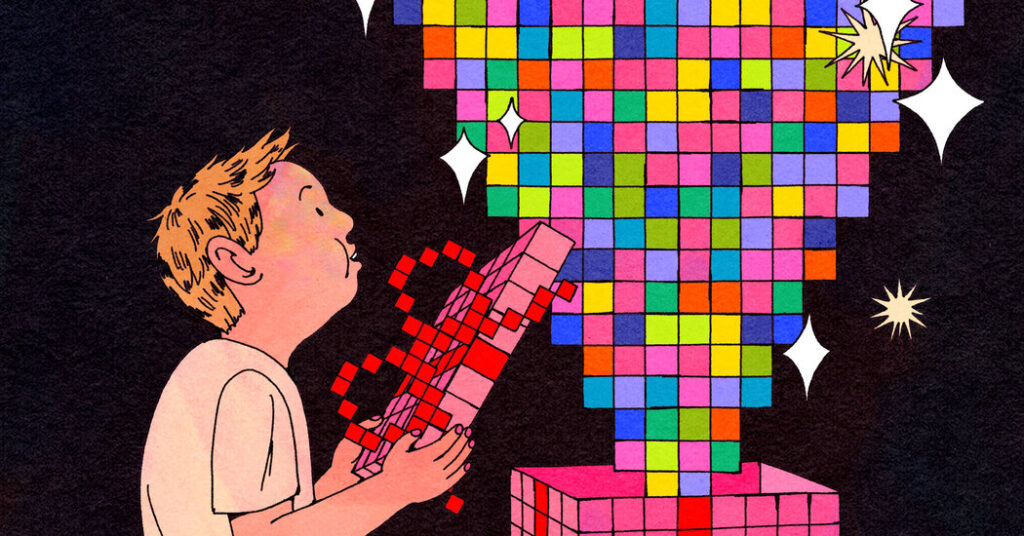
“Daddy, who is that man?” my four-year-old son, Omie, asked recently, after barging into my office.
As a single father who works mostly from home, it’s an interruption I look forward to. On video calls with colleagues who work around the world, I will sometimes put Omie on my lap and introduce him.
But this time I wasn’t on a video call. I didn’t know who he was referring to until I glanced at my screen: It was displaying an ultrarealistic avatar with animated mouth movements, part of a project to create A.I. actors with their own personalities and performance styles. Omie had assumed it was a new co-worker.
I’ve been thinking about that moment ever since. I’m a developer who has led several A.I. projects, including Google’s LaMDA, a conversational large language model that preceded Gemini. I think these technologies are important because they can ultimately help us solve some problems more quickly, allowing us to focus more of our time and energy on bigger priorities, professional and personal alike.
Yet even I have trepidations about what kind of future my son will grow up in as A.I. progresses. And I am far from alone: In a recent survey, 61 percent of parents said they worry that the increasing use of A.I. will harm students’ critical thinking skills. Will using large language models (which power tools like ChatGPT) hurt children’s development, or will not using them hinder their future employment prospects?
The future is uncertain, but by fostering critical thinking and creative flexibility in our children now, I think we can help prepare them for a future with A.I.
Someone recently asked me if I will let Omie use ChatGPT when he is old enough to operate a keyboard. As a father, I agree with the concerns that large language models tend to short-circuit a child’s thinking processes with easy, unearned answers. The instant gratification doesn’t encourage children to solve problems or take pleasure in difficult tasks. I further worry about the social effects of A.I. on them, when a child’s peers and mentors are no longer just their classmates and teachers, but also automated companions and perfectly engineered online personas.
Still, many students are already using tools like ChatGPT. Data suggests that the vast majority of university students worldwide regularly do so. It is inevitable that children like my son will be exposed to these tools and encouraged to use them in some way.
I do think I will allow my son to use ChatGPT and similar tools at some point. But when I do, I plan to show him how to fact-check the sources the A.I. has provided, and make sure he understands that computers often “learn” the wrong thing from online sources.
When it comes to Omie’s education, I’ve looked to teaching philosophies that encourage students to ask their own questions and design their own investigations. U.S. schools should encourage projects that require students to develop reasoned solutions to real world problems. Making ethical decisions and navigating situations where there’s no single, correct answer are things only humans can do.
At home, I try to help my son respond creatively to uncertainty. A lot of our play is a type of improvisation. Omie creates superheroes and villains and their powers, and I challenge them with difficult scenarios. He thwarts my summoned salt water crocodiles by throwing them raw chicken with sleeping pills inside, and blocks my ice attacks with a wall of lava. While I do not support the use of A.I. as a replacement for creativity, it can be a wonderful complement to a child’s free-form imagination. So we use generative A.I. programs to create images and theme songs to accompany our role-play adventures.
Part of my job as a tech developer is to advise institutions on A.I. ethics. These conversations often sound like bedtime negotiations with my son. What limits are fair? How much freedom is too much? What happens when the rules conflict with growth? The answers are never final, but the act of answering together matters.
Parents need to be part of these conversations and the shaping of regulation around A.I. We should call for companies to add mandatory parental controls to their A.I. programs and agents. We should ensure people have control of how A.I. uses their personal data, especially when it comes to how these models are trained.
My hope is that I am building a future for Omie in which A.I. helps create a world where we have two varieties of everything: one that is automated and easily created; the other that is painstakingly made only by humans, and is therefore cherished. I want my son and his generation to still value human-made movies and other art — while also using A.I. to help tell stories about themselves, where they are agile and inventive superheroes, overcoming future challenges we have yet to imagine.
Soulaiman “Soul” Itani is co-founder and chief technical officer of Incantor AI, and managing director for the Center of Advanced AI at Accenture. He was previously the lead developer for A.I. at Google.
The Times is committed to publishing a diversity of letters to the editor. We’d like to hear what you think about this or any of our articles. Here are some tips. And here’s our email: [email protected].
Follow the New York Times Opinion section on Facebook, Instagram, TikTok, Bluesky, WhatsApp and Threads.
The post How to Prepare Your Kids for the A.I. Revolution appeared first on New York Times.