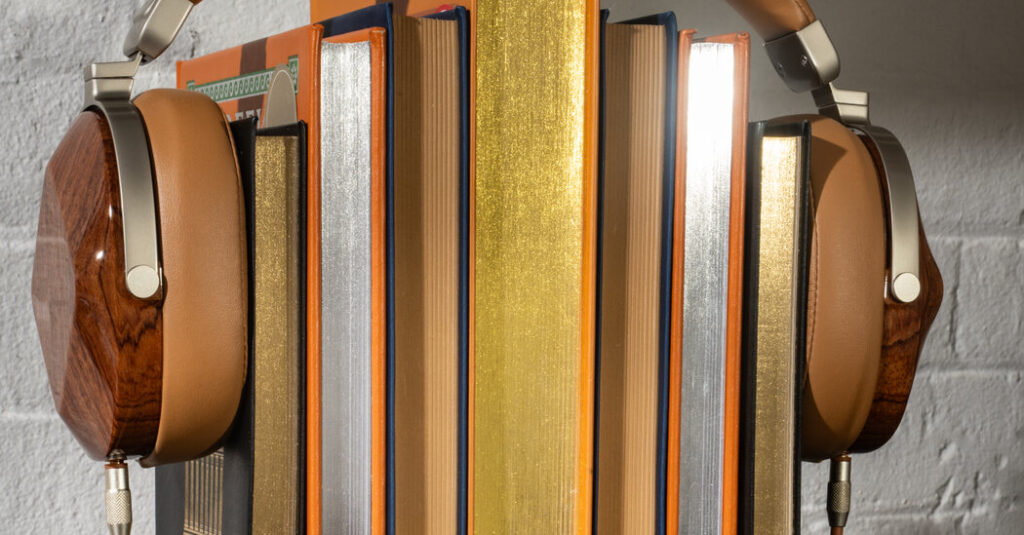
Do you listen to audiobooks? How does the experience compare to reading a print book? Do you have a preference?
Should listening to a book be considered equal to reading a physical book? Or is it an inferior substitute — and maybe even a form of cheating?
In the guest essay “Do Audiobooks Count as Reading?,” Brian Bannon, the chief librarian at the New York Public Library, writes about how he came to appreciate the value of listening to books:
As a librarian, I get a lot of questions. One I am hearing more often is: Do audiobooks qualify as reading?
Many people don’t think so. There is a pride — even a snobbishness — to being well read. Telling someone that you have only listened to a certain book usually comes out sounding like an apology. A recent NPR-Ipsos poll found that 41 percent of adults don’t believe audiobooks qualify as reading. One friend of mine, who argues with his husband over this, once memorably told me that listening to a book felt like seeing a musical in New Jersey instead of on a Broadway stage. Close, but not the real thing.
I used to feel the same way myself. A few years ago, sitting in an airport bar, I noticed a man next to me scrolling through his phone as a robotic voice read every word aloud at high speed. At first, I thought it was gibberish. Then I realized he was blind, using a feature on his iPhone that read aloud the text on his screen. Watching him — absorbed in the words, taking in their meaning — it struck me that he was reading the same way I did with my eyes.
Because I have dyslexia, reading has never come easy. After that chance encounter, I tried a similar accessibility feature on my own iPhone. It was a revelation. For the first time, I could keep up, effortlessly absorb ideas and focus in a way I hadn’t before.
My experience isn’t unusual; our definitions of reading haven’t kept up with how people actually read today.
The essay explores how traditional ideas of reading books have prevented us from recognizing the merit of audiobooks:
Part of the confusion comes from how we tend to think reading works. Learning to read with the eyes starts with decoding, linking letters to sounds and meaning. But once those pathways are built, the brain draws on the same language network to make sense of words, whether they arrive through sight or sound. A 2019 study in The Journal of Neuroscience by researchers from the University of California, Berkeley, found that the brains of people reading or listening to the same stories processed meaning in almost the same way. Focused listening lights up those networks just as print does.
Casual or distracted listening, like playing an audiobook while doing chores, doesn’t appear to engage those networks fully. But attentive listening can deliver the same comprehension as print reading — and for some, especially those with reading disabilities, attentive listening can improve comprehension and help them stay with the story.
In plenty of classrooms, students still track their progress in reading logs that note pages read but not listening time, sending the message that only print counts. We should give students credit for listening to books, too.
Youngsters who read daily for enjoyment tend to develop stronger skills and score higher in school — on average, roughly the equivalent of a year and a half ahead, according to Organization for Economic Cooperation and Development data on student performance in member countries. Some research suggests they’re also more likely to keep reading for pleasure later in life. According to last year’s survey by the National Literacy Trust of Britain, younger people who grew up with audiobooks and podcasts were already reporting a preference for listening over traditional text-only reading. And pairing print and audio has been shown to improve comprehension for some struggling readers, especially when decoding written text is a barrier.
Students, read the entire article and then tell us:
-
Do you think audiobooks count as reading? Why or why not?
-
Do you ever listen to audiobooks? How does the experience of listening compare to print reading? Do you have a preference for one method?
-
Have you ever listened to a book assigned in school? Did it make a difference in your understanding of the text? Did it feel like cheating?
-
Mr. Bannon writes that “our definitions of reading haven’t kept up with how people actually read today.” Should students be able to count audiobooks on their school reading logs? Should teachers ever assign audiobooks instead of text-only books for reading? Why might an audiobook be a more effective assignment for some students?
-
Mr. Bannon ends his essay: “However we read — by eye, by ear or both — it all counts. What matters is that the words get in, the brain makes meaning and the identity of being a reader takes hold. We need more readers, however they get there.” Do you agree? How persuasive is his argument for recognizing the value of audiobooks?
-
The essay notes a recent study that found a drop of more than 40 percent in daily reading for pleasure in the United States over the past two decades. How often do you read or listen to books for pleasure — and not for a class assignment or a parental bribe? Do you think audiobooks would help more people find joy in reading?
-
After reading the guest essay, are you more likely to listen to an audiobook in the future?
Students 13 and older in the United States and Britain, and 16 and older elsewhere, are invited to comment. All comments are moderated by the Learning Network staff, but please keep in mind that once your comment is accepted, it will be made public and may appear in print.
Find more Student Opinion questions here. Teachers, check out this guide to learn how you can incorporate these prompts into your classroom.
Jeremy Engle is an editor of The Learning Network who worked in teaching for more than 20 years before joining The Times.
The post Does Listening to an Audiobook Count as Reading? appeared first on New York Times.