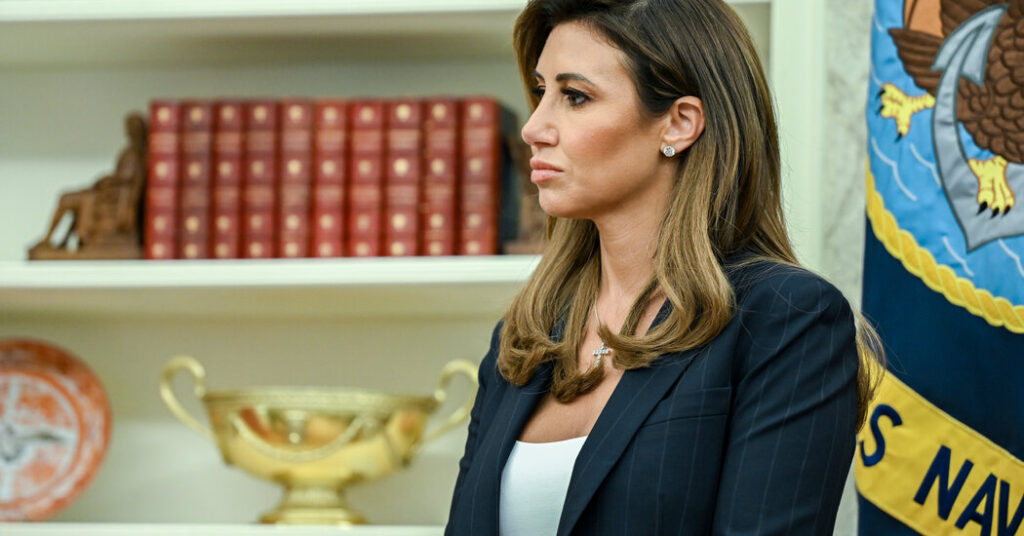
A federal appeals court said on Monday that Alina Habba had been serving unlawfully as the U.S. attorney in New Jersey, dealing a blow to the Trump administration and most likely setting up a showdown at the Supreme Court.
In its ruling, the three-judge panel, based in Philadelphia, affirmed an earlier ruling by a Federal District Court judge, shooting down each of the government’s arguments for why Ms. Habba could continue to serve.
In their opinion, the judges wrote that the Trump administration appeared to have become frustrated by the legal and political barriers that have prevented its preferred U.S. attorneys from leading federal prosecutors’ offices. They added that the maneuvers undertaken to keep Ms. Habba in charge exemplified the difficulties it had faced.
“Yet the citizens of New Jersey and the loyal employees in the U.S. attorney’s office deserve some clarity and stability,” the judges wrote.
Ms. Habba is one of a number of U.S. attorneys whom the Trump administration has kept in power even though she was neither confirmed by the Senate nor appointed by district trial court judges — the two traditional pathways.
The challenge to Ms. Habba’s authority may be the first to reach the Supreme Court, though a similar case involving the U.S. attorney in Virginia, Lindsey Halligan, may be expedited by virtue of being entangled with criminal cases against President Trump’s enemies.
Last week, a federal judge found that Ms. Halligan, too, had been unlawfully appointed by the Trump administration, but the Justice Department has vowed to appeal.
The Justice Department did not immediately respond to a request for comment.
Ms. Habba, 41, had represented Mr. Trump in several civil cases and played a public role in his 2024 presidential campaign. But she had no experience in criminal law before the president named her in March to a 120-day interim term as New Jersey’s top federal prosecutor. Mr. Trump nominated her to take on the role permanently, but her appointment was doomed by opposition from the state’s two Democratic senators, Cory Booker and Andy Kim.
In July, judges in the District of New Jersey declined to extend Ms. Habba’s term and instead tapped a veteran prosecutor, Desiree L. Grace, to lead the office. That led Attorney General Pam Bondi to disparage the judges, fire Ms. Grace and elevate Ms. Habba to the role of acting U.S. attorney through a complicated series of maneuvers that were at the heart of the appeal.
The decision on Monday affirms a ruling by Matthew W. Brann, the chief judge for the Middle District of Pennsylvania, who concluded in August that Ms. Habba had been serving as New Jersey’s U.S. attorney without legal authority since July 1.
The state’s federal courts have since been operating in limbo. The confusion has now extended for nearly four months and has slowed certain types of criminal cases and halted some grand jury proceedings.
Lawyers with the Department of Justice, which had appealed Judge Brann’s decision to the Court of Appeals for the Third Circuit, had argued that the president’s power was broad and gave the executive branch “substantial authority to decide who is executing the criminal laws of the United States.”
Lawyers for Cesar Humberto Pina, a defendant indicted in New Jersey on fraud charges on July 10, had countered that Ms. Habba’s installation as the state’s top prosecutor violated a law known as the Federal Vacancies Reform Act.
The lawyers, Abbe D. Lowell and Gerald Krovatin, said in court papers that Mr. Trump had “pursued a shell game to keep her in power.”
“Relying on a chimera of at least seven different statutes, the government has, at various times, described Ms. Habba as ‘interim U.S. attorney,’ ‘acting U.S. attorney,’ ‘first assistant U.S. attorney’ and ‘special attorney,’” they wrote. “But she does not have the authority to lead the U.S. attorney’s office for the District of New Jersey under any of those titles.”
Devlin Barrett contributed reporting.
Jonah E. Bromwich covers criminal justice in the New York region for The Times. He is focused on political influence and its effect on the rule of law in the area’s federal and state courts.
The post Appeals Court Says Alina Habba Is Unlawful U.S. Attorney appeared first on New York Times.