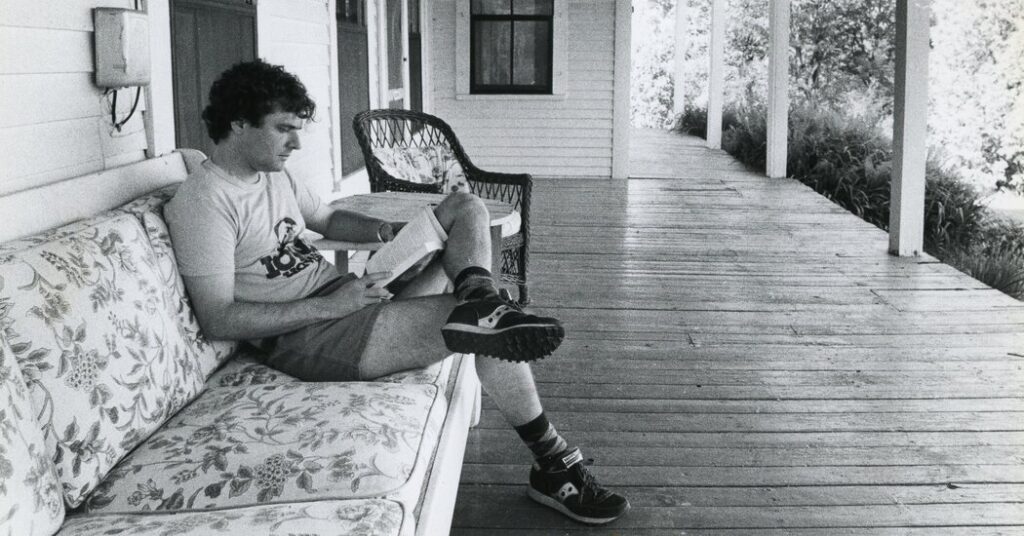
FLAGRANT, SELF-DESTRUCTIVE GESTURES: A Biography of Denis Johnson, by Ted Geltner
When Denis Johnson told his parents he wanted to be a writer, they supported the idea. His father, a diplomat who’d taken his family to live in Tokyo and Manila, was an acquaintance of the poet Stanley Plumly. He asked Plumly what Denis should do. Plumly replied: “He should get himself to the Writer’s Workshop in Iowa City, indubitably.”
Johnson arrived at the University of Iowa as an undergraduate in the fall of 1967. By the time he left Iowa City, more than seven years later, he was both a legend and a cautionary tale. Everyone understood, almost on contact, that he was best writer of his era there. Before long he was selling remarkable poems and stories to important publications.
It didn’t hurt his reputation that, as one classmate remembers in “Flagrant, Self-Destructive Gestures,” Ted Geltner’s new biography of Johnson, that “he had long hair, and he looked like Dennis Wilson of the Beach Boys. He was this golden god kind of guy.”
Johnson’s literary bible, his vade mecum, was Leonard Gardner’s novel “Fat City,” which he read repeatedly. What attracted Johnson to “Fat City,” a novel about second-rate boxers, was its spareness and grit and the resonance of its despair. Gardner captured lives at the margins. Johnson studied “Fat City” while drifting into increasingly marginal places himself.
He was a born nonconformist and the kind of person, Geltner writes, whose life “was touched by experiences that went way beyond those of ordinary people.” At Iowa he became an alcoholic and a heroin addict. He sometime dealt heroin, too — unsuccessfully. He wasn’t threatening enough to compel anyone to pay up. Also, he was too wasted to try very hard.
He mostly stopped going to classes. He lived in welfare housing and sold his plasma to get by. He got into bar fights and spent time in jail. He sometimes stole from friends for drug money. He married while still in his teens and became a father. During the birth, he was too drunk to be admitted into the delivery room. People would see him dragging his clothes around in a bag.
More comically, he would give wrong information to any visitor or student who asked for directions. No matter what the question, he’d respond: “You go seven blocks, make a left, you can’t miss the sign.” Still, everyone wondered: Genius or casualty?
Johnson spent much of his time in Iowa City in a dive bar called the Vine, the misfit lives of whose regulars he would absorb and intricately and electrically elaborate upon in “Jesus’ Son” (1992), a short story collection that would appear two decades later, long after he’d gotten sober.
“Jesus’ Son” — the title comes from a Velvet Underground song — detonated across American letters and has never really stopped detonating. By now we know what people mean when they say that something feels or sounds “like a Denis Johnson story.” There will be hard times and bad luck and bleak surroundings and beautiful losers, nursing chronic hurts, with a narrow shot at redemption.
As his would-be imitators would discover, there was also something extra, something you can’t pick up at a writer’s workshop. “Collect and squirrel away in your soul certain odd moments when the Mystery winks at you,” Johnson once advised. His stories were pinned together by such moments, of the sort not everyone can A) recognize or B) wrestle onto the page.
Johnson (1949-2017) published novels, books of stories, collections of poetry and assemblages of reportage. He won the National Book Award in 2007 for “Tree of Smoke,” a big, branching novel that’s in part about a C.I.A. operative during the Vietnam War. But “Jesus’ Son” — he hated it when people added an “s” after the apostrophe — is his greatest claim on posterity.
Geltner’s biography, the first to be written of Johnson, is a mixed bag. It lacks the confidence, fluidity and insight of his previous book, “Blood, Bone and Marrow” (2016), a biography of Harry Crews. There is something tentative here. A certain amount of critical texture is absent. But he captures Johnson’s lonely intelligence and gets the story told. It’s hardly uninteresting.
Geltner pays attention to the working artist — a cynic might use the word “careerist” — behind Johnson’s seemingly wayward path through the world. “You’re only hanging out with us so you can write about us later, aren’t you?” one regular at the Vine asked. And indeed, Johnson had a book deal in his pocket.
Later, when he was teaching writing in Arizona’s Florence State Prison, an inmate asked, “I wonder, did you take the job here in order to learn about prison?” Johnson was soaking up material he would use in his 1983 novel “Angels.”
Johnson seemed to know he was special. (He bragged to a girlfriend that his I.Q. was 162.) He had a sense of vocation. “To write a short story you have to be able to stay up all night,” Lorrie Moore wrote, and Johnson could. There is a sense, in this biography, of him tending his own flame while attempting to urinate upon it at the same time.
He married three times. He cheated, especially after he got famous. “He had a million affairs, because who doesn’t want to have an affair with a famous poet author,” said his second wife, the sculptor and painter Lucinda Johnson. He began to attend Sexaholics Anonymous meetings alongside his Alcoholics Anonymous sessions. He was gentle when he wasn’t manic, but when he was manic, he could be abusive.
His circumstances grew more comfortable after he began to get work in Hollywood writing screenplays. Most of these, such as his script for “Barbarians at the Gate,” Bryan Burrough’s and John Helyar’s 1989 best seller about the fall of RJR Nabisco, went unproduced.
He also became a seasoned war correspondent, reporting from Nicaragua, Mogadishu and elsewhere for Esquire and other magazines. Being in danger zones scratched an itch; it was heroin of a different sort. He was again throwing himself in the way of experience. The emotional content of these experiences was pliant to his demands.
People tended to like Johnson, the unmown grass of his character. He was “twinkly and foxlike,” in the words of Tess Gallagher, who knew him at Iowa. He was exuberant. When he made his first money as a writer, he bought a used sports car (a Datsun 240Z), painted it bright orange and had Lucinda write the words “MANIAC DRIFTER” on the side.
Later in life, when he lived on 40 acres in northern Idaho, he threw a sprawling annual party called the “Week of Chaos.” He liked bars even after he stopped drinking. He cried easily.
“Nothing bad can happen to a writer,” Philip Roth said. “Everything is material.” Yet Johnson’s drug years, all those shared needles, caught up with him. A long undiagnosed case of hepatitis C led to liver cancer. He died at 67.
Johnson was uncompromising about his writing. When The New Yorker bought some of the stories that would later appear in “Jesus’ Son,” editors asked him to cut the last line of one of the best, “Car Crash While Hitchhiking.” They pointed out that while the story is related in the first person, the final line is inexplicably in the second.
Johnson refused to cut it, and the story ran elsewhere. The uncut line became one of the best-known sentences he wrote: “And you, you ridiculous people, you expect me to help you.”
FLAGRANT, SELF-DESTRUCTIVE GESTURES: A Biography of Denis Johnson | By Ted Geltner | University of Iowa Press | 345 pp. | Paperback, $22.50
Dwight Garner has been a book critic for The Times since 2008, and before that was an editor at the Book Review for a decade.
The post A Writer Who Dazzled on the Page but Lived for the Margins appeared first on New York Times.