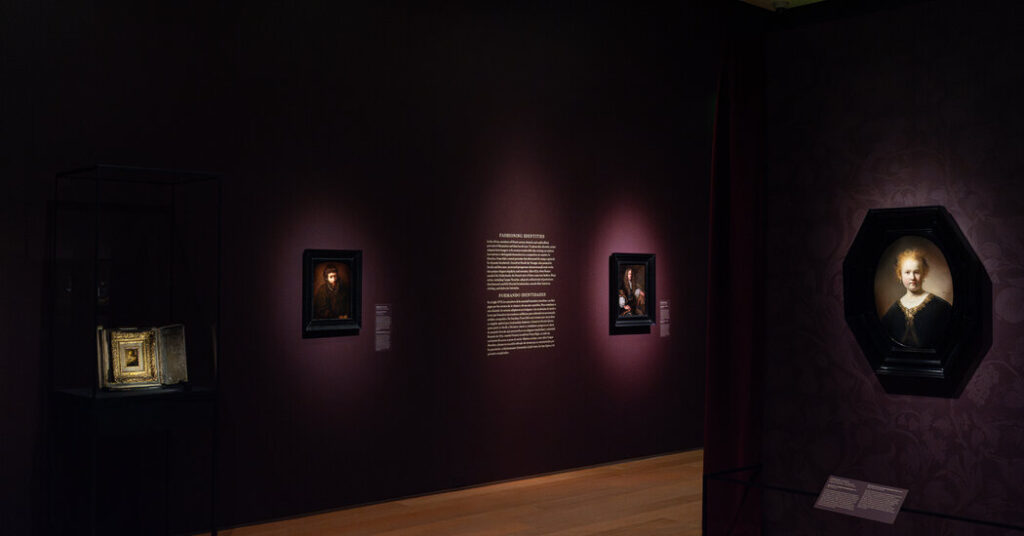
The lighting is regally dim, the huge gallery shadowy.
Small ceiling spotlights set the faces in the paintings aglow. The fine wrinkles, the whiskers and the granular stitching in the gowns and jackets are framed and highlighted by broad, dark brush strokes, the hallmark of artists in the Netherlands in the 1600s.
The illuminated faces are the stars of “Rembrandt’s Time: Masterpieces from the Leiden Collection,” a show of 76 Dutch old masters paintings on display for the first time in the United States at the Norton Museum of Art.
It is a breathtaking exhibition: 17 Rembrandts, the largest number owned by a single collector and more Rembrandts than those owned by all but a handful of the world’s finest art museums; the only one of Vermeer’s perhaps three dozen paintings in private hands; and 58 other pieces by Rembrandt’s contemporaries.
The rare, striking display of treasures is drawing crowds for limited, two-hour visits. It is a show ready for art fans from around the world coming to Miami for the 23rd anniversary of Art Basel Miami Beach, the international fair of mostly modern art that runs from Friday to Sunday. The Norton exhibition will run through March 29.
The museum, which has an airy restaurant overlooking a neat tropical garden, is an hour-and-a-half drive north of Miami. The Brightline train from downtown Miami to West Palm Beach station makes the trip in about the same time for as little as $19.
Ellie Hart and Elissa Baum, neighbors who were visiting the museum from just south of Palm Beach, were feeling the power of the exhibition as they walked outside. “Spectacular,” Hart said. “Just spectacular.”
“His use of light and the fine detail; all the individual hairs, all the wrinkles,” Hart added. “And you think, this was 400 years ago.”
The paintings are highlights from the 220-piece Leiden Collection of the American billionaire investor Thomas S. Kaplan and his wife, Daphne Recanati Kaplan. Since their first purchase in 2003, the Kaplans have built one of the biggest private collections of Dutch old masters in the world.
Art scholars say the paintings now at the Norton are worth hundreds of millions of dollars. Ben Hall, who once led the old masters department at Christie’s in London and now has his own gallery in New York, said the whole Leiden Collection, which is named after the Dutch town where Rembrandt was born and started painting, was easily worth “in excess of a billion dollars.”
The exhibition might very well have been held at the Metropolitan Museum in New York or the National Gallery in Washington, or at some other place with a global reputation. It happened in West Palm Beach almost by chance.
Daisy Soros, the widow of Paul Soros, the older brother of the investor George Soros, has a house in Palm Beach. She is a friend of Ghislain d’Humieres, the chief executive and director of the Norton. She introduced him to Kaplan. D’Humieres asked if he could show one of Kaplan’s pieces, Kaplan recalled in a talk at the Norton on the day the exhibition opened. D’Humieres kept that piece on display for two years. Then he asked for something bigger: the highlights of the Leiden Collection. Kaplan said yes.
Kaplan became fascinated by Rembrandt as a small boy when his mother took him regularly to the Met. He traveled around Europe seeking out Rembrandts while he was in prep school in Switzerland and later as he studied history at Oxford University in England, earning a Ph.D. In 2002, his mother-in-law suggested that he and his wife begin collecting art. The next spring, the Kaplans jumped in, buying about a painting a week for the first few years.
For more than a decade, the collection did not have a formal name. It privately lent a painting or two, sometimes a handful of pieces, to museums around the world. Then the Kaplans decided to adopt the name Leiden, in honor of Rembrandt’s birthplace. They started showing big chunks of their art around the world.
In 2017 the Kaplans, who live in New York and Paris, opened their first Leiden Collection event, an exhibition with more than 30 pieces at the Louvre in Paris. They went on to present shows in museums in Russia, China and other countries. They finally brought their art home to the United States for the first time with the opening of the Norton show on Oct. 25.
Kaplan was born in New York City and lived on the Upper West Side as a child. When he was 8, he and his parents moved to South Florida and lived in Pompano, about 35 miles north of Miami, and for a time in Fort Lauderdale.
The shift from New York was “a culture shock,” Kaplan said in an interview. But within a few weeks he was enjoying himself in the fields and woods, collecting snakes and turtles, hoping to see an endangered Florida panther. One day, riding home on a public bus, he saw a grayish brown panther standing on a sand dune. The next day he went back to the dune with plaster of Paris and copied the paw prints of the cat. He never saw another Florida panther. But he was enthralled by big cats.
Years later, he and Alan Rabinowitz, a zoologist, created Panthera, a foundation to protect endangered lions, tigers and other big cats around the world. To help finance Panthera, Kaplan is planning to auction off one of his Rembrandt drawings, “Young Lion Resting,” in February in New York. Sotheby’s estimates it will sell for $15 million to $20 million; Kaplan thinks it will go higher. “It’s a jewel,” he said.
The exhibition at the Norton opens with two modest-size paintings. One is a dark image of a young painter seated with a large wooden easel, his face catching some of the soft light, a fighter’s helmet and other props spilling out of a big trunk. The painting is attributed to Gerard Dou, one of Rembrandt’s star students.
The other painting is a commanding self-portrait of a young Jan Lievens, a friend and colleague of Rembrandt’s. Light pours over his long, dark hair, his eyes fixed in a determined, steady gaze, darkness wrapping around him.
Farther down the hall is a self-portrait of Rembrandt in a dark beret. At the center of the hall, agleam in the scarce light, is one of the most prized Rembrandt pieces in the exhibition: “Minerva in Her Study” (1635), a painting of the Olympian goddess of war and peace.
The sole Vermeer in the exhibition, “Young Woman Seated at a Virginal” (ca. 1670-75), is a small piece showing a woman at a keyboard, soft, clear light washing over her from a high window. The painting stands alone in the exhibition on a slab of a wall, isolated in recognition from the other works. And in a nearby piece by Lievens, “Card Players” (ca. 1625), a splash of light captures Rembrandt and other players.
The show is already proving popular. “I didn’t have much awareness for this kind of art,” said Jocelyne Wolf, visiting from the nearby town of Coral Springs.
“The paintings were intricate and interesting,” she said. “They depicted daily life, everyday life. The light and dark in the paintings really pops.”
The post A Rare Collection of Dutch Old Masters Gets Its First U.S. Outing appeared first on New York Times.