SALISBURY, Md. — It was a little over an hour into the city council meeting when tensions finally boiled over.
Randy Taylor, the mayor of this community of about 33,000 on Maryland’s Eastern Shore, had had enough.
“Stop it with all the criticisms. I’m on your team,” Taylor said, whacking the table in front of him as he glared at the council members. “I’ve been here my whole life and I’m sick of it. You guys piling up on me like you’re superior. I don’t get it. Like I’m this bigot and racist or whatever. I’m sick of it. I’m not that person.”
Council member Michele Gregory fired back moments later: “Mr. Mayor, if you don’t want to be called a bigot, don’t do bigoted things.”
The dustup last month had its roots in a number of contentious issues, including disagreements over approaches to affordable housing and handicapped access. But it was a decision Taylor made earlier this year and set in motion three days before the meeting that ignited the exchange.
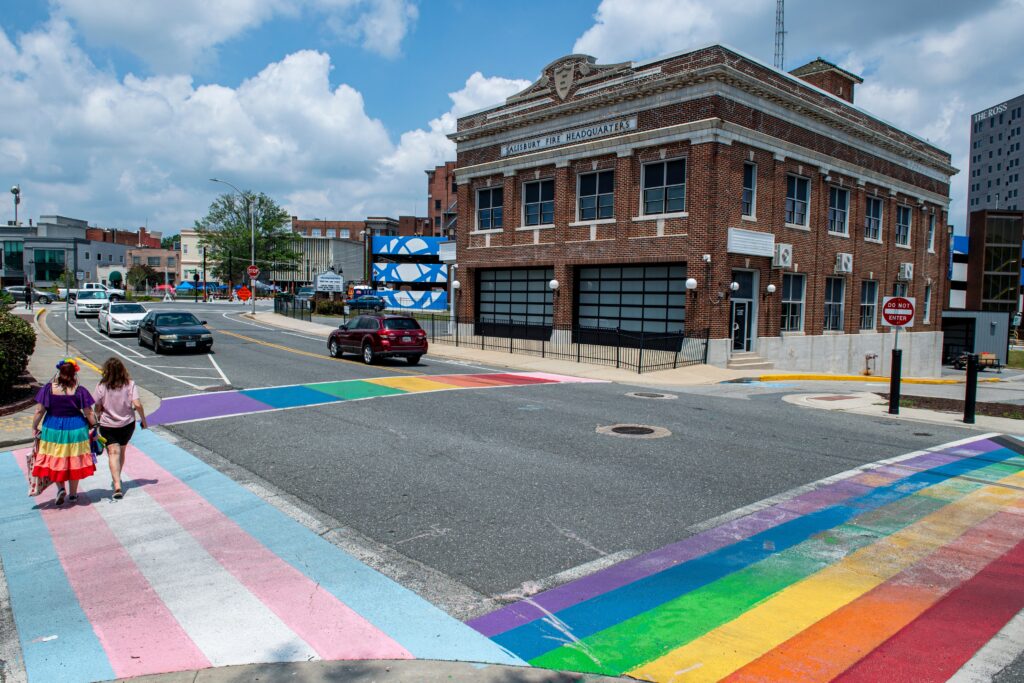
In May, Taylor said Salisbury would remove its only rainbow crosswalks from a downtown intersection. Painted to reflect LGBTQ+ inclusion in 2018, they were the first of their kind in Maryland.
“Our City is home to a diverse and vibrant community, and we want our public spaces to be welcoming to all,” Taylor, who was elected in 2023, said in a statement announcing the decision. The city had a responsibility, he continued, “to ensure that government property remains neutral and does not promote any particular movement or cause.”
Members of the local LGBTQ+ community and their supporters were incensed by Taylor’s announcement. They saw it as an effort to roll back hard-won efforts to make the city more inclusive and safe. And they didn’t understand how the Pride symbols would make any residents feel unwelcome in the town.
“You don’t make things equal and fair by taking away from the underrepresented community, especially the youth,” said Lisa Taylor, board president of Shore Pride Alliance, formerly the Salisbury chapter of PFLAG, a national LGBTQ+ rights and advocacy organization.
The order arrived as similar efforts were unfolding across the country. States, counties and towns have been pushing to ban rainbow flags or other LGBTQ+ symbols from public buildings, schools and workplaces. The federal government has also taken steps to remove LGBTQ+ symbols and bar rainbow flags from federal property.
In a July 1 letter, Transportation Secretary Sean P. Duffy ordered states to study crosswalks at intersections as part of his “Safe Roads” initiative. Duffy said “non-standard” colors don’t belong on streets.
“Roads are for safety, not political messages or artwork,” he said in a statement announcing the initiative.
Faced with vocal opposition, Taylor held off on implementing the crosswalk removal. As the months passed it seemed possible to many here that they would remain untouched. But on Nov. 7, the mayor issued a new statement announcing the work would go forward.
“Repainting the crosswalks with a neutral design will ensure compliance with both Federal guidelines and our commitment to maintaining neutrality in public spaces,” he wrote.
A little before 8 a.m. on Nov. 11, the morning after the contentious council meeting, road crews began milling the crosswalks. By 10 a.m. they were gone.
More than 60 volunteers took part in painting the original crosswalk in 2018. Organizers took pride in leading the way in Maryland and volunteers repainted the crosswalks each year at their own expense.
Their removal has stung Salisbury’s LGBTQ+ community.
Jonathan Franklin, 23, was a community college student in Salisbury when he first helped with the annual repainting of the crosswalk in 2023. “It was something we wanted to keep up and running as a symbol of the community,” he said. “As a young adult in my early 20s, I know it’s kind of stupid to say, but it really made the community feel safer. It communicated that LGBTQ people are part of the fabric of Salisbury and that our presence matters.”
Its removal, Franklin said, has sent an unambiguous message: “It reflects something that they’re trying to do on a larger scale, trying to remove LGBTQ visibility.”
Nicole Hollywood, a Shore Pride Alliance board member who works at the nearby University of Maryland at Eastern Shore, said that research shows that pride symbols help LGBTQ people feel less marginalized and reduce feelings of isolation and suicidal behaviors. It’s one of the reasons her group supported the rainbow crosswalks.
“The intent has never been to make a political statement or to be divisive, but rather to serve as a potent celebration of diversity,” said Hollywood, who also serves on the Maryland Commission on LGBTQIA+ Affairs.
Alfred Brewer was born and raised in Salisbury and moved back here a few years ago with his husband to open a hair salon. He said the removal of the crosswalks has him considering leaving Salisbury.
“My ultimate reaction to knowing that it’s gone is that I’m very tempted to pack my business up and move it,” Brewer, 36, said.
Gregory, the city council member, said she confronted Taylor at the meeting because she felt the people she represents were being disrespected.
“With this whole situation, I’m just not going to filter myself anymore. I have filtered myself for long enough out of deference to others and I have found that that is not working for us,” she said in an interview. “So if we need somebody to match energies with him, I am perfectly able and willing to do it.”
Taylor did not respond to requests for an interview.
The effort to remove the rainbow symbols from Salisbury’s public space did not happen in a vacuum. It mirrors recent actions taken elsewhere across the country as states, counties and towns have pushed to ban rainbow flags or other LGBTQ symbols from public buildings, schools and workplaces.
In March, Utah became the first state to effectively ban Pride flags in public buildings and schools. Violators could face a $500 a day fine.
Montana soon followed, passing a bill in May banning flags from public buildings that “represent a political party, race, sexual orientation, gender or political ideology.” A similar law went into effect in Idaho at the beginning of July. Legislation that would curb displays of LGBTQ+ identity in public buildings is under consideration in other states including Florida, Texas, Arizona, Wisconsin and Alabama.
In September, Florida painted over a rainbow crosswalk in Orlando that had originally been installed to show solidarity with the city’s LGBTQ+ community and honor the 49 people killed in a mass shooting at the Pulse nightclub there in 2016. The state took the action in response to directives from Gov. Ron DeSantis (R) and President Donald Trump to wipe crosswalks and sidewalks considered to have “social, political or ideological messages.” Orlando Mayor Buddy Dyer (D) called it a “cruel political act.”
A number of states already have what critics call “don’t say gay” laws, which prohibit classroom discussion of sexual orientation or gender identity below a certain grade level. The ACLU is currently tracking 616 bills across the country that the organization says will harm LGBTQ+ people if enacted. That’s up from 533 a year ago and 510 in 2023.
New restrictions have been enacted at the federal level as well. On his first day in office, Trump signed executive orders to end diversity, equity and inclusion programs, calling them “illegal and immoral.” Federal agencies including State, Education and Veterans Affairs announced policies allowing only American flags to be displayed with few exceptions.
In its first week, the administration also halted transgender people’s passport applications, transferred incarcerated trans women to solitary confinement and moved to bar transgender troops from serving in the military. In November, a veteran FBI employee filed a lawsuit in federal court alleging he was fired for displaying a rainbow Pride flag at his workstation.
Removing flags or displays supporting LGBTQ+ rights “tells people in the LGBTQ+ community specifically that they aren’t safe, they aren’t welcome and they should go back into hiding or disappear altogether,” said Brandon Wolf, press secretary for the Human Rights Campaign, the nation’s largest LGBTQ+ advocacy group.
Wolf said the combined attempts at the federal, state and local level to push back against displaying Pride symbols and signs is having a chilling effect. “LGBTQ+ people across the country are scared,” he said. “They’re afraid of what the future holds.”
It wasn’t that long ago that Salisbury was seen as a solidly progressive city, especially for Maryland’s deep red Eastern Shore, which is represented in Congress by Rep. Andy Harris (R), a Trump supporter and chair of the House of Representative’s far-right Freedom Caucus.
Jim Ireton, who is openly gay, served two terms as mayor beginning in 2009. And in 2019, then-Mayor Jake Day personally raised the LGBTQ+ pride flag on a city flagpole to honor Pride Month.
A conservative, Taylor is a bit of an outlier in Salisbury. He won the 2023 mayoral race by 50 votes when two more liberal-leaning candidates split their votes.
The Salisbury Pride Parade last summer was both a celebration and, for many who took part, an act of defiance against Taylor, who they felt wanted to undo the progress they had made.
Gay couples marched with their children waving American and rainbow flags. Drag queens in the back of a pickup truck blew bubbles and threw candy to the crowd. Several thousand people lined the short parade route down Main Street cheering on participants as a sound system blared “I Got a Feeling” by the Black Eyed Peas and KC and the Sunshine Band’s “That’s the Way (I Like It).”
Taylor’s decision to remove the symbols of LGBTQ+ pride felt like a U-turn for many who live here.
When he got rid of the rainbows that had brought many LGBTQ+ residents of Salisbury a sense of belonging and safety, they had to consider what the future held for them in the city.
Suzanna Mallow, 66, has lived in Salisbury since 1977. She was saddened that the crosswalks were removed. Angry, too. A gay woman who teaches at Salisbury University, Mallow said it made her wonder if the city was still the right place for her.
Maybe it wasn’t.
After giving it a lot of thought, she plans to stay.
“I want to make stands for things in this community because I love this community and I love the people here,” Mallow said. “And I can feel part of this.”
For Christmas, she will decorate the trees in her yard with lights. And rainbows.
The post A Maryland mayor removes rainbow crosswalks, citing neutrality concerns appeared first on Washington Post.