Welcome to the Book Review Book Club! Every month, we select a book to discuss with our readers. Last month, we read “Hamnet,” by Maggie O’Farrell. (You can also go back and listen to our episodes on “The Buffalo Hunter Hunter,” “Pride and Prejudice” and “Wild Dark Shore.”)
Books are funny things. They’re seemingly static documents, yet often they take on lives of their own, growing and evolving with time. They’re written by an author but their longevity and impact are determined by readers who consume, love, reject, remember, forget, idolize and/or challenge a work, with a book’s influence often shifting from generation to generation. Great books live in history, but neither the immortalized works nor their authors get the final say on how.
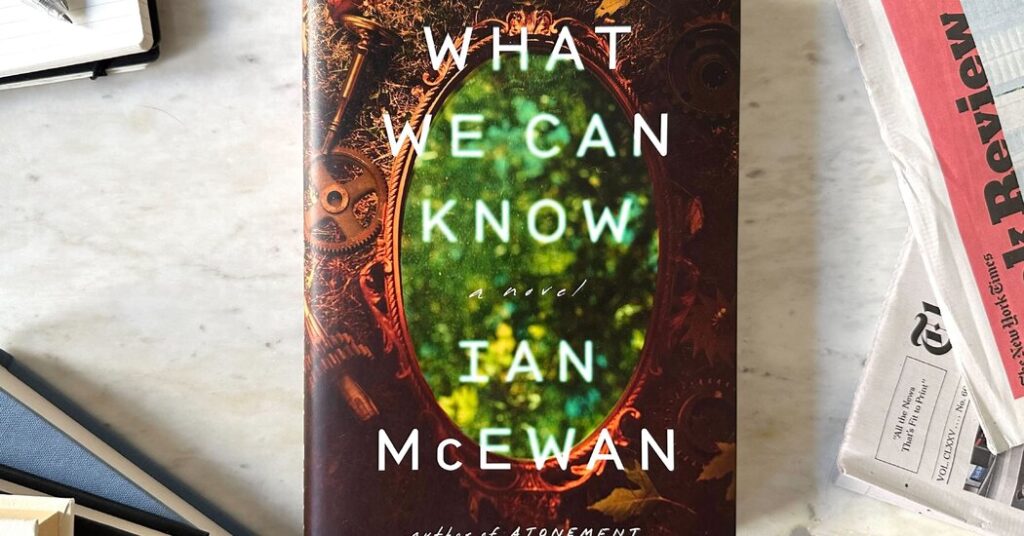
That conundrum is at the heart of Ian McEwan’s new novel, “What We Can Know.”
The novel is split between two timelines. We open a century in the future, in 2119. The world has been remade by a devastating climate crisis and wars over dwindling resources. In this dystopia, two scholars, Tom and Rose, research a lost poem, “A Corona for Vivien,” by the writer Francis Blundy. It’s a tricky poem: It has been adopted as an environmental rallying cry for the ages, but nobody has ever read the exact text of the verses, which have been lost to time. Then Tom stumbles on a clue that may help him find the poem at long last, but the journey to it is treacherous and its discovery could change both Tom’s life and the life of the poem forever.
The other half of the book is set in the early 2000s, culminating in a 2014 dinner party hosted by Francis and his wife, Vivien. It’s for this occasion that Francis has written his soon-to-be iconic poem, but behind the corona itself are secrets, hidden histories and private ambitions that shape not only Francis but everyone at the party.
Our writer at large, Sarah Lyall, described the book best: “The novel is an enticing literary mystery, but it’s about much more besides: intellectual reputation, academia, love, the secrets and lies in marriage, climate change, the ultimate unknowability of the past and — perhaps most poignantly — how we in our turbulent present will be judged by generations to come.”
In December, the Book Review Book Club will read and discuss “What We Can Know,” by Ian McEwan. We’ll be chatting about it on the Book Review podcast that airs on Dec. 26 and we’d love for you to join the conversation. Share your thoughts about the novel in the comments section of this article by Dec. 18, and we may mention your observations in the episode.
Here’s some related reading to get you started.
-
Our review of “What We Can Know”: “Ian McEwan’s new novel, ‘What We Can Know,’ is brash and busy — it comes at you like a bowling ball headed for a twisting strike. It’s a piece of late-career showmanship (McEwan is 77) from an old master. It gave me so much pleasure I sometimes felt like laughing.” Read the full review here.
-
Our 2025 profile of Ian McEwan: “You often hear, you know, ‘history will be my judge,’” McEwan said. “But history will just have its own obsessions, prejudices and amnesia.” Read the full profile here.
-
Our 2002 review of Ian McEwan’s novel “Atonement” (which was recently named one of The New York Times’s Best Books of the 21st Century): “Ian McEwan’s remarkable new novel ‘Atonement’ is a love story, a war story and a story about the destructive powers of the imagination. It is also a novel that takes all of the author’s perennial themes — dealing with the hazards of innocence, the hold of time past over time present and the intrusion of evil into ordinary lives — and orchestrates them into a symphonic work that is every bit as affecting as it is gripping. It is, in short, a tour de force.” Read the full review here.
We can’t wait to discuss this novel with you. In the meantime, happy reading!
The post Book Club: Read ‘What We Can Know,’ by Ian McEwan, With the Book Review appeared first on New York Times.