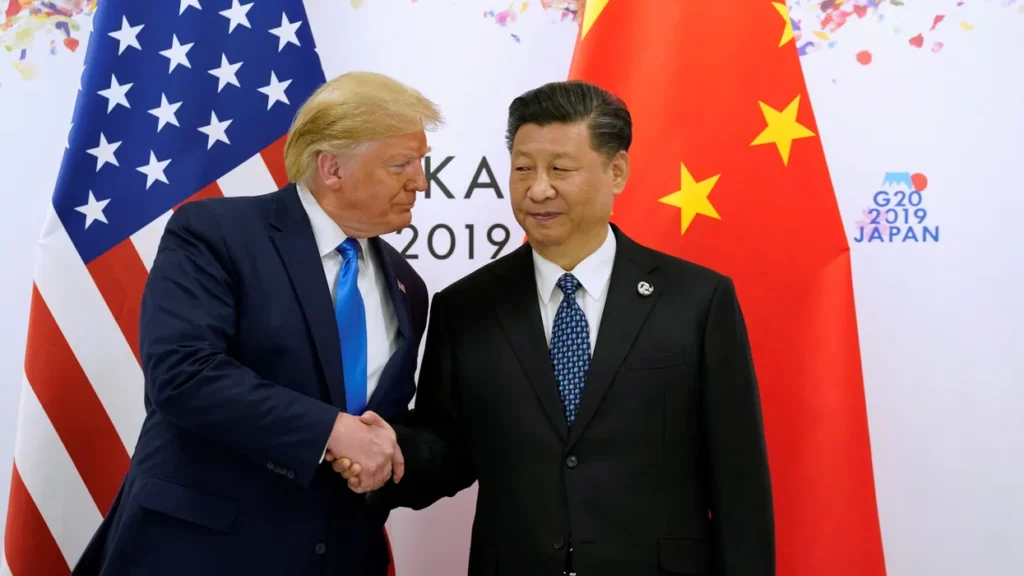
Foreign Affairs writer Jonathan A. Czin writes that Chinese leader Xi Jinping has played President Donald Trump and is now reaping the rewards.
Although “Trump promised to unleash an economic fusillade on China after his return to the presidency, Beijing has enjoyed a remarkably strong year of diplomacy,” Czin writes.
Trump escalated the trade war with China, imposing broad tariffs that were met with swift retaliation from Beijing. Negotiations in November resulted in a temporary truce, including some tariff reductions, but the overall trade conflict continues.
China, Czin notes, has not yielded in the face of Trump’s threats. In fact, they have seemingly benefited from them instead.
“After spending much of the year simply reacting to U.S. policies, Beijing went on the offensive, imposing an expansive export control regime on the supply chains for rare-earth elements just weeks before the meeting with Trump,” he writes.
“And although the Trump administration has exhorted Beijing to make sweeping structural reforms to its economy, Xi has doubled down on his techno-industrial economic ambitions for China’s next five-year plan—a plan that according to analysts, could exacerbate global trade imbalances by expanding China’s share of global manufacturing even further,” he explains.
The trade war escalated in early 2025 with new tariffs imposed by the Trump administration, primarily under the International Emergency Economic Powers Act (IEEPA), on a wide range of goods, with China retaliating in kind.
“Whereas most countries targeted by Trump’s tariffs have rushed to the negotiating table, China has instead dug in,” Czin notes. “China has gained, not suffered, from this obduracy.”
Trump’s bluster with China, Czin writes, has been an abject failure for the United States.
“By every measure, China is diplomatically, strategically, and technologically better off than it was a year ago. In contrast, the Trump administration’s strategy, which has lurched from attempts to clobber China economically through tariffs to attempts to mollify China through serial concessions, has achieved little,” he says.
“The United States seems less able to either reassure or deter China; Chinese officials have learned that the Trump administration, for all its bluster, will not follow through on its promises or its threats,” he adds.
China’s control over the processing of nearly 90 percent of the world’s rare earth minerals (essential for everything from smartphones to military hardware) has been a significant point of leverage.
The U.S. and China are also engaged in a technology race, with both sides imposing export controls.
Tensions extend beyond trade. In a November phone call with Trump, Xi pressed the issue of Taiwan, stating its return to China was an “integral part of the post-war international order”.
U.S. intelligence agencies have also raised concerns about Chinese infiltration of U.S. critical infrastructure, such as power grids and water systems.
But despite all the tensions, China seems to have prevailed, Czin writes.
“Beijing has weathered Washington’s escalatory onslaught. The White House now risks finding itself in the worst of all possible worlds, with a confused China policy that ensures friction but lacks a disciplined approach to competition, a negotiating partner in Beijing that has conceded little while steering Trump back to the status quo ante, and a year of theatrics that has produced no tangible gain for the United States,” he explains.
The current trade truce between the U.S. and China is also dubious, Czin writes.
“The latest trade truce, in which China postponed its own expansive export controls, set a pernicious precedent by vitiating the Biden administration’s tenet that export controls are off-limits in negotiations with Beijing because they are meant to safeguard U.S. national security,” he explains, adding that Trump has also pulled back his support for Taiwan.
As a result, Taiwanese President Lai Ching-te has canceled “a planned transit through the United States and offering scant moral support as Beijing has continued its pressure campaign,” he writes.
Trump’s obsession with trade has “has led it to sweep other, thornier points of diplomatic contention under the rug,” including strategic issues, Czin notes.
“Indeed, the second Trump administration appears content to let Beijing off the hook rather than hold it accountable—as long as Washington can claim it has made a splashy deal, regardless of how shallow, narrow, or fragile that deal might be,” he says.
The Trump administration’s decision to defer enforcement of a U.S. law mandating the sale or ban of TikTok and “instead include its fate in trade negotiations further enhanced Beijing’s position, giving China a bargaining chip it could trade away at little cost to its own interests,” Czin writes.
The TikTok situation played right into China’s strategy, he writes.
“The TikTok case reflects Beijing’s diplomatic tactic with the second Trump administration: whittling down the scope of the discussions from the major strategic issues at the heart of U.S.-Chinese relations to relatively narrow commercial issues ancillary to the competition but of outsize importance to the Trump administration and its key constituencies,” he explains.
China’s pledge to buy soybeans from the U.S. is another failure for Trump, he writes.
“By narrowly construing discussions with Washington as commercial negotiations, China ensnares U.S. policymakers in a game of whack-a-mole in which Washington, distracted from addressing the major concerns about China’s economic policy,” he explains.
Unlike Trump, he writes, Xi remains focused and is aware of Trump’s “hunger for a deal.”
“Xi’s objective is to keep Trump invested in his game of whack-a-mole,” he explains. “The Trump administration, with its maladroit attempts at diplomacy and erratic shifts in policy, might appear ill equipped to pursue a détente with China.”
And although Czin says the U.S. still has some points of leverage against China, Xi has made remarkable gains in playing Trump.
” A year into the second Trump administration, it has made startling progress,” he writes.
The post How China played Trump in a game of ‘whack a mole’: analysis appeared first on Raw Story.