Times Insider explains who we are and what we do and delivers behind-the-scenes insights into how our journalism comes together.
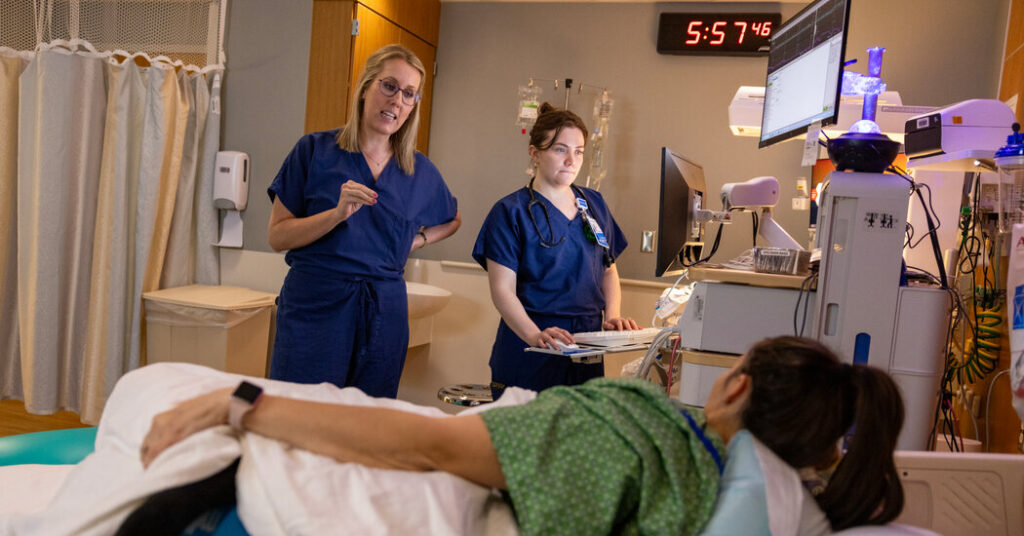
This summer, I spent two days shadowing obstetricians and midwives on the bustling labor and delivery floor of Rochester General Hospital in New York. I interviewed soon-to-be mothers, taking breaks while they had contractions. I took notes as nurses coached patients through labor, and I got teary-eyed watching deliveries.
I was there to understand how the hospital had over the past few years dramatically cut its cesarean rate for first-time, healthy moms. And I knew the hospital had undergone a change only because of a 1,619-line spreadsheet that two of my New York Times colleagues had built.
I often write in-depth stories on women’s health. I became interested in digging into the overuse of C-sections late last year, after covering a study that suggested that American hospitals gave Black women unneeded surgical deliveries to fill open operating rooms.
While C-sections can be lifesaving for mom and baby when needed, the overuse of the procedure can prolong recovery and increase the risk of serious complications. And year after year, the United States has failed to meet public health goals, set by federal and state health agencies, to lower C-section rates.
Almost immediately into my reporting, I confronted an obstacle: U.S. hospitals do not have to publish their C-section rates. Many choose to keep that information confidential. It would be tricky to report on C-section overuse when I didn’t know where, or how often, the surgery was happening.
Fortunately, there are about 1,600 hospitals that voluntarily report the information to the Leapfrog Group, a nonprofit focused on tracking metrics related to health care quality. I asked the group to share data. I gave those spreadsheets to my colleague Bianca Pallaro, a data reporter, and her editor Jeremy Singer-Vine.
They analyzed the data and found something interesting: Across the country, a few dozen hospitals had substantially cut C-section rates.
That surprised me. The doctors I had interviewed about C-sections described the overuse of the surgery as an intractable problem, bound to get worse as more women get pregnant and deliver in their late 30s and early 40s. More patients are also coming to the obstetrician’s office with chronic conditions, such as diabetes and high blood pressure, which can make birth more complicated.
But the hospitals at the bottom of my spreadsheet — those with big drops in C-section rates — suggested that improvement was possible.
I started calling them. I talked to doctors at small, rural facilities and large, well-known academic medical centers. When I asked hospital leaders how they cut C-section rates, I kept hearing the same thing: It wasn’t as hard as I thought. The most important step, they told me, was deciding to tackle the problem.
Rochester General happened to be the very last line of the spreadsheet, the hospital with what looked like the strongest decline in our original data set, from 2021 to 2024. In January, I spoke with Dr. Elizabeth Bostock, who oversees obstetrics for the hospital’s parent system, Rochester Regional Health. She ticked off a laundry list of changes they had established to reduce C-sections in recent years.
Six months later, I was on Dr. Bostock’s labor and delivery floor observing those adjustments. I watched as residents learned from midwives how to reposition a woman to encourage the progression of labor. I saw a checklist posted on the wall of all the steps that should be taken to promote vaginal delivery before surgery is deemed necessary. Nurses and midwives stopped by to chat about other changes, too, like how the midwives recently became their own division of the hospital and a new prenatal education class that emphasized how long an induced labor could take.
After visiting Rochester, and talking with leaders at other hospitals who had achieved similar C-section rate declines, the problem didn’t seem nearly as intractable as it had initially been described to me. The proof was clear at Rochester: The hospital cut its C-section rate for first-time, healthy moms from 40 percent in 2021 to 25 percent this year.
As an investigative reporter, I often write about the litany of problems in our health care system. My Times biography notes that I focus on the way it “falls short for patients.”
My reporting on C-sections has certainly revealed problems. This month I published an article showing how electronic fetal monitoring, a widely used technology with little evidence behind it, has driven unnecessary C-sections. I documented the consequences of those surgeries in an article about placenta accreta, a life-threatening C-section complication that used to be rare but has recently become more common.
But in this recent article, I was able to focus on something I often do not get to report on: a solution.
Sarah Kliff is an investigative health care reporter for The Times.
The post On the Labor and Delivery Floor, a Reporter Sees a Solution appeared first on New York Times.