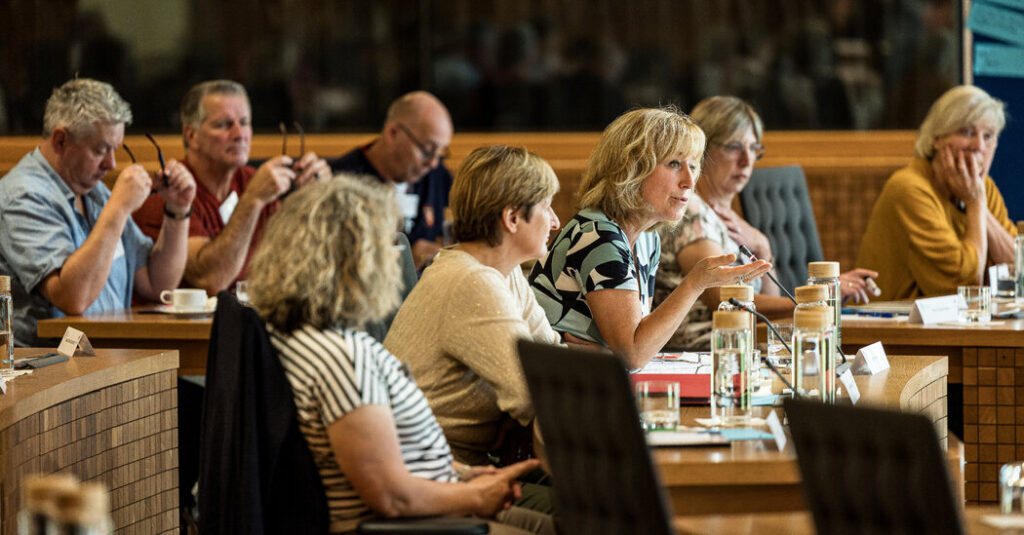
About two dozen people met in a white stone parliament building in eastern Belgium on a recent Saturday. They held a lively debate over the region’s retirement policy and hashed out recommendations.
They were not elected officials, however, but ordinary citizens — a truck driver, a physical therapist, a laboratory assistant and others — taking part in an effort that might seem unusual in modern democracy: government more directly by the people.
In Ostbelgien, a German-speaking region of about 80,000 people, residents are chosen through a lottery each year to convene as a group to make recommendations to lawmakers on issues such as health, education and social services.
The project, known as the Ostbelgien Model, began six years ago as a way to increase trust in government. Those who started it say it now feels more urgent than ever.
Surveys indicate that dissatisfaction with democracy is increasing in wealthier nations, including the United States and much of Europe. Far-right or populist parties have ridden voter disaffection to the top of opinion polls in France, Britain and Germany, and they are in power or in coalition governments in Hungary, Italy and Sweden.
Oliver Paasch, the minister-president of Ostbelgien, said that officials needed to find ways to address public frustration.
“If we want citizens to have more confidence in politicians, we, as politicians, have to give more confidence to the citizens,” he said.
There are signs that the citizens’ assemblies, Bürgerversammlungen in German, have had some impact.
One recommendation that has already been enacted is a ban on cellphones in middle schools and high schools. A citizens’ assembly proposed a partial ban in 2022, and a subsequent group argued for a total ban, which went into effect in September.
Isabelle François, a teacher who was part of the 2022 assembly, said that she had long been distrustful of politicians and frustrated by government inefficiency. But after participating in the assembly, she said, she had a better understanding of the lawmaking process and why changes take so long. She also saw the importance of bringing people from all walks of life together to debate the best course of action.
“Everyone is living in his own world, and we have to see the other points of views to find a solution that suits everyone,” said Ms. François, 29.
Her experience inspired her to run as a candidate in local elections last year. Though she lost, she said she might run again in the future.
About 1,500 letters are sent once a year to randomly selected residents in Ostbelgien. Of those who indicate interest, about 30 are chosen to join the citizens’ assembly.
Starting in September, they meet on Saturdays for several hours over a period of two months, or longer if needed, and are assigned a topic. Each participant is paid a stipend of about 115 euros ($133) per day. They gather in the regional parliament building, which served as a military hospital during World War II, with a moderator employed by the government facilitating the discussions.
Though the assemblies’ recommendations are not binding, lawmakers are required to consider them, and many have been adopted. Among the changes they have spearheaded: easing eligibility requirements for low-income housing; including residents’ family members on the boards of assisted-living facilities; and new funding to encourage young people to take up professions such as nursing, which is facing a shortage in the region.
The Belgian experiment recalls ancient Athenian democracy, in the 5th century B.C., when groups of free men were chosen at random to serve as government officials each year. There wasn’t much diversity in that citizenry, however, and these days, leaders in Eupen, the capital of Ostbelgien, acknowledge that what works in their small, relatively homogenous region may not translate everywhere.
The assemblies’ purview is also limited, naturally, to areas where the regional government has control, such as education and housing, rather than more divisive topics like the entry of immigrants which is overseen by the federal government in Brussels.
Thibault Simar, a participant in the current assembly, which is discussing retirement policy, said that when the question of government funding comes up, and talk turns to how immigration has put pressure on budgets, the moderator often cuts off discussion.
“My only fear is that this is a project for show,” said Mr. Simar, 23, a customer adviser at an energy company. Still, he chose to get involved because, he said, “I want to see the ideas of our citizens come to life for the good of the German-speaking community and Belgium as a whole.”
Similar initiatives have been tried in Seattle, Toronto, Madrid and other cities. Nearly a dozen countries, including Ireland, Britain, France and Montenegro, have used some form of citizens’ assemblies at a national level, according to the Institute for Government, a British research group.
In Portugal, Lisbon’s city government in 2008 started to bring in citizens to help determine budget allocation, an effort adopted at the national level from 2016. Both initiatives were halted as government priorities changed.
Graça Fonseca, a former Portuguese culture minister who pioneered the national and local initiatives, acknowledged that it can be difficult to measure the effectiveness of such programs. But she said that participants found it meaningful.
“People want to be heard,” Ms. Fonseca said. “Most of the causes of the not-so-progressive or right-wing movements growing is about people feeling that they were left behind and that politicians don’t have a clue on what their life is.”
Michaela Rothkrantz, a housekeeper in Ostbelgien, said she had barely followed regional politics before sitting on a citizens’ assemblyin 2022, when their topic was digital policy. After that, she said, she voted in local elections for the first time.
“My political life went from zero to 100,” said Ms. Rothkrantz, 46. She had a glimpse of how elected officials work, and saw the government implement her assembly’s suggestions on improving internet access and online services for residents.
“That actually makes me really proud,” she said.
Jenny Gross is a reporter for The Times covering breaking news and other topics.
The post Democracy Is in Trouble. This Region Is Turning to Its People. appeared first on New York Times.