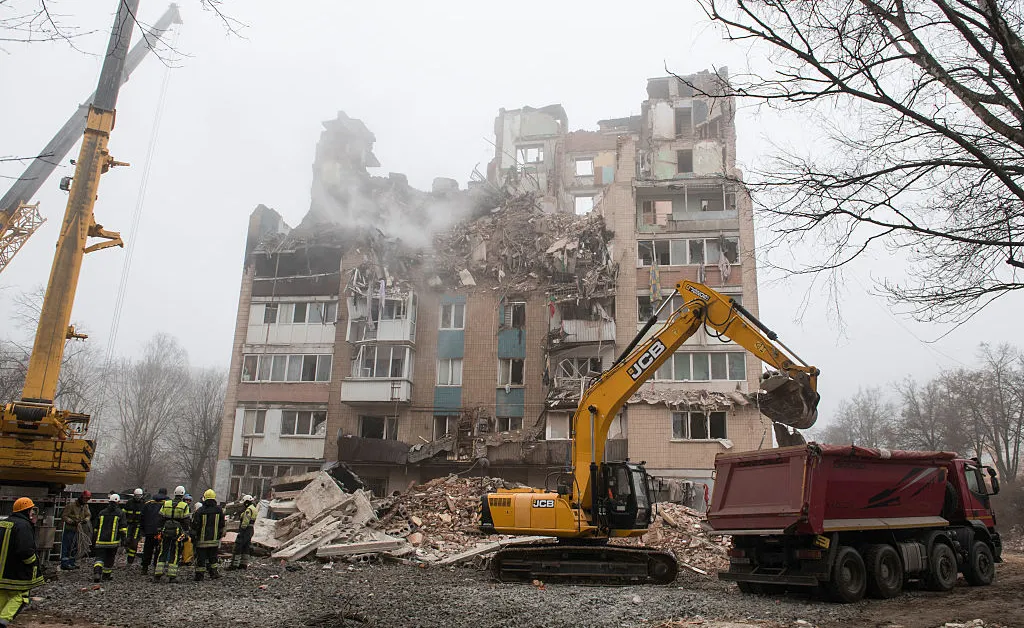
Ukraine plans to seek nearly $44 billion in damages from Russia for emissions caused by the ongoing war, marking the first time a country will claim damages for an increase in emissions caused by conflict.
“A lot of damage was caused to water, to land, to forests,” Pavlo Kartashov, the country’s deputy minister for economy, environment, and agriculture, told Reuters at this year’s annual U.N. climate conference, COP30, on Tuesday. “We have huge amounts of additional CO2 emissions and greenhouse gases.”
[time-brightcove not-tgx=”true”]
Since Russia began its invasion of Ukraine in February 2022, national emissions have risen by over 230 metric tons of carbon dioxide equivalent—roughly equal to the annual emissions of Austria, Hungary, Czech Republic, and Slovakia combined—according to a February assessment by the nonprofit Initiative on GHG Accounting of War.
“Armed conflicts cause a huge range of direct and indirect harms to the environment,” says Doug Weir, director of the U.K.-based independent nonprofit Conflict and Environment Observatory. “Many of these impacts can last years.”
Since the war’s outbreak, Ukraine has been using the climate conferences to highlight the environmental impacts of the war. Now, the country has announced it is preparing to submit a claim through a new compensation process being set up by the Council of Europe, according to Reuters. All claims, including those filed by companies and individuals seeking compensation (for a range of issues), will be decided by a commission—though it is currently unclear where the money would come from for successful claims.
The country’s environmental ministry first set out to use international law to get Russia to pay for the environmental damages caused by the war in 2022, originally planning to file a claim to international courts when the war ended. As the conflict has dragged on, prosecutors in Ukraine are now pursuing 247 cases of environmental war crimes against Russia in Ukrainian courts and the International Criminal Court, according to reporting published in April by the New York Times.
In Ukraine, the largest increase in emissions has come from warfare, with the use of tanks, fighter jets, and artillery shells causing an uptick. Bombs and munitions meanwhile contain toxic substances that contaminate soil, water, and vegetation. Explosives can destroy buildings, generating debris and releasing hazardous materials like asbestos, while damaging water supplies and sanitation facilities. The war also triggered a number of forest fires that led to a 113% rise in emissions, according to the Initiative on GHG Accounting of War. Reconstruction of buildings and the destruction of energy infrastructure also added to the country’s emissions.
“In the case of war, you always have heavy use of machinery, like tanks, that are very carbon intensive in terms of the fuel they use,” says Jerome Dumortier, professor at the O’Neill School of Public and Environmental Affairs at Indiana University, Indianapolis. “The bombardment also causes forest fires, these are carbon emissions that would not have happened in the absence of the war.”
During times of war, governments often divert funding and resources that might have gone to addressing climate emissions instead towards the war effort, Weir says. This leaves nations with fewer resources to identify and address polluting practices.
Russia’s war against Ukraine marks the first time that researchers have tried to comprehensively document the emissions footprint of any war. This means that the United Nations Framework Convention on Climate Change (UNFCCC) is still playing catch up when it comes to addressing just how military activity and global conflicts impact the world’s carbon emissions.
“Because this research is so new, conflict emissions are not properly addressed within the UNFCCC,” Weir notes. Ukraine’s announcement is “another first, and perhaps also a sign of things to come as the climate crisis accelerates,” he adds.
While researchers now have emissions data from conflicts in Ukraine and Gaza, Weir says that only scratches the surface. When the Kyoto Protocol was adopted in 1997, with the aim of getting industrialized countries to reduce their greenhouse gas emissions, military emissions were specifically excluded from the commitments. Similarly, the Paris Agreement allowed countries to voluntarily report their military emissions, which means that we still do not have any way to accurately assess the global environmental toll of warfare.
What’s more, Weir notes that we need to begin to address the carbon footprint of the military industrial complex as a whole—from the supply chain of the metals and critical minerals, to weapons production, to the direct impact of weapons on the environment, to the wastes they leave behind. “It’s an incredibly complex picture,” he says, “and one we are just beginning to untangle.”
The post Ukraine to Claim $44bn in Climate Damages From Russia. Why War Is So Bad For Emissions appeared first on TIME.