
The 43-day government shutdown didn’t only affect affairs on Earth, it also reached into space. While the feds idled, an interstellar object known as 3I/ATLAS was barnstorming the solar system, at a speed that reached 153,000 miles per hour as it tore past Mars, whipped around the sun, and headed on a trajectory that will take it back into deep space. It was only yesterday, with the government’s lights back on, that NASA released an album of images taken by at least 20 spacecraft and ground telescopes tracking the comet’s visit. It is just the third known rock from outside our solar system to pay us a call and NASA and the European Space Agency made the most of the opportunity to document it.
[time-brightcove not-tgx=”true”]
3I/ATLAS was discovered on July 1 by a NASA-funded telescope in Rio Hurtado, Chile known as ATLAS, for Asteroid Terrestrial-impact Last Alert System. The telescope is part of a cluster of four observatories that include two in Hawaii and one in South Africa, whose job is to do exactly what the Chile telescope did: scan the skies for interstellar ordnance that might be on a collision course with Earth. The good news is that 3I/ATLAS poses no danger; analysis of its trajectory shows that it will pass no closer than 168 million miles from our planet, on Dec. 19. The scary thought is that if it did hit us, it would pack a globe-rattling wallop. The comet measures somewhere between 1,400 ft. and 3.5 miles across—significantly wider than the island of Manhattan, which measures only 2.3 miles across at its greatest. (That is still a relative pipsqueak compared to the asteroid that wiped out the dinosaurs, which is believed to have measured up to nine miles across.)
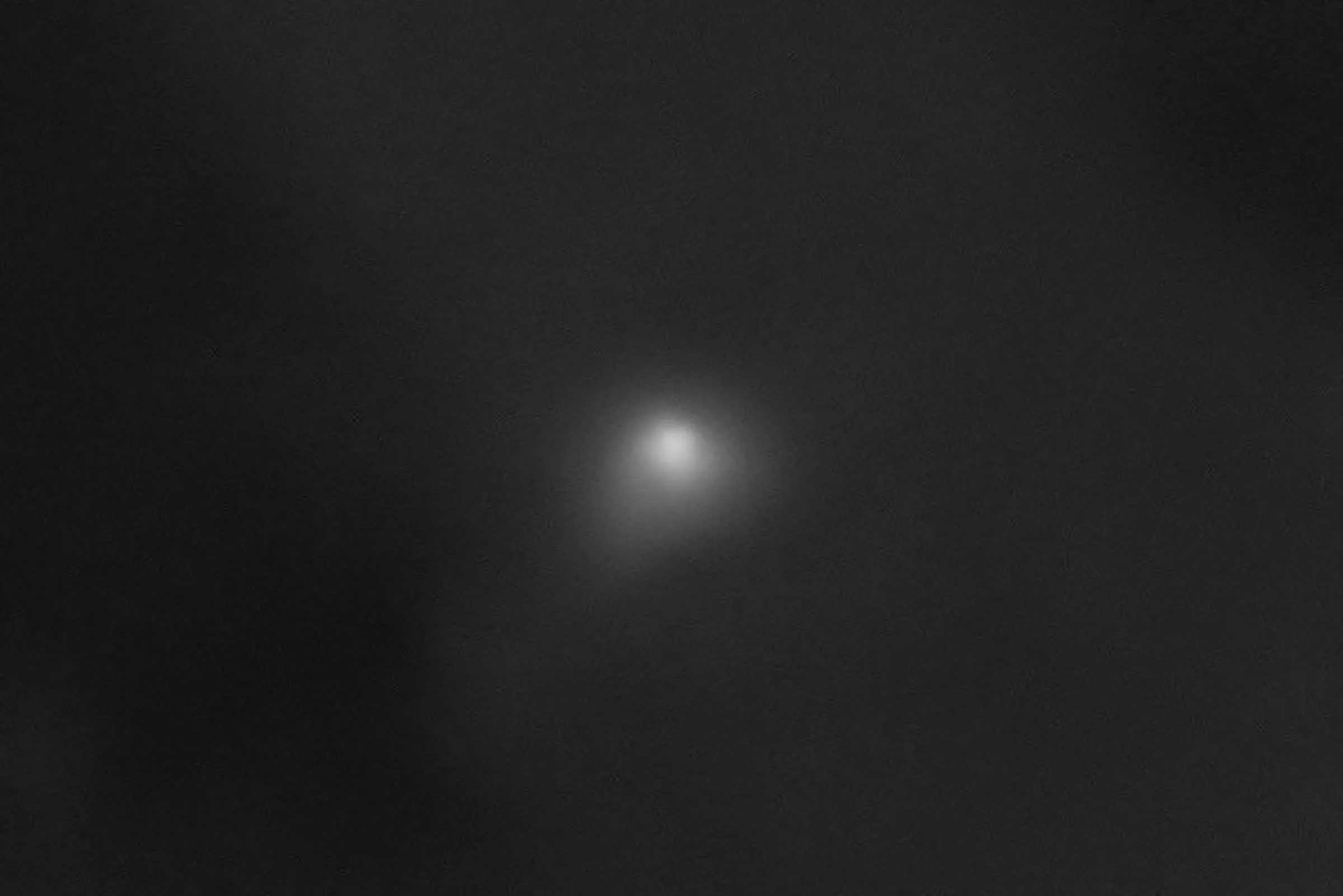
It is a testament to humanity’s technological reach that so many flying and Earth-based instruments have tracked the object as it has sped through our neighborhood. NASA’s Lucy and Psyche spacecraft, both aloft to study asteroids, captured images of 3I/ATLAS as it passed. So did the James Webb Space Telescope, and the Hubble Space Telescope, as well as the Mars Reconnaissance Orbiter, the Mars MAVEN craft, the European Space Agency’s ExoMars Trace Gas Orbiter, the Perseverance Mars rover, and three different NASA probes observing the sun. Two Jupiter-bound spacecraft—NASA’s Europa Clipper and Europe’s Jupiter Icy Moons Explorer—will observe the comet on its trip back out of the solar system in the spring. All of those spacecraft craning their necks to track a single object on command from Earth amount to nothing short of a sort of cosmic infrastructure, built and deployed by humans throughout their local solar system.
Rumors have swirled—as rumors do—however, that 3I/ATLAS was not a space rock, but in fact an alien spacecraft. That decidedly unscientific idea has been encouraged by a very scientific man—Harvard astrophysicist Avi Loeb. In 2021, Loeb published a book titled Extraterrestrial: The First Sign of Intelligent Life Beyond Earth. The work came after the 2017 discovery of the cigar-shaped Comet Oumuamua, one of the other two interstellar objects known to have entered our solar system. Loeb argues that that comet is an alien craft, based on its unusual shape, its high reflectivity, and its apparent acceleration as it flew away from the sun. Other scientists have dismissed these supposed strands of evidence. They attribute the comet’s reflectivity to the likelihood that its surface was burned away and refreshed by its close pass by the sun; its elongated shape to the possibility that it is a shard of a broken planet; and its acceleration to the outgassing of hydrogen as the sun warmed it.
This didn’t stop Loeb from publishing a new paper on Cornell University’s preprint site arXiv, making similar alien claims about 3I/ATLAS. “[I]n this paper,” Loeb and his co-authors wrote, “we present additional analysis into the astrodynamics of 3I/ATLAS, and hypothesize that this object could be technological, and possibly hostile.” They base their argument on the trajectory of the comet, “which approaches surprisingly close to Venus, Mars, and Jupiter,” and thus “allows the object access to our planet with relative impunity.”

Nonsense, say other experts. “It’s natural to wonder what it is. We love that the world wondered along with us,” said Nicola Fox, associate administrator of NASA’s Science Mission Directorate, at a news conference, as reported by Reuters and USA Today. “We were quick to be able to say, ‘Yup, it definitely behaves like a comet.’ We certainly haven’t seen any technosignatures or anything from it that would lead us to believe it was anything other than a comet.”
In another Reuters piece, University of Oxford astrophysicist Chris Lintott was blunter. “You might as well argue that the moon is made of cheese,” he said.
Heedless of all this chatter, 3I/ATLAS is taking its leave of us. The comet made its closest approach to the sun on Oct. 30, passing within 130 million miles of the solar fires. It will come our way shortly before Christmas, soar into the outer solar system a few months later, and pass back into the deep space reaches that birthed it billions of years ago. Earthlings who know where to look can spot it with a telescope in the pre-dawn skies, but most won’t take the trouble. Today’s sensation will, inevitably, vanish into the void.
The post NASA Just Got A Close Look at the Interstellar Comet Whizzing Through Our Solar System appeared first on TIME.