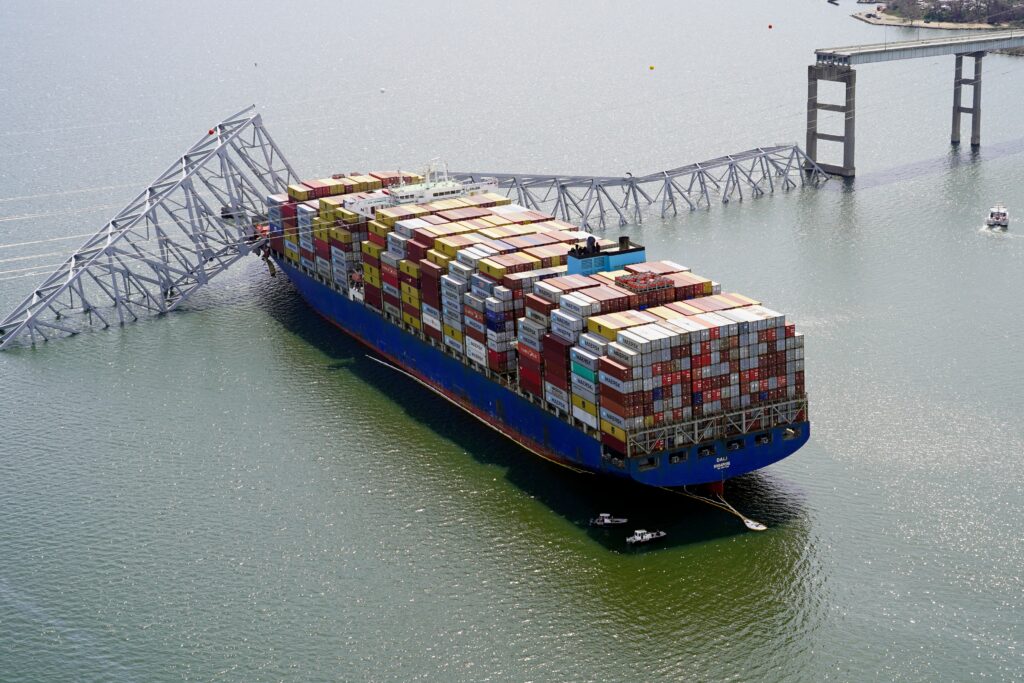
Federal investigators probing last year’s collapse of the Francis Scott Key Bridge in Maryland reported Tuesday that timely communication with the construction workers filling potholes that morning might have saved their lives.
Police officers with the Maryland Transportation Authority, stationed at either end of the bridge to help keep the workers safe, were notified that the massive container ship Dali was veering toward the bridge after losing power. Though they had exchanged cell phone numbers with the construction team inspector, they did not call to warn him of the coming danger, the National Transportation Safety Board said during a hearing.
“Had the highway workers been notified of the Dali’s emergency at the same time as the MDTA police officers, there would have been about 1 minute and 29 seconds to evacuate before pier 17 collapsed,” reported Scott Parent, an NTSB highway factors engineer. That, Parent said, may have given them “sufficient time to drive to a portion of the bridge that did not collapse.”
Their cars were facing south, and the worker furthest from safety would have needed to drive 2,928 feet to avoid the Dali’s destruction, investigators said. Instead, six workers fell into the water and died that morning as the bridge toppled.
That was among the revelations Tuesday as NTSB officials met to begin releasing findings from the agency’s long-running investigation.
While safety investigators had previously given factual accounts of electrical and other problems that beset the ship before the crash, Tuesday’s meeting will include the NTSB’s final conclusions on the causes of the tragedy.
The meeting came after Maryland transportation officials updated their financial and construction projections for the rebuilding of the destroyed Key Bridge, pushing the reopen date two years to 2030 and estimating that the cost could more than double the state’s initial estimate of $1.9 billion.
The new cost projection of about $4.3 billion to $5.2 billion.
Maryland Transportation Authority officials said in an interview Monday that the $1.9 billion figure — which they said last year was in line with cost estimates of projects of a similar scale and complexity — was assembled in the immediate aftermath of the collapse to access emergency relief funds from the federal government.
State officials have used the funds they have received so far to clear the Port of Baltimore shipping channel in the Patapsco River, where the Key Bridge fell on March 26, 2024, when the massive Dali container ship lost power and crashed into a key support pillar, plunging a construction crew into the icy waters below.
Six men died and two survived.
More than 18 months later, MDTA officials said they have a much clearer picture of the price tag for constructing a span, which includes the cost of labor, enhanced safety measures and construction materials that have become more expensive because of tariffs.
“Estimating is difficult on these larger projects,” said Jim Harkness, MDTA’s chief engineer. “The market factors, that all comes into play.”
U.S. Transportation Secretary Sean P. Duffy had said in August that he thought the state’s initial projections likely weren’t “anywhere near accurate” and could be closer to “double plus.”
“It’s like if you go to dinner, and someone else is buying, you might order the finest, most expensive steak on the menu, versus if you’re buying, you might go, ‘I might get a little cheaper cut,’” Duffy said at the time.
On Monday, MDTA Executive Director Bruce Gartner said those working on the rebuilding effort are working to mitigate costs and keep the bill closer to the lower estimated range.
“We are spending every dollar like it’s our dollar,” Gartner said, noting that the state is also cognizant of how the missing roadway has affected commuters in the Baltimore region. “We do recognize that. We are taking measures. We are trying to do everything we can.”
Gov. Wes Moore (D) said in a statement that “national economic conditions have deteriorated and material costs have increased” since the state’s initial estimates.
“Still, despite this new economic reality, our resolve is unwavering,” Moore said. “We remain committed to rebuilding as safely, quickly, and efficiently as possible.”
In many ways, the story of the Key Bridge disaster has been about more than technical problems, potential personnel or corporate issues, or missed prevention opportunities in a single U.S. state. Safety experts said the tragedy raises concerns about how various federal and state agencies, and private companies, managed a potentially catastrophic risk for bridges nationwide over decades.
“We have to accept the fact that if we do nothing, if we don’t invest, something like the Key Bridge will happen again. And it won’t happen again 200 years from now. It will happen within the next couple decades,” said Michael D. Shields, a civil engineering professor at Johns Hopkins University in Baltimore who has led research into the vulnerability of bridges across the country. The question, Shields added, is what level of risk government and society will tolerate. “That is the decision that’s before us.”
NTSB investigators had previously described technical failures that preceded the Dali’s path of destruction. The ship had two electrical blackouts while docked at the Port of Baltimore the day before it set sail. In the moments ahead of the crash, there were two more blackouts before the vessel veered into one of the bridge’s main piers, toppling the span and blocking the main shipping channel.
NTSB Chairwoman Jennifer Homendy told members of Congress last year that the root cause of those sudden blackouts on the night of the collapse is “what we’re really focused on.”
The NTSB said this year that the Maryland Transportation Authority, which owned and operated the Key Bridge, failed to analyze the risk that the bridge could collapse after being hit by a ship, and did not take steps to reduce the chance that such a disaster might occur.
“There’s no excuse,” Homendy said at a news conference in March.
At the same time, the NTSB issued urgent safety recommendations to the owners of 68 bridges across the country. Citing a general “lack of awareness” of the risk of a catastrophic bridge collapse after a ship strike, the NTSB said state agencies or other owners should swiftly calculate such risks. If what they find is higher than the threshold established by the American Association of State Highway and Transportation Officials, which develops and issues U.S. bridge design specifications, the NTSB said owners should put in place short- and long-term strategies for reducing the probability of disaster.
The Maryland Transportation Authority performed the calculations for the Bay Bridge, which crosses the Chesapeake Bay, and told the NTSB that the risk was above the allowed threshold. It has embarked on an approximately $177 million project that will build protective barriers to reduce the chance an errant ship could knock over either of the two spans. That project is scheduled to be finished in 2029.
In May, the California Department of Transportation told the NTSB it is working on calculating the risk of collapse for the identified bridges, a process it had already begun. The agency said in some cases it is “extending the scope” of ongoing work to obtain “detailed statistics on vessels navigating the bridge channels, including dry weight tonnage.” Such data is crucial for calculating a bridge’s potential vulnerability to the traffic beneath.
Long before the Baltimore collapse, a cargo ship knocked down the Sunshine Skyway Bridge over Tampa Bay in 1980, killing 35 people. The collision would eventually lead to new design specifications for bridges that took into account the risks of vessel strikes.
But maintaining the safety of bridges over shipping channels in the long run would require numerous actors working in concert, experts warned at the time.
“Regulatory and institutional activities address parts of the ship-bridge-waterway system: none addresses the functioning of the system as a complex whole,” a National Research Council inquiry into vessel strikes concluded in 1983.
The absence of such a holistic approach would end up as a key factor in the Key Bridge tragedy in 2024, experts said.
The NTSB board said it will release its final report in a few weeks, but it likely will be years before the legal issues surrounding the crash are resolved.
In U.S. District Court in Maryland, dozens of people and businesses have sued the Dali’s owner, Grace Ocean Private, and its operator, Synergy Marine Pte, alleging their negligence led to the power blackout and arguing that the two companies should not be allowed to limit their financial liability.
The companies have asked U.S. District Judge James K. Bredar to cap how much they may be required to pay out to those suing them at $43.6 million. But already, Grace Ocean and Synergy Marine agreed to pay the Justice Department more than $100 million in damages — signaling the possibility of more payouts in the future.
The parties are in discovery, and attorneys have conducted depositions of the ship’s crew, owner and operator.
Maryland may also face its own onslaught of lawsuits.
Just before the first anniversary of the Key Bridge tragedy, lawyers representing more than 20 people and businesses sent letters to the Maryland State Treasurer saying they intend to sue the state for its failures to keep the bridge — and the people using it — safe from tragedy. Those attorneys estimated the total payout amount could cost the state billions.
After the collapse, some experts said the tragedy might become the most expensive disaster in maritime history. In his statement Monday, Moore said the state will work with the White House to “find ways to reduce costs and rebuild faster” — a nod to the politically fraught relationship between President Donald Trump and the governor, who have publicly sparred over federal threats to withhold bridge funding because of the state’s political positions on social issues.
Harkness, the Authority’s chief engineer, said demolition and pre-construction work at the collapse site is progressing. Crews have been removing spans of steel beams and the concrete decks that once attached the bridge span to land. Just this past weekend, demolition began on old concrete piers.
The design phase of the project is almost 70 percent complete, state officials said. Crews have begun driving test piles — which will provide the structural foundation of the bridge — into the river bed to ensure they will perform as planned.
“The scale is significant,” Harkness said.
The post Key Bridge deaths could have been prevented, federal investigators find
appeared first on Washington Post.