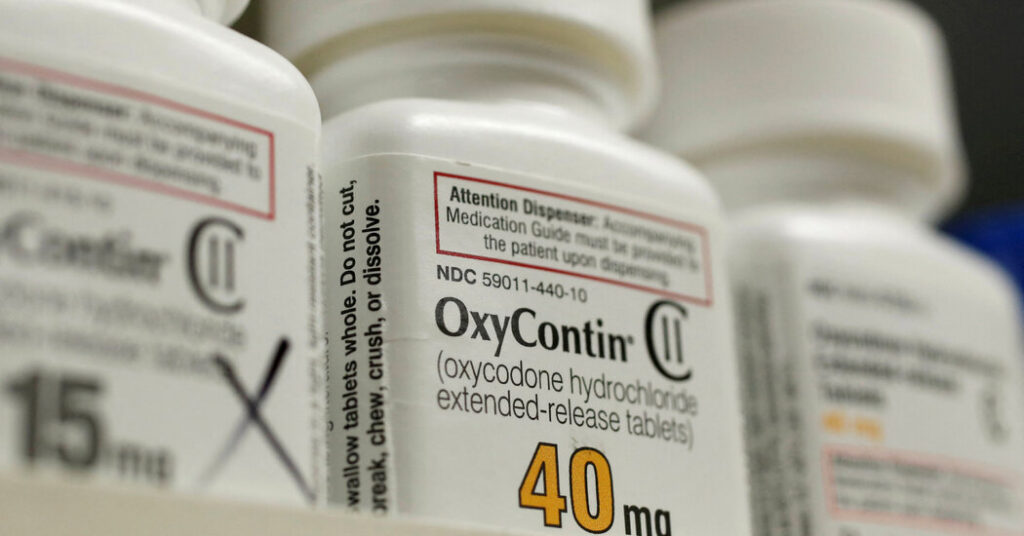
The drugmaker Purdue Pharma, which along with its owners came to symbolize greedy indifference to surging opioid overdose deaths, will soon cease to exist, after a bankruptcy judge said Friday that he would give final approval to a plan to settle thousands of lawsuits against the company.
The agreement comes more than two decades after the first legal actions were filed against Purdue over its aggressive sales tactics and promotion of the opioid painkiller OxyContin as nonaddictive. It requires members of the billionaire Sackler family to relinquish ownership of the company and pay as much as $7 billion over 15 years to states, communities, tribes and others harmed in what became a decades-long national opioid addiction crisis.
“I will tell you now that I’m going to confirm the plan,” Judge Sean H. Lane of the United States Bankruptcy Court for the Southern District of New York, said Friday afternoon, at the conclusion of three days of testimony. He said he would issue a formal ruling on Tuesday.
Purdue will immediately contribute $900 million and then be dissolved. It will be reborn as a public benefit company called Knoa Pharma, which will manufacture limited quantities of opioid painkillers and also opioid overdose reversal medications. Profits will go to programs to remediate the continuing devastation related to opioids.
In the many years of the national opioid litigation, this plan represents the largest settlement with a single company. It will bring long-sought payments to states, municipalities, hospitals and school districts, plus nearly 150,000 personal injury victims and families of babies born with symptoms of opioid withdrawal. (On a separate track, the company and the Sacklers agreed to pay $175 million to federally recognized tribes.)
At a hearing Friday on the plan in bankruptcy court in Lower Manhattan, lawyers for Purdue said payments could possibly begin in March or April.
“It is time to close this overly long chapter and let the money begin to flow,” Marshall S. Huebner, a bankruptcy lawyer who represents Purdue, told the judge. But while the ruling is a landmark moment in Purdue’s legal ultramarathon that was fought all the way to Supreme Court, it also creates contentious and costly uncertainties for the Sacklers, as well as for states and families of people who died from OxyContin overdoses.
The agreement sets aside some $865 million to compensate close to 150,000 personal claims, mostly from family survivors but also from people raising children born with symptoms of opioid withdrawal. To be eligible for compensation, they must produce proof that the injury was caused by a Purdue opioid, typically a legible prescription document.
“This is just the beginning of the end,” said Cheryl Juaire, a Massachusetts mother who lost a son to an overdose of prescription OxyContin in 2011. While she sat on an official Purdue bankruptcy committee, representing individual victims, a second son who had been prescribed opioids, fatally overdosed in 2021.
“I’m numb and exhausted,” Ms. Juaire said, describing what many caught up in the bankruptcy case refer to as “Purdue fatigue.”
This summer, as voting on the plan was underway, many families began receiving letters saying that they may be ineligible for compensation.
At bankruptcy confirmation plan hearings on Thursday, Arik Preis, a lawyer for the bankruptcy case’s watchdog committee, said that the number of claims was likely to be winnowed down considerably. The gross amount for each claim is expected to range from $7,000 to $16,000, though they will arrive in a lump sum, not parceled out over years, as governmental money will be. Lawyers will take a cut of the payments.
Lindsey D. Simon, an associate professor at Emory University School of Law, noted the “frustration and disappointment” of the individual plaintiffs. “They now know that the plan’s complicated division of money between governments and people, filtered through a confusing gauntlet of trusts, means recovery is not certain, and it is estimated to be far less than under the original plan.”
Jan Hoffman is a health reporter for The Times covering drug addiction and health law.
The post Judge to Approve Purdue Pharma Bankruptcy, Releasing Billions for Opioid Plaintiffs appeared first on New York Times.