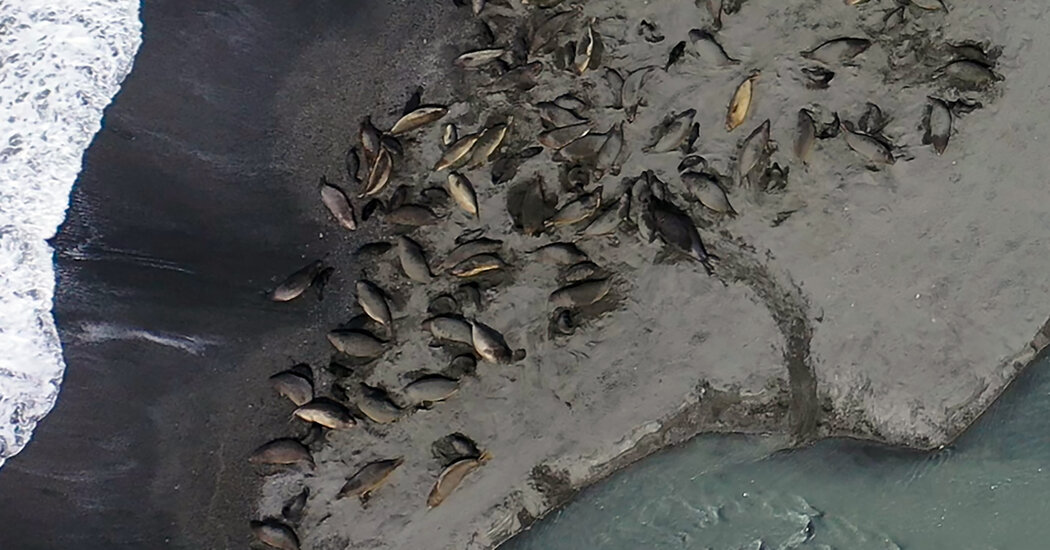
A bird flu outbreak on a remote, sub-Antarctic island has decimated the world’s largest population of southern elephant seals, scientists have found. After the virus arrived on the island of South Georgia in 2023, the number of breeding females fell 47 percent, according to a new aerial survey of the three largest seal colonies on the island.
“It painted a starker picture than I was expecting,” said Connor Bamford, a marine ecologist at the British Antarctic Survey who led the study, which was published in the journal Communications Biology on Thursday.
If all of the South Georgia seal colonies suffered similar losses, it could mean that more than 50,000 females disappeared from the breeding population, the scientists reported.
It is at least the second time that the virus, known as H5N1, has caused a mass die-off of southern elephant seals, which could have long-term consequences for a population that had been considered relatively stable and robust.
The population “will almost certainly have shifted its current stable status to one with more of a question mark attached to it,” Dr. Bamford said.
Although avian influenza viruses are typically best adapted to birds, a new form of H5N1, which emerged several years ago, has infected an unusually broad array of mammals, including domestic animals like cows and cats, as well as wild ones like foxes, bears and raccoons.
Marine mammals, including seals and sea lions, have been hit especially hard by the virus. In late 2023, H5N1 devastated the southern elephant seal population in the Valdes Peninsula in Argentina, killing an estimated 17,400 pups — more than 95 percent of the newborn seals.
Also in late 2023, the virus was detected on South Georgia for the first time, initially in birds. Shortly thereafter, it was confirmed in the local elephant seals, which had begun turning up dead on the beaches.
The island’s remote location has made it difficult for scientists to monitor the local elephant seal population, but the last comprehensive population census, conducted in 1995, suggested that South Georgia was home to 54 percent of the seals’ global breeding population.
In 2022, the year before bird flu arrived, Dr. Bamford and his colleagues had been experimenting with using a drone to conduct new aerial surveys of South Georgia’s wildlife, including its elephant seals.
And when Dr. Bamford returned to the island in 2024, the beach that was typically home to the island’s largest seal colony was unrecognizable. “Normally it’s pretty much solid elephant seals,” he said. Last year, there were “huge gaps,” he recalled. “And that was kind of the first realization that even on the ground, before we’d counted anything, something was wrong.”
The researchers used drones to photograph the three largest colonies during the 2024 breeding season, comparing those images with photos of the same beaches during the 2022 season, before the virus arrived.
At these three sites, the number of breeding females dropped by an average of 47 percent from 2022 to 2024, they found. According to the 1995 census, the colonies on these beaches represented 15.6 percent of the South Georgia elephant seal population. If they assumed that the population was roughly the same size that it was in 1995, and that every colony was hit equally hard, it would meant that roughly 53,000 females missed breeding in 2024.
That doesn’t necessarily mean that all of those missing females died or that bird flu accounted for the entire decline, Dr. Bamford said. But the decline far exceeds normal fluctuations in the breeding population and may not capture the full scope of the virus’s impact, he added.
The loss of 53,000 females would most likely mean that “a similar level of pups weren’t raised and weaned,” Dr. Bamford noted. “So there’s kind of a multifaceted impact of bird flu over the next decade probably.”
Emily Anthes is a science reporter, writing primarily about animal health and science. She also covered the coronavirus pandemic.
The post Bird Flu Ravaged the World’s Largest Elephant Seal Population, Study Finds appeared first on New York Times.