Climate change does its damage in a lot of ways—birthing hurricanes, heat waves, floods, droughts, and wildfires. Now add to that list earthquakes, continental rifting—or breakup—and magma production. That’s the conclusion of a new paper in Scientific Reports, which adds to a growing agreement among scientists that the Earth’s atmospheric processes can affect its geological processes in surprising ways.
[time-brightcove not-tgx=”true”]
“Ultimately, plate tectonic forces play the dominant role in driving continental rifting,” says geologist James Muirhead, senior lecturer at the University of Auckland in New Zealand and lead author of the paper. “However, our study shows that climate plays a key role in modulating the rate of continental rifting, which can drive phases of greater earthquakes or volcanic activity.”
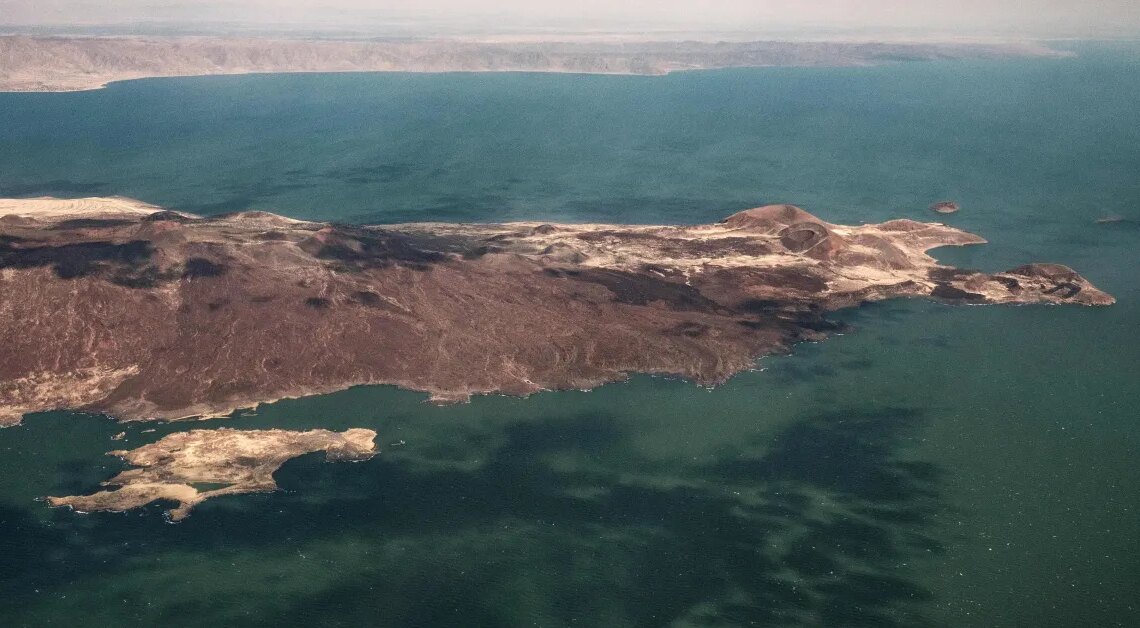
Muirhead and his colleagues base their conclusions on studies they conducted of Lake Turkana, a body of water 155 miles long and 18 miles wide, located in Northern Kenya. That portion of the country is found in a part of the continent known as the East African Rift Valley, an area home to numerous deep lakes and tectonic fractures. The researchers collected seismic data on 27 faults below Turkana, looking back over the course of the past 10,000 years—a time horizon that saw a lot of changes in East Africa.
Beginning about 9,600 years ago and extending to 5,300 years ago, the continent experienced climate conditions known as the African Humid Period. From 5,300 years ago to the present, the post-African Humid Period prevailed. As the names suggest, the first of these two stretches saw a warm, wet continent, with abundant rainfall and flooding; the second saw drier conditions and some desertification. The local lakes went through corresponding changes.
“Water levels in Lake Turkana reflect regional ‘hydroclimate,’” said Chris Scholz, professor of Earth sciences and a co-author of the study, in a statement that accompanied its release. “During wetter intervals approximately 9,600 to 5,300 years ago, the lake was hundreds of feet higher than today.”
That, in turn, had an impact on the earth below the lakes. Water is heavy, weighing 2,200 lbs per cubic meter—which adds up fast in a lake the size of Turkana. All of that water weight exerts a steady downward pressure, suppressing rifting and magma flow, and keeping the subterranean region relatively quiescent. That, at least, is what happens when the lake is full. But as temperatures rise and rainfall slows, water levels drop by as much as 450 feet over the course of one or a few centuries, relieving much of that pressure—and allowing the ground to stir.
“We found that faults slipped faster and more magma was produced…when the lake was lower,” said Scholz. Such increased activity below other lakes that also experienced drying could have played a role in subterranean fracturing that characterizes the entire East African Rift Valley.
Africa is by no means the only place this phenomenon would have played out. Muirhead, Scholz, and their colleagues point to a similar history of rising and falling water levels leading to decreasing and increasing seismic activity in Iceland and the Yellowstone region of the western U.S. The loss of the ice cover that blanketed much of the planet’s northern latitudes at the end of the last Ice Age could have similarly unleashed powerful tectonic forces.
“A number of studies have demonstrated that the retreat of glaciers…resulted in increased activity along fault lines in North America and Europe,” says Muirhead. “Similarly, magma production at Earth’s mid-ocean ridges has been hypothesized to change in response to changing sea-level during glacial and inter-glacial periods on Earth.”
Unlike most geological processes, which unfold over millions of years, rising and falling water levels happen relatively quickly. “Lake level drops of this magnitude may occur [across] hundreds of years and the stress changes associated with a reduction in lake water loading would have been felt almost immediately by fault lines across Lake Turkana, increasing the likelihood of faulting,” says Muirhead. “The magmatic system would have likely taken a little longer to respond to this reduction in pressure, on the order of thousands of years.”
In the short run, this may not present a problem—at least where Lake Turkana is concerned. The researchers cite climate models that show increased rainfall across the region over the next two decades. That may cause local flooding—which can lead to its own kind of devastation—but it will also top off the lake, increasing its volume of water and containing tectonic forces.
And none of these impacts will happen rainfall to rainfall or season to season, but rather decade by decade or century by century. Still, those are relatively narrow time windows where planetary dynamics are concerned, and that has implications for policymakers, developers, and insurers, who will have to take seismic activity into consideration as they make long term plans.
“If I were doing a hazard assessment for a fault line in a continental rift like Turkana,” says Muirhead, “I would need to consider how its rate of activity, and resulting likelihood of an earthquake, is affected by the current climate state and associated lake water volumes.”
The post How Climate Change Can Lead to Earthquakes appeared first on TIME.