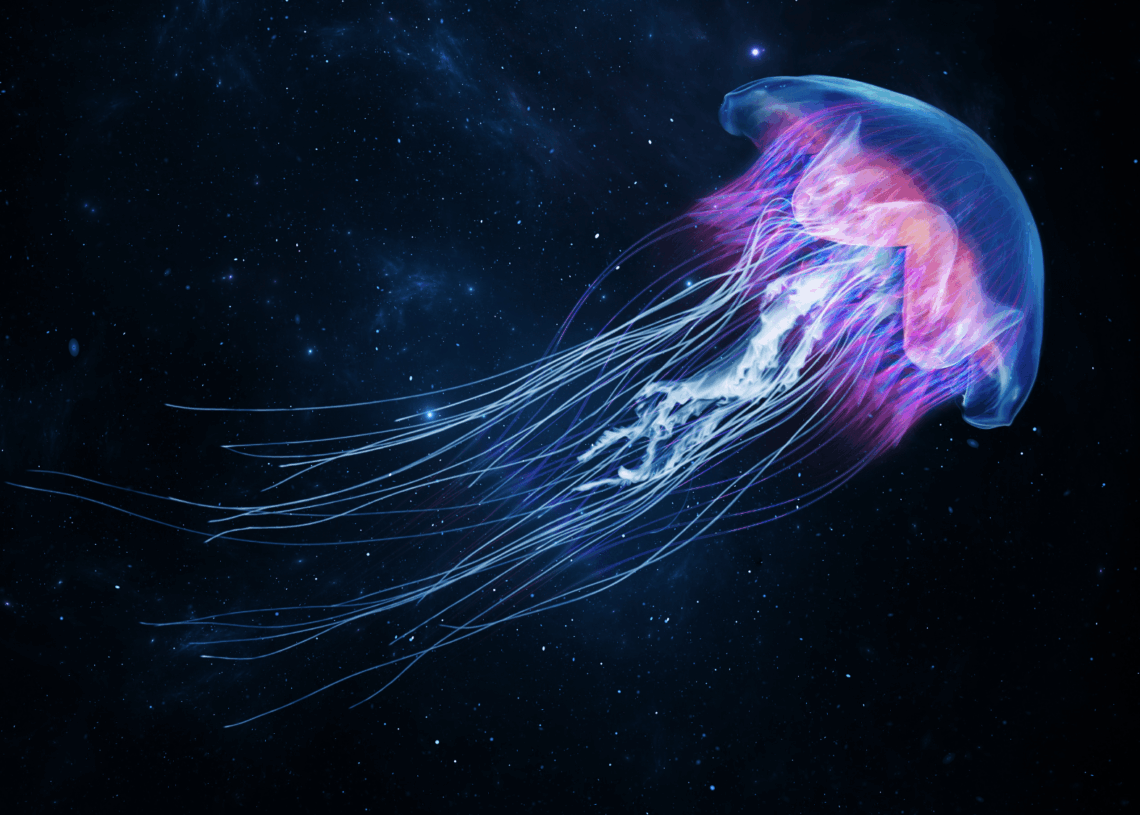
A jellyfish doesn’t have a brain, but it still knows when to sting you. A sea star can crawl toward food and somehow avoid predators without a single centralized thought. Somewhere in there, something that looks like decision-making is happening, which raises a strange question: can brainless animals actually think?
Scientists say the answer depends on what we mean by “thinking.”
“Brainless does not necessarily mean neuron-less,” Simon Sprecher, a neurobiology professor at the University of Fribourg, told Live Science. With the exception of marine sponges and the blob-like placozoans, nearly all animals have neurons. Creatures like jellyfish, hydras, and sea anemones use what’s called a nerve net. It’s a diffuse web of neurons spread across the body that processes sensory information and triggers coordinated responses.
“The nerve net can process sensory input and generate organized motor responses,” said Tamar Lotan, who leads the Cnidarian Developmental Biology and Molecular Ecology Lab at the University of Haifa. That system handles everything from swimming to stinging to feeding—functions that look a lot like basic cognition.
Recent studies suggest these animals are capable of something closer to learning. Sprecher’s team trained starlet sea anemones to associate a harmless flash of light with a mild shock. Eventually, the light alone made them retract. Another experiment showed anemones could recognize genetically identical neighbors and stop attacking them after repeated encounters—a sign they can tell “self” from “non-self.”
Box jellyfish appear to show similar learning. A 2023 study led by Jan Bielecki at Kiel University found they can associate visual cues with the feeling of bumping into obstacles, helping them steer around them. “Learning can be achieved by single neurons,” Bielecki said.
Still, whether this counts as “thinking” depends on who you ask. “Thinking is too vague a concept,” Bielecki added. Scientists prefer “cognition,” which Ken Cheng, a professor of animal behavior at Macquarie University, defines as information processing that uses environmental input to make functional choices.
If that’s the benchmark, even brainless species qualify. “Basic cognition can be regarded as any change in behavior that goes beyond reflexes,” Sprecher said. But the higher-level stuff—consciousness, self-awareness, reflection—likely requires more.
Lotan put it best: cnidarians have survived for over 700 million years while many brainy creatures have gone extinct. Whatever they’re doing, it works.
The post These Animals Don’t Have Brains. Can They Still Think? appeared first on VICE.