One month short of America’s 250th birthday, it’s clear that we won’t be getting an extravagant and unifying celebration of American greatness and patriotism. So maybe the best we can hope for is a healthy debate about the nature of American identity, which might lay a foundation for a more splendid celebration come 2076.
Throughout the Trump era the what-is-America debate has often pitted a creedal vision of national identity rooted in allegiance to certain ideals — and thus, by implication, immediately available to any new-arriving immigrant — against a cultural nationalism that emphasizes a deep ancestral heritage. In these debates, apostles of the creedal conception often cast themselves as defenders of an embattled center, menaced by an anti-patriotic left as well as an ethnically or religiously chauvinist right.
Recent essays on patriotism and nationalism by The Atlantic’s Yoni Appelbaum and the prolific Substacker Noah Smith stand as useful exemplars of this creed-as-centrism perspective, as does a recent book co-written by the Supreme Court justice Neil Gorsuch. And in polling the creedal perspective does seem much more unifying than any obvious alternative.
Smith’s essay cites a July 2025 survey showing that “supporting the U.S. Constitution” and “believing in the principles of the Declaration of Independence” are treated as fundamental markers of American-ness by large majorities of both political coalitions, while not even a majority of Republicans identify being born in the United States, speaking English or “having many generations of American ancestors” as essential. “Being white,” meanwhile, polls at 2 percent of Democrats and 8 percent of Republicans.
It’s hard to look at those numbers and see a promising future for the more exclusivist understandings of American identity, whether they ground themselves on an attenuated Anglo-Protestant inheritance, a hazily defined “white culture” or an invented “heritage American” category. Those projects often exist in a dynamic interaction with identity politics on the left, imitating their challenge to the creedal consensus without offering a stable ground for the America that actually exists for us today.
But the creedal perspective can still learn something important from the culturalist critique, something crucial to its own self-understanding and ultimate survival. What needs to be recognized is that creedal Americanism is itself a culture, in which the formal commitment to a principle is intertwined with other habits and practices that make the commitment meaningful, successful, real.
Because it’s creedal, this culture is open, often radically open, to newcomers in a way that many cultures aren’t. But the assimilation to American norms is still a process rather than a single act of intellectual assent, and if the social and cultural inheritance carried by native-born Americans disappeared tomorrow, you couldn’t easily recreate the creedal culture from its first principles alone.
Let me give two examples of what I mean, from the polling that Smith cites. What does it mean to say that “supporting the U.S. Constitution” is essential to American identity? One answer would just be that it means accepting the Constitution as the law of the land, and not working to actively overthrow the government. But that seems much too thin: The thicker interpretation, which I suspect is what many respondents have in mind, is that supporting the Constitution means believing that its core principles are right and good and just, better than available alternatives, a moral architecture worth embracing and not just obeying.
And that kind of thicker belief isn’t necessarily easy to live out. Take one important aspect of the First Amendment, the right to free speech. It’s easy enough to say “I believe in free speech,” to give the idea formal assent. It’s much harder to accept what real free speech means for your social and cultural experience — a world where people are constantly giving offense, where your sacred things are regularly subjected to withering critique, where people seem (from your perspective at least!) to lie and get away with it, where someone is always wrong on the internet and the innocent or paranoid are being led astray.
It’s so hard that lots of Americans don’t fully accept it: Donald Trump clearly doesn’t really believe in the full vision of free speech, and neither do some of his “misinformation”-policing progressive critics.
But American culture as a whole is still a free speech culture in a way that many societies around the globe are not. And not just societies with authoritarian governments. The culture of the European Union is much more liberal than the culture of the People’s Republic of China, but Europe is not a free speech culture in the same way as the United States is. For all kinds of historical reasons, Europeans are much more naturally comfortable with censorship, and I suspect that comfort would remain even if the laws were altered.
Creeds are not self-interpreting: If Harry Truman had imposed the First Amendment on Western Europe as a condition of the Marshall Plan, or, for that matter, if every American today were magically replaced by an E.U. citizen, the First Amendment would be interpreted differently than it is under American cultural conditions. And so sustaining those conditions is part of how you sustain a creed.
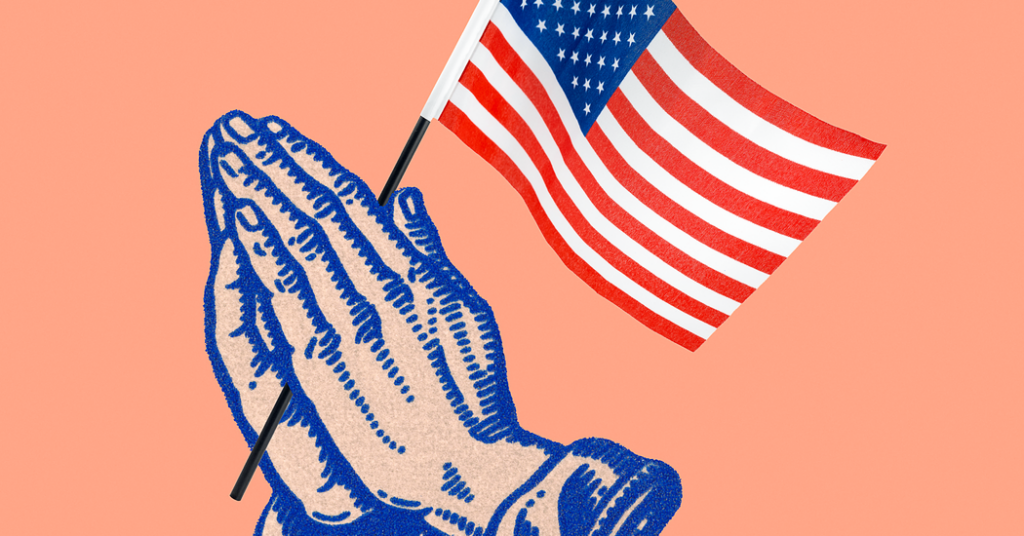
Now a second example from the survey Smith references: If someone commits to “believing in the principles of the Declaration of Independence,” what is the nature of that belief? Again, one could give a thin answer and say that it just means believing in equality and human rights. But the actual words of the Declaration ground equality in theology, insisting that all men are “created equal,” that their rights are something “endowed by their creator” rather than created by a contract or invented by the state. So to fully believe the Declaration’s principles might require some kind of metaphysical understanding of equality, some kind of theological perspective on the world — which is more likely to be sustained by religious practice and belonging than by mere intellectual assent.
The fact that the man who wrote those words was not a Christian, or was at best a Christian heretic, is a strong indicator that one doesn’t need to be a specific kind of religious believer to be a good believer in the Declaration. But if you look at the sweep of American history, it’s very hard to disentangle the advance of equality from the religious belief that our rights come from God and that human beings are equal in his eyes.
And if you look at 20th- and 21st-century history, it’s very easy to see how a formal commitment to equality that refuses any religious grounding can end up being purely notional. (The Communist world, for instance, had a creedal commitment to equality that meant absolutely nothing.)
Both the sincere believer and the secularist have good reason to recoil a bit from Dwight Eisenhower’s famous comment that the American political order “has no sense unless it is founded in a deeply felt religious faith, and I don’t care what it is.” But Eisenhower was accurately describing the cultural matrix and the ecumenical religious habits that grounded our commitment to equality. The creedal conception of America doesn’t require everyone to recite the Nicene Creed, but it has more power in a context where most Americans believe in a providential God.
To believe in a creedal center for the American experiment, then, is to believe in something that’s more universalist than a heritage-American conception of the country — but not so universal that it can exist without the actual historical culture of the United States. The test of the next 50 years is whether that culture can renew itself in ways that reflect the power of our ideals — but also, crucially, the habits required to make an idea into a nation.
Breviary
Caitlin Myers and Ezekiel Hooper on the iPhone fertility collapse.
Eric Levitz on the (coming) A.I. fertility collapse.
Geoff Shullenberger on how A.I. unravels anti-humanism.
Arash Azizi on “Fjord,” faith and liberalism.
Phil Magness on left-academic quote doctoring.
Scott Sumner on the true scale of the world.
Robert Louis Wilken, R.I.P.
The post The American Creed Is a Culture appeared first on New York Times.