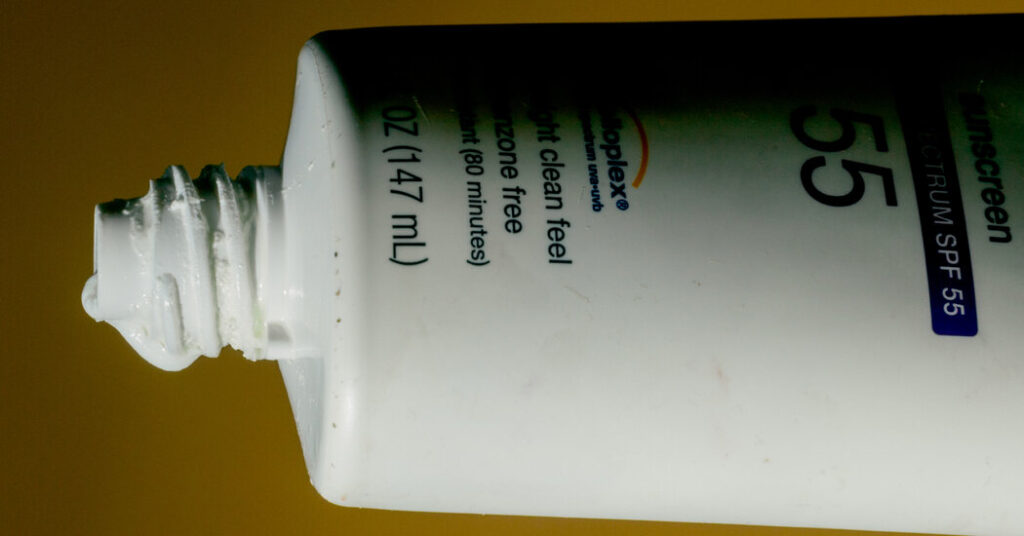
The Food and Drug Administration cleared a new ingredient for sunscreens on Tuesday, paving the way for American companies to begin using a compound that has long been a part of popular sunscreens in Europe and Asia.
The ingredient, bemotrizinol, works by blocking ultraviolet radiation. It filters out two kinds of ultraviolet rays: ultraviolet A, which contributes to wrinkles and skin aging, and ultraviolet B, which causes sunburns.
Dermatologists said bemotrizinol offers a few advantages over other sunscreen compounds currently available. The ingredient fills “a need in the field,” Dr. Elisabeth Pedersen, a dermatologist at University of Michigan Health, said.
Dr. Jennifer Stein, a dermatologist at N.Y.U. Langone Health, said sunscreens with bemotrizinol were more “cosmetically elegant.” Many sun protection products already on the market are mineral or physical sunscreens, which leave a chalky, white film on the skin — “really thick and pasty, kind of like the zinc on the lifeguard’s nose that you stereotypically see,” Dr. Pedersen said. Bemotrizinol, by contrast, rubs into the skin without leaving a cast.
Bemotrizinol is also better for sensitive skin than some other sunscreen ingredients are, with a lower risk of causing irritation, said Dr. Victor Quan, an assistant professor of dermatology at the Northwestern Feinberg School of Medicine. And it can last longer in the sun without breaking down, he said.
Unlike ingredients in some other sunscreens, bemotrizinol is a large molecule that sits on top of the skin and does not get absorbed into the bloodstream. Scientists are not sure how concerned to be about the safety of sunscreens that do enter the bloodstream. “It just left a question mark,” Dr. Stein said. “It doesn’t mean that they’re not safe, it just means we don’t know and that more testing needs to be done to prove that it is safe.”
Bemotrizinol is the first new ingredient for over-the-counter sunscreens the agency has greenlit in 20 years, Health Secretary Robert F. Kennedy Jr. wrote in a statement announcing the move. Sunscreens are regulated in the United States as drugs, rather than as cosmetic products, as they are in other countries, which is why it can take so long for new ingredients to be authorized, Dr. Pedersen said. “It takes a lot more rigorous testing, and it’s expensive for companies.”
The F.D.A. said it considered bemotrizinol to be “generally recognized as safe and effective” — a designation that means an ingredient can be used without additional testing. A company called DSM Nutritional Products LLC requested that the F.D.A. add bemotrizinol to the list of allowed over-the-counter sunscreen ingredients.
It may take some time for American companies to formulate products with the new ingredient. But international manufacturers that have long made sunscreens with bemotrizinol may just move some of them over to the U.S. market, dermatologists said.
The options without bemotrizinol that are currently on the market are still very effective and will work well for many people, Dr. Quan said.
“Big picture,” he said, “the best sunscreen is the one that you like using.”
The post F.D.A. Clears Sunscreen Ingredient Long Used in Europe and Asia appeared first on New York Times.