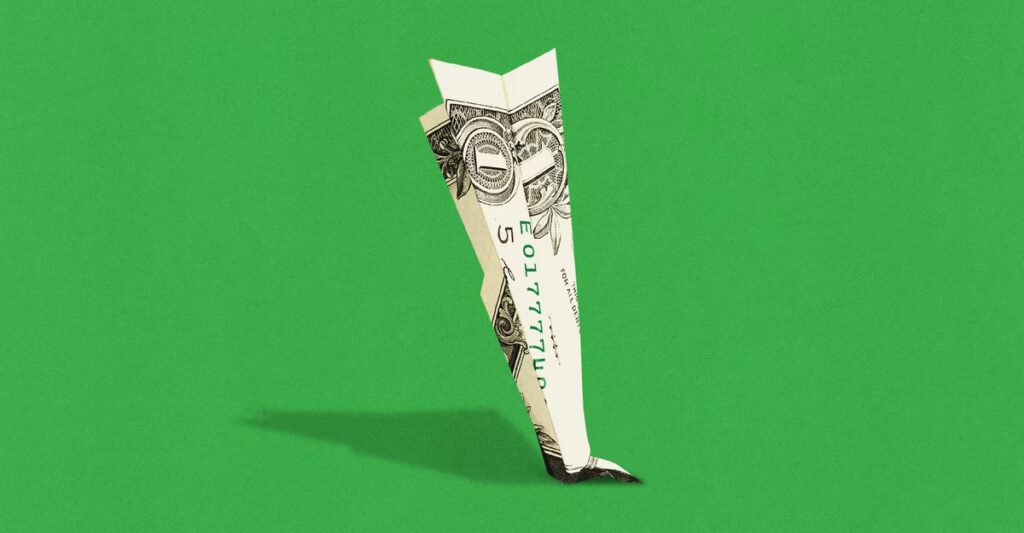
The casual air traveler has never had so much information at his fingertips. He sits before a battleship-worthy console of maps, prices, dates, and times; orders up grids that plot one variable against another. He is monitoring the situation. He is in conversation with his wallet, but also with his future self: Will he want to take the red-eye and leave his bags at the hotel all day? Will he want to leave the house at 4 a.m.? What’s so great about Iceland, anyway?
This stupendous array of choices, once reserved for professional travel agents, is emblematic of our optimized-shopping era. Consumers don’t just price-shop; they scrutinize rates of change, guided by algorithms that purport to know where prices are headed. With airfares at historic highs, the sites that advise travelers whether to buy now or wait have never felt more necessary. Unfortunately, they have rarely felt less helpful.
Sites such as Hopper, Kayak, and Google Flights are trained on price histories. “They use data from the past to inform models in the present that make predictions for the future. Their level of confidence and predictive accuracy drops—whether they disclose that or not—precipitously when there are exogenous shocks,” Oren Etzioni, a computer scientist who built and sold the pioneering airfare-prediction site Farecast to Microsoft in the 2000s, told me. The sites’ powers are limited in chaotic times, and chaotic this summer is.
Fare changes are a cat-and-mouse game in which airlines try to fill empty seats and capitalize on last-minute travel needs—countervailing tendencies that can lead to lower or higher prices, respectively. In the main, as most air travelers have probably experienced, the overwhelming trend is for tickets to get more expensive as the date of a flight approaches. But algorithms have been able to deduce currents within that rising tide. Generally speaking, these sites offer decently reliable predictions. AirHint claims that its recommendations are correct 80 percent of the time. Hopper once claimed that its predictions were 95 percent accurate. Back in 2019, Kayak told The Wall Street Journal that its timing advice saved the average customer $28. (The company declined to provide updated figures “given ongoing market volatility.”) These are of course data points generated by the companies themselves, but academic researchers have confirmed that making accurate airfare predictions is possible with publicly available data.
Airfares are determined by three main factors: customer demand, airline competition, and input costs such as labor and fuel. Events affecting the first two categories—a supersize World Cup, the disappearance of Spirit Airlines—have contributed to the summer’s high prices. But it’s the closure of the Strait of Hormuz, and the ensuing explosion in jet-fuel costs, that may overwhelm the predictable patterns of price changes.
[Saahil Desai: The only thing worse than Spirit Airlines]
“It’s a binary,” Zach Resnick, who runs the boutique travel service Ascend, told me. “If the blockade continues, a certain scale of disruption, especially in Asia and Europe, is not priced in.” With jet-fuel prices up in the air, sudden changes such as surcharges and canceled routes could still be in the works for later this year. That makes it harder than usual to know whether to buy or wait. In April, for example, Japan Airlines tacked an additional $170 surcharge onto flights to North America and Europe, citing “abnormally high” fuel prices. No algorithm saw that coming.
This wouldn’t be the first time the flight-prediction industry’s powers fell short. In 2022, as global aviation rebounded from the coronavirus pandemic, Aarian Marshall reported for Wired that the volatility in fares had forced Google Flights to fall short of its expected prediction accuracy of 90 percent. The company paused its offer, launched in 2019, to guarantee certain fares and send refunds to buyers if prices fell. (The feature was officially reinstated in 2023 but does not seem to apply to most flights.)
These days, the apps seem to be showing the most consensus on waiting to book certain far-off domestic trips. For a Labor Day flight from Chicago to Las Vegas, for example, Hopper told me to wait, AirHint told me to wait, and Google Flights told me that the cheapest time to book is usually later. Expedia suggested that the price would drop by $5 on July 20. When I asked ChatGPT Pro, I received guidance to buy now for international travel but wait for domestic travel, based on Expedia’s 2026 “air hacks,” which posit that domestic economy prices bottom out 15 to 30 days before departure. (That figure is 31 to 45 days for international routes.) Hopper even advises waiting for prices to come down for several international flights. Aleksei Udachny, who runs AirHint, told me the ratio of “wait” to “buy” recommendations has gone up this year.
Waiting may be good advice—unless something big shifts for the worse on the world stage, sending prices even higher. Although Udachny insists that this year’s challenges are not exceptional, and that trends have been largely predictable, other prognosticators are less confident. “When prices move outside typical ranges, we take a more conservative approach, sometimes limiting the recommendations rather than risk misleading travelers,” a Kayak spokesperson told me in an email. For certain queries, Kayak is not providing the option of price prediction, but is merely offering current prices. The airline expert Michael Taylor, from the consumer-review company J.D. Power, told Slate’s Alex Kirshner recently that trying to buy plane tickets based on the ups and downs of the war in Iran was like trying to time the stock market—subject to dumb luck.
I asked Etzioni, whose app was originally called Hamlet (slogan: “To buy or not to buy”), how he would handle a recommendation to wait. “I’d take it with a huge grain of salt, unless I was a betting man and willing to take a substantial risk,” Etzioni said.
[Kaitlyn Tiffany: The great travel meltdown of 2026]
The same thing that made prices high can still make them higher, because fuel is a crucial component of airline costs, accounting for about one-third of the cost of operating a flight. Already, Delta has said it is paying about twice as much for fuel as it did last year. Fuel isn’t just an input cost that gets passed along to ticket buyers. High fuel costs also force airlines to cancel flights—Lufthansa announced in April that it would cancel 20,000 flights; United cut capacity for this year by 5 percent in March—making fewer seats available than usual. The U.S. Travel Association and the Airlines Reporting Corporation both calculate that domestic fares are up more than 20 percent this spring. Some international destinations are much more expensive than last year: Flights from the United States to London are $300 more, per Kayak, up to $1,151 from $826.
Even if a lasting peace brings the Persian Gulf oil trade back to normal, airline executives have warned that a resolution may not bring down prices right away. Willie Walsh, the head of the International Air Transport Association, the trade group for the world’s airlines, told The Guardian in May that the fuel-induced price hikes are likely to continue for months and even into next year.
In this environment, the savvy traveler might want to set aside the algorithms and just buy tickets sooner rather than later. Gary Leff, who writes the aviation blog View From the Wing, told me that flyers who want a specific itinerary probably shouldn’t wait to see what happens—last-minute bargains may require flexibility with travel dates, times, and layovers. Additionally, any potential savings from correctly timing the cheapest fare can be small compared with possible last-minute price surges if you guess wrong. He advised that those who are able can always hedge with a refundable ticket: If the price goes down, the airline may provide a credit to use at a later date. If the price goes up, you’re locked in.
Still, travelers comfortable with risk—that a trip might not pan out, or that it may require spending 18 hours in Reykjavik—may prefer to wait. Sometimes waiting works, because in the short term, airlines have a relatively inflexible supply of flights. They are guessing what the market will bear, and sometimes they get it wrong. That means last-minute deals for buyers, even in summers like this one.
The post Airfare-Prediction Apps Can’t Handle a Summer Like This One appeared first on The Atlantic.