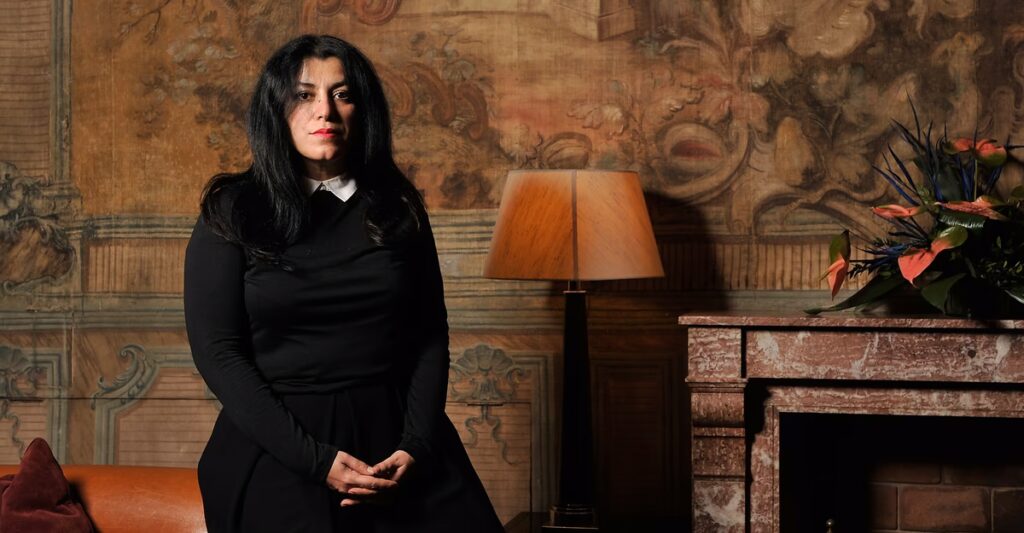
When the news broke last week that Marjane Satrapi, the French Iranian artist best known for the groundbreaking graphic memoir Persepolis, had died at age 56, I had what turned out to be a common reaction: That’s impossible. A friend wrote to me that Satrapi seemed invincible, which feels correct—not only because of the bold vitality of her books and films and public statements but also because Persepolis is, in so many ways, about survival.
A quarter century after the publication of her most famous work, Satrapi still had so much to say, both in her art and in her role as a public intellectual. Just last year, she declined the Legion of Honor, France’s highest order of merit, citing the government’s “hypocritical attitude towards Iran.” (Born in Rasht, Iran, Satrapi moved to Paris in 1994 and became a French citizen in 2006.) This refusal did not affect her stature in her adopted country: On Thursday, French President Emmanuel Macron issued a statement announcing her death and calling her “a leading figure in French culture and a freedom-loving artist.”
Satrapi was against mandatory veiling in Iran and veil bans in France; she was a fierce opponent of Iran’s theocratic regime and an equally sharp critic of U.S. intervention against it. These positions drew detractors, of course—even a few ghoulish posts following her death—but they felt inconsistent only to those who expected obeisance to some doctrine or other. She spent her life in rebellion against attempts to pigeonhole people, herself included, into any reductive framework—whether that pressure came from an oppressive regime, a prize jury, or even political allies. She expressed this in everything she made and did, first and foremost in Persepolis.
An account of enduring the Islamic Revolution and the Iran-Iraq War as a child growing up in an upper-class leftist family in Tehran, Persepolis may be the most globally famous graphic narrative of the past 25 years. After serial publication in France beginning in 2000, it was translated into two English volumes in 2003 and 2004 and became an international best seller, demonstrating the ability of graphic memoir to capture the public imagination. It also articulated, in an innovative form, the traumatic experiences of dictatorship, war, immigration, and exile. Its success and acclaim marked a major turning point for comics in publishing.
The protagonist, Marji, is split in half—her child self drawn on the page while her older, recollective self narrates the story of her coming-of-age. Together, they reveal a passionate kid struggling to understand class, religion, and the violence exploding around her. Persepolis is both dark and funny, like all of Satrapi’s work (she has repeatedly claimed that “people with no sense of humor, they’re just stupid people”). The charismatic Marji wants to be a prophet at age 6 “because our maid did not eat with us. Because my father had a Cadillac. And above all, because my grandmother’s knees always ached.” As she grows up and the stranglehold of the Islamic Republic tightens, Marji’s rebellion only intensifies; she becomes dangerously outspoken against the new regime. After she hits her school principal and disputes politics with a religion teacher, her parents send her out of the country for her own safety—to Austria, alone at age 14. Marji’s rebelliousness, both admirable and terrifying for those who love her, is her salient characteristic. This continued to be the case in Satrapi’s adult years.
[Read: Sex, violence, and radical Islam: why Persepolis belongs in public schools]
In an interview with the actor Emma Watson for Vogue, Satrapi said that after emigrating to Paris in her 20s, she became so depressed that she felt she couldn’t breathe. She called an ambulance, and as the medics carried her down her building’s spiral staircase in a stretcher, she fell out and rolled down all of the stairs; then she needed four stitches in her head. “That made me come out of my depression actually,” Satrapi remarked. “Because I had so much pain there that my breath came back and I decided: Now you have to do something. And then I wrote Persepolis.”
She hadn’t planned on creating a graphic memoir when she arrived in France. Satrapi came to Paris with two arts degrees but no background in comics. Yet after she read Maus, Art Spiegelman’s graphic epic about the Holocaust, it became “a bomb in my head”: proof that comics could express the realities of war. Encouraged by cartoonists with whom she happened to share studio space, she sat down and put ink to paper. Iran has produced many memoirs, particularly by women, including Azar Nafisi’s Reading Lolita in Tehran and Iran Awakening, by the Nobel Peace Prize winner Shirin Ebadi. What sets Persepolis apart is its visual form.
One of the most powerful aspects of the book is the way it bears witness to individual—and collective—experience through the eyes of a child. For instance, Satrapi draws scenes of violence as a child would imagine them: Blazing skeletons fly up out of their seats after the police lock the doors of a burning cinema, a massacre that Marji overhears her parents discussing; the fatal torture of a family friend is depicted as a dismembered doll floating in space with cleanly severed body parts.
Persepolis is rendered in flat black and white, with no shading; this stripped-down visual idiom reflects the starkness with which the young girl sees the world; unlike many adults around her, she knows right from wrong. For a pivotal scene in which Marji publicly contradicts her teacher’s claim about political prisoners, Satrapi withholds background detail entirely, save for a whisper of trees outside a window. This focuses readers on the all-black uniforms of the veiled pupils, who—in a long frame at the center of the page—sit between the looming, frowning teacher on the right and Marji on the left, who stands up to explain that her uncle was executed by the Islamic regime. The students exchange approving looks; the next two panels feature Marji alone. In the second, she asks, “How dare you lie to us like that?” In the page’s last panel, the students clap as the teacher mutters, “Oh, Satrapi!”
After Persepolis, Satrapi swerved in another direction with Embroideries, which was named after (and partially about) a cosmetic procedure for vaginal tightening. Although the book also connects the personal and the political, its irreverent intimacy felt risky for someone with a mass audience. (You could almost imagine some squeamish fans muttering “Oh, Satrapi.”) In 2007, she worked with another cartoonist, Vincent Paronnaud, to make a film adaptation of Persepolis as unique and pathbreaking as the book—an animated black-and-white feature for adults that won, among other awards, the Jury Prize at the Cannes Film Festival. A debut film for both co-directors, it was nominated for an Academy Award in the Best Animated Feature category—competing against children’s films including Ratatouille and Surf’s Up.
[Read: Iranians have had enough]
At Satrapi’s insistence, the movie was completely hand-drawn; the animators, employing a largely obsolete technology, traced images on paper with the same type of black marker that Satrapi had used to compose the book. Her intention was to preserve “the shake in the line,” which infuses both works with a punk aesthetic. Satrapi’s artistic legacy may come down to this kind of insistence—that great art is rebellion, because anything truly unique must be made in defiance of what’s expected, and it must be the product of a person who refuses to be boxed in.
Although her comics have all been very widely read (3.5 million copies of the Persepolis editions have been sold in the United States alone), Satrapi followed up the movie by shifting in earnest to cinema, directing five more films—none of them animated. In 2024, she edited a collection of comics, Woman, Life, Freedom, for which more than 20 Iranian, American, and European cartoonists contributed work inspired by the feminist protest movement of the same name (formed in response to the 2022 death in Iranian custody of Mahsa Amini after she was detained for improperly wearing her veil). It is a book, she wrote, about “a people resisting.”
The last film she directed, Dear Paris, was co-produced by her husband, Mattias Ripa, who died last year. An anthology about death whose major characters confront mortality in one way or another, Dear Paris features a cameo by Satrapi, playing a film director, and it sends the clear message that when you’re alive, you’ve got to actually live. Few artists did that better than she did.
The post Marjane Satrapi’s Rebellious Life appeared first on The Atlantic.