Photographs by Nate Langston Palmer
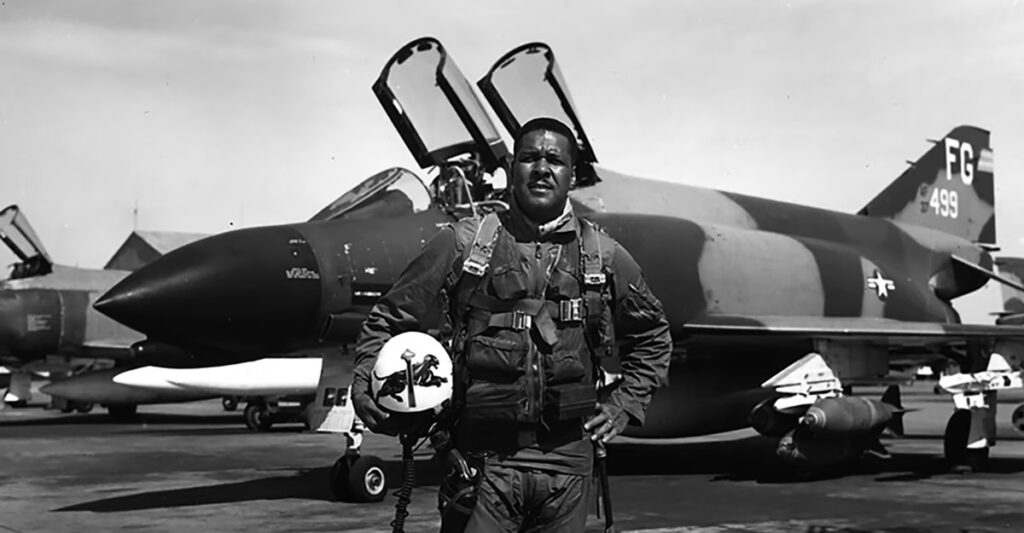
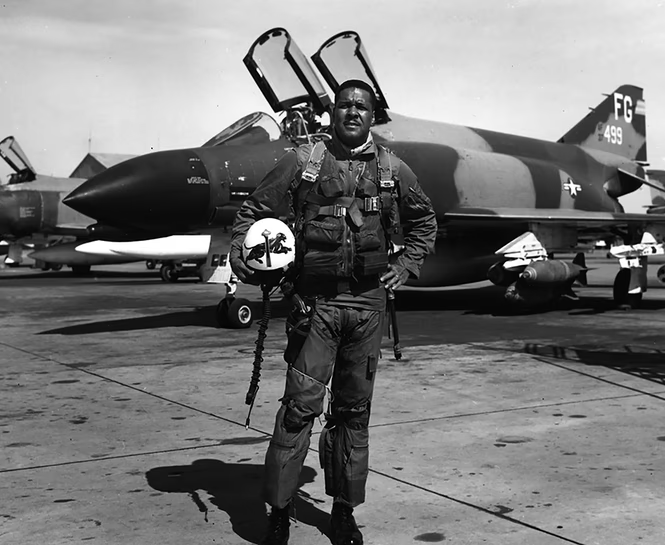
Daniel “Chappie” James Jr. became commander of the Wheelus Air Base, near Tripoli, just after rebels under Muammar Qaddafi took control of Libya in a coup in 1969. In the midst of the insurgency, Qaddafi led an effort to break into the U.S. air base, but James managed to close the gate in time to prevent the young rebel from entering. The incident, which James recounted in a 1978 interview, would come to be the stuff of Air Force lore. As the two men confronted each other, the story goes, Qaddafi got out of his vehicle and reached for his gun. James had a .45 in his belt. He told Qaddafi that he’d better not pull the gun, or he’d regret it. They stared at each other for a moment as the future dictator considered James. Then Qaddafi pulled his hand away, got back in his vehicle, and drove off. The rebels never attempted a similar stunt again. One reporter later referred to James as a “black John Wayne.”
By the time he was facing off with Qaddafi in Libya, James had already served in the military for 26 years. During World War II, he’d trained at the Tuskegee Institute, before joining the 477th Bombardment Group—the first unit of Black bombers in U.S. military history. He then flew 101 combat missions in the Korean War, and 78 more in the Vietnam War.
James was eventually promoted to four-star general, becoming the first Black American in the history of the U.S. military to reach that rank. “If my making an advancement can serve as some kind of spark to some young Black or other minority, it will be worth all the years, all the blood and sweat it took in getting here,” he said at the time. The general became a hero to Black Democrats and white Republicans alike. At a 1987 ceremony dedicating an aerospace-science and health-education center at Tuskegee University to James, Ronald Reagan called him a “darned good pilot and a revered military officer and a truly great American.” In 2020, the state of Florida named a bridge after James; the bill was signed by Governor Ron DeSantis.
But last year, after Donald Trump signed executive orders gutting DEI programs across the federal government and the military, people in the Pentagon noticed that a painting of James had been taken down from its prominent location in the Air Force Art Gallery. Instead of putting a new painting in the spot where James’s portrait had been, the Pentagon kept the space empty, leaving employees with the impression that, in spite of his many achievements, the new administration viewed the general as a symbol of unearned advancement, unworthy of recognition.
[Clint Smith: Tell students the truth about American history]
James, who died in 1978, might not have been surprised. “One of the most insulting questions that gets asked to me sometimes is Did they give you your fourth star just because it’s the bicentennial year coming up and they wanted to say we got a Black general? ” he said in a 1975 interview. “They didn’t give me anything. And they don’t give away stars in my service. You got to earn them.”
He may as well have been responding directly to Defense Secretary Pete Hegseth, who derided “affirmative action promotions” in the military in his 2024 book, The War on Warriors. “Our strength,” Hegseth wrote, “is not in our diversity.” At the Pentagon, Hegseth has directly intervened to block or delay the promotions of more than a dozen Black and female senior officers; he has dismissed or pushed out several high-ranking Black and female officers; he has presided over the restoration of tributes to Confederate soldiers, traitors to the United States who fought a war predicated on maintaining and expanding the institution of slavery. All of these actions are extensions of the same project: delegitimizing the accomplishments—and the very presence—of Black people in the military. Some Black service members have chosen to quit or retire early in response to what they see as a newly hostile environment; others are still serving but feel deeply demoralized.
[Adam Serwer: Pete Hegseth is trying to resegregate the military]
In interviews with two dozen currently enlisted, civilian, and retired Black members of the military across the armed forces, person after person told me they have watched in dismay as a new administration has diminished and erased a proud history. Many of the officers I spoke with were the second or third generation in their family to serve, and had children who were serving as well. Racism in the military, they were quick to remind me, is not new. Those who came before them had it much harder. At the same time, it has been difficult to see the gains of their forebears undermined so starkly in such a short period. They are concerned about the cost of this administration’s actions for individual Black service members, and for Black Americans more generally.
“Right now,” one retired senior Air Force officer told me, “I’m questioning whether it was all in vain.”
When Colonel Gerald Curry was a child, he and his family visited a cousin who lived on Fort Knox, in Kentucky. The base had a movie theater and a shopping center, and the house, to his astonishment, had a basement. “In my small mind, this was luxury,” he told me. Curry looked at his cousin standing in his beautiful home, in his pristine Army uniform, and saw security and pride. He began to imagine himself in a uniform and a house just like those.
That trip to Fort Knox stayed with Curry. At Tennessee State University, a historically Black university in Nashville, he joined ROTC; later, after graduation, he joined the Air Force. Most of the men in Curry’s family—including his father and grandfather—had served, but they had been drafted and had not remained in uniform long enough to procure the same benefits that his cousin had. If he stayed in the service for 20 years, he would receive a pension for the rest of his life. Service would provide not only stability, he understood, but also mobility: a chance to see the world, educational opportunities (Curry would go on to earn a Ph.D.), the kind of house he’d dreamed of since he was a kid, a safety net for future generations. A chance to follow his father’s and grandfather’s lead and prove that the country belonged as much to them as it did to anyone else; going back to the Revolution and the Civil War, military service for Black Americans has been a powerful symbol of their commitment to a country that has not always shown commitment to them.
Curry also understood that racism was still present in the Air Force. In the early 1980s, during basic training in Wichita, Kansas, at McConnell Air Force Base, Curry’s roommate, a Black man from Ohio, had been asked by a white captain to help prepare a meal. When the white captain found out that the roommate had blown off the task, he slapped him “and called him a fucking nigger.” Curry, who at the time was a top-ranked kickboxer in the United States, glared at the captain and stepped toward him, daring him to do or say something else. The captain backed off, but Curry never forgot the look in his eyes, or the venom in his voice.
Curry graduated and received his officer commission in 1983. He was smart, athletic, and likable, and he ascended the ranks quickly. By 1989, Curry had become a squadron commander, responsible for law enforcement for the entire Hahn Air Base, which had about 10,000 people, in Germany. At 28, he told me, he was the youngest Air Force squadron commander in all of Europe. “The Cold War was still going on, and we had medium-range nuclear missiles that were pointed toward Moscow,” Curry recalled. His job was to protect these tactical nuclear weapons and the F-16s on base. The job brought prestige, but also a sense of isolation. It was not uncommon for Curry to be the only Black officer in meetings.
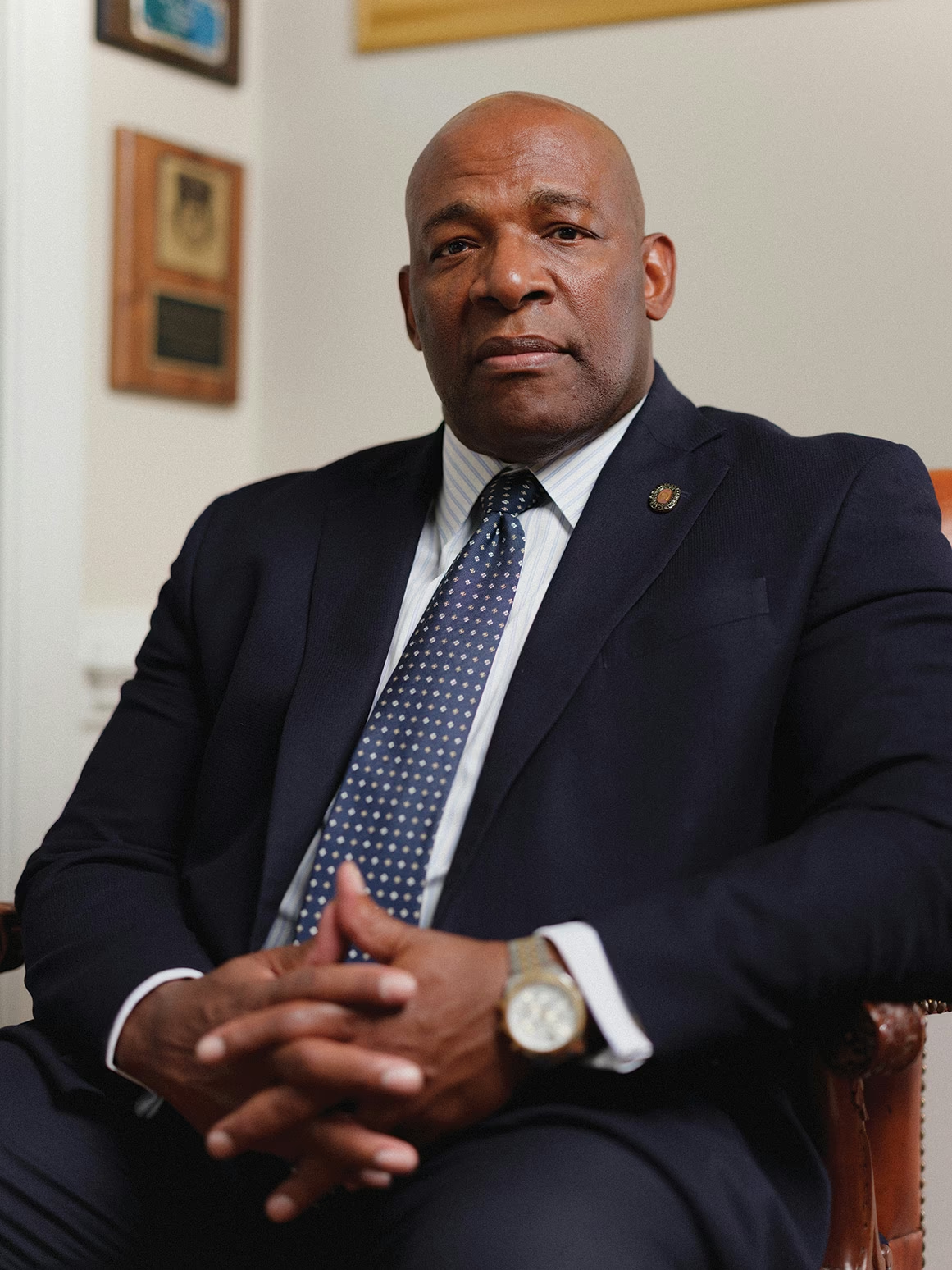

He and the few other Black officers on base made a point of getting to know the more junior Black service members and their families; they would all get together at one another’s homes after church, bonding over shared culture while far from home. “It was important to build a community that would support you in your career,” Curry said, “because oftentimes you had to navigate hostile waters.” During meetings where promotions were decided, white officers would sometimes make disparaging comments to Black airmen, Curry recalled. Sometimes they wouldn’t say anything at all. “You would walk away from a meeting knowing that you had done everything in your power and you had outdone your white peers, and you still wouldn’t get selected.”
Curry served 27 years on active duty, and another 15 in a civilian capacity in the Pentagon. In 2019, he became the director of the Air Force Review Boards Agency (Curry likens it to the Supreme Court of the Air Force), the equivalent of a two-star-general position. Racial progress in the military had been slow, but visible: When Curry graduated from Tennessee State in 1983, there had been only a handful of active-duty Black generals and admirals. By 2024, there were more than 80. Among them were Lloyd Austin, who had become the first Black secretary of defense in 2021; C. Q. Brown, then the chairman of the Joint Chiefs of Staff; Michael E. Langley, the first Black four-star general in Marine Corps history; and Darryl A. Williams, who’d been West Point’s first Black superintendent.
When Trump took office last year, Curry tried to keep an open mind. But just after he was inaugurated, Trump signed the anti-DEI executive orders. Then, four weeks after he was confirmed as secretary of defense, Hegseth told Brown that he’d been fired while Brown was visiting troops on the southern border. Curry became furious as he watched the Department of Defense take down the portrait of General James, whom he considers a hero, from the Air Force Art Gallery. He said he’d passed the painting daily on the way to his office for more than a decade; it made him smile and buoyed him to “keep on keeping on.” Curry is writing a leadership book based on James’s service, and meets regularly with James’s son and granddaughter; he is also working with the family to develop a film about James’s life. Seeing the newly empty wall space “really, really hurt.” (When reached for comment before this article went to press, Joel Valdez, the acting Pentagon press secretary, said that the Air Force had “added” a portrait of James to a different location “in the past two to three weeks.”)
In May 2025, Troy Meink was confirmed as secretary of the Air Force. Shortly after Meink arrived at the Pentagon, he told senior leadership, including Curry, that the Air Force would remove books from military libraries and educational institutions that fell under the wide umbrella of “DEI.” Curry was aghast. This, on top of the broader dismantling of initiatives that he believed were finally bringing some measure of equal opportunity to the military, was too much. Curry notified senior Pentagon leadership that he would retire.
He did not, however, want more junior officers to be pushed out of the military by a racist administration. At a luncheon held a few months later to celebrate his decades of service, he told the young Black officers in the room that it was now their responsibility to support one another. He encouraged them to stay in the service to defend the country and the Constitution. “You’ve got to carry it on. It’s going to be tough. And sometimes you’re going to have to swallow your pride,” he recalled saying to them. As Brigadier General Jimmy E. McMillian, a retired Air Force officer, told me, “If everybody that cares walks away, there will be nobody left who cares.”
Other senior Black military officials I spoke with expressed a similar sentiment. As one told me, “This country is great because of us, despite how they have treated us. And when I think about what I’m willing to live or die for, I would not sit idly by and let someone else come in and take away what we’ve built, despite some folks not recognizing the role that we played in building it.”
But there was a disconnect, it seemed, between these ideas and Curry’s actions. He was encouraging young officers to stay in the military and fight for their place within it when he himself had chosen to retire. How did he reconcile those two things?
Curry considered the question. “Just because you’re not in uniform doesn’t mean that you’re not still serving, that you’re not still contributing value to the fight,” he said. In retirement, he noted, he has the ability to speak more freely than if he had remained at the Pentagon. He also acknowledged that being able to step away is a privilege; he had long since completed the two decades of military service necessary to receive his pension. He got the house. He got the promotions. He got the recognition from his peers and the insignia on his uniform. He got the financial stability that allowed him to support his family.
For younger service members, deciding to quit comes with professional and financial consequences. Curry worries about the long-term damage being done to Black officers; some young Black Americans who see what’s happening in the military today, he realizes, may decide not to enlist at all. “In my opinion, it’s going to take us about 30 or 40 years to be able to create the appetite for Black men and women to want to serve and see the military as a viable career option,” he said. Curry and others hope that day will return eventually. (Sean Parnell, the chief Pentagon spokesperson, said in a statement that “individuals from all races, religions, and backgrounds are enlisting in our armed forces with greater enthusiasm than ever before.”)
The retired senior Air Force officer who told me he was “questioning whether it was all in vain” also spoke about his hopes for the future. The officer was one of several people I interviewed who asked to remain anonymous out of fear of personal or professional retribution. “I look at this as a bad fever,” he said, “and one day that fever is going to break.” But who will be left once it does?
Brigadier General McMillian worries that more early retirements could mean that young Black service members end up with fewer senior Black officers to serve as mentors and examples. “They look up and nobody in the room looks like them—that has a huge impact on your morale,” McMillian told me. “If Black officers don’t get mentors, it can kill their careers pretty early.”
But that, he thinks, is exactly what the defense secretary and his ilk want. “If Pete Hegseth and the current administration had their way, you wouldn’t see any of us in key leadership positions,” he said. “I think the whole idea is to eliminate as many of us as they can, take us back as far as they can.”
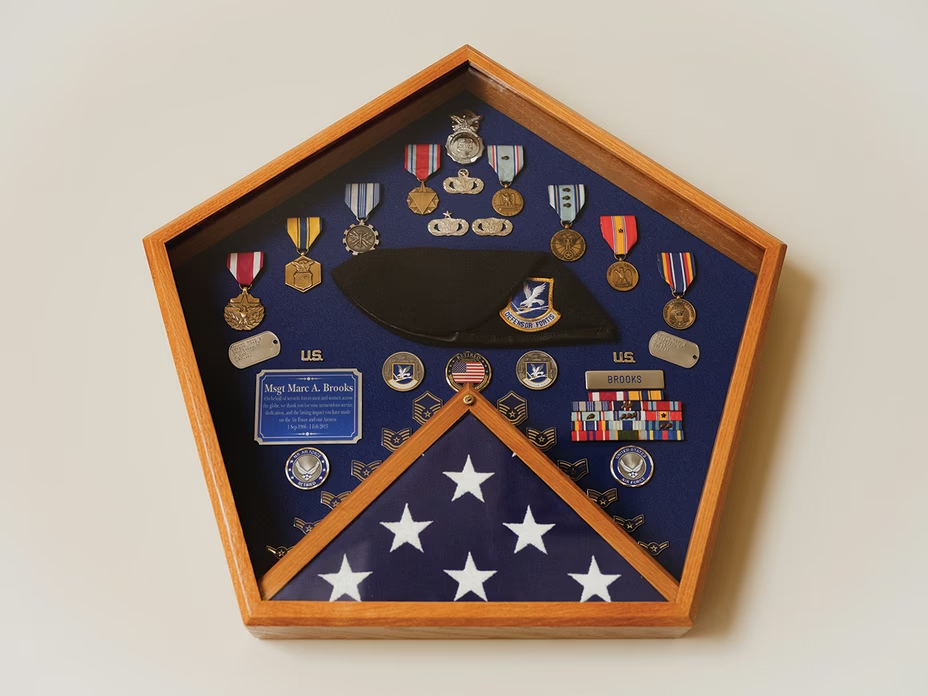
Essentially, “we’re talking about an administration that says, When people of color succeed, they took that opportunity out of the hands of a qualified white man,” Marc Brooks, a retired master sergeant in the Air Force, told me. (Parnell, the Pentagon spokesperson, said in his statement that “all personnel changes by the Secretary of War’s office are based on merit and job performance.”)
McMillian, who retired in 2012, knows firsthand about overt racism in the military. When he was a major and a commander in the 1990s, someone wrote GO HOME, NIGGER on one of the police vehicles under his purview. (An investigation failed to identify the person responsible for the vandalism.) He also knows that racism can manifest in more subtle ways. Throughout his 30 years in the Air Force, he worked to mentor Black officers, and particularly Black female officers, whom he thought had been systematically overlooked and might need extra support to remain in the service. “I was criticized for that early on in my career,” he told me—other male officers warned him that he might be perceived as showing favoritism to Black women—but he kept doing it anyway.
McMillian had grown up in rural North Carolina, where he attended segregated schools and was raised by a single mother with an elementary-school education. “She always would tell us, ‘You got to do better than me,’ ” McMillian said. At North Carolina A&T State University, a historically Black university in Greensboro, he joined ROTC. He eventually became the director of the Air Force’s Security Forces, in charge of some 40,000 people around the world. He was the first Black person to hold the position.
The longer McMillian spent in the military, the more he understood that success was not simply a matter of doing your job well. A Black service member had to learn to navigate tacit social and political norms—it was important to spend evenings at the officers’ club, for instance, even if you didn’t drink or would rather be with your family. He advised young Black officers not to have facial hair. He told them to consider themselves on duty at all times; even if they were just going to the convenience store, they should wear khakis and a nice shirt, not flip-flops and shorts. If their music was too loud when they drove around on base, he would tell them they needed to turn it down, not because it bothered him, but because there were people looking for reasons not to promote them. He had benefited from other Black officers having frank conversations with him about these dynamics, and so, as he advanced in his career, he tried to share this knowledge with younger Black members of the Air Force. “You don’t know what you don’t know,” he said.
He finds it ironic that Hegseth has put so much emphasis on the idea of unearned “affirmative action” promotions when McMillian believes that Hegseth himself—a former Fox News host who retired from the military as a low-ranking senior officer—is unqualified for the job of secretary. McMillian cited, as an example of what he sees as the secretary’s politicized agenda, the speech that Hegseth gave in Quantico, Virginia, in September 2025, for which he’d made the unusual decision to require 800 generals and admirals to travel in from their posts around the world. In the speech, Hegseth told military leaders that it was okay to use profanity with subordinates or even to “put hands” on them—seeming to suggest that he would condone physical assault. If they faced complaints of unfair treatment or discrimination, Hegseth said, the Pentagon would make sure that their records remained clean.
[Tom Nichols: Pete Hegseth needs to go—now]
Some Black service members told me that they interpreted this as a license for white officers to treat their Black subordinates poorly, without fear of repercussion. “It’s setting up a climate that perpetuates and protects wrongdoing,” Brooks told me. The tone of the speech was Get on board or get out. Listening to it, he said, “sent shock waves to those of us that spent a career in our beloved military.”
Robert Cook, who joined the Army out of Hampton University’s ROTC program, agreed with this assessment. Cook believes that the speech could, for instance, empower a white sergeant to overlook the work of his Black private, or a white captain to disregard the contributions of his Black lieutenant. “Under a good set of leaders, no white person wants to be accused of being a racist,” Cook told me. “Under this leadership, it could be seen as a badge of honor.”
In 2022, Joe Biden named Cook principal deputy assistant secretary of the Army for financial management and comptroller. Not long after, he became the Army’s acting chief of financial operations, responsible for a $188 billion budget and 15,000 employees. He worked closely with Joint Chiefs of Staff Chairman Brown as well as Secretary of Defense Austin, whom he’d known since the mid-’90s. Because Cook was a political appointee, he knew he would be leaving the Pentagon in early 2025. But although he says he had never had any trouble working with Republicans, many of whom he considered friends, he grew concerned about Trump’s intentions for the Pentagon even before the president returned to office. “Everybody knew that they were coming in to just gut the place and put their sycophants in,” Cook said.
During his first meetings with members of Trump’s DOD transition team, Cook was asked to single out the funds that had been appropriated for DEI initiatives. Cook, who had championed many of these programs, wasn’t going to make this task easier for the new administration. “When you get into the office,” he said, “you can look that up yourself.”
Other officers I spoke with expressed concern that both the new political appointees and some officers put in place by the administration might be dangerously underqualified for the jobs they were filling. Dan Caine, who replaced Brown as chairman, was considered an especially unorthodox pick. Caine had not attained the rank of four-star general, and had never led a joint military command.
Ultimately, having people like Hegseth in senior leadership, Cook thinks, has enabled immoral and even unconstitutional behavior in the military. Cook, who is now retired and works in the private sector, became particularly incensed when the military began bombing boats in the Caribbean in September. “I can’t shoot you because I suspect you’re a drug dealer,” Cook said, and yet that was exactly what seemed to be happening. Hegseth had already taken the highly atypical action of removing the judge advocates general of the Army, the Navy, and the Air Force, who were responsible for making sure that military actions were legal and authorized. He replaced them with people of his own choosing, saying that the administration wanted lawyers who “don’t exist to be roadblocks to anything.” (The Pentagon spokesperson said that all military operations in the Caribbean have been conducted “in complete compliance with the law of armed conflict.”)

In October, Admiral Alvin Holsey, who had been the head of the U.S. military’s Southern Command, which oversees Central America, South America, and the Caribbean, abruptly announced his retirement. Holsey, who is Black, didn’t give a reason for his retirement, but The New York Times reported that he “had raised concerns about the mission and the attacks on the alleged drug boats.”
Cook is worried about the implications of these sorts of actions for American service members in enemy territory. Since the war in Iran began, he has become even more concerned about the possibility of retribution. “You want to bomb kids in a school and not apologize for it,” he said, of Pentagon leadership. “What do you think they’re gonna do with us?”
One Army officer I spoke with, whom I’ll call Reginald, joined Junior ROTC in high school. His father was absent, and Reginald said that the Black Vietnam veterans who were in charge of the program were the first examples he’d encountered of “responsible Black men.” Much like Gerald Curry, Reginald was drawn to the military for the reliability it promised: “What I saw was stability, discipline, and financial security.”
After graduating from college, Reginald joined the Army and was deployed for multiple tours, including to both Iraq and Afghanistan. Over time, he realized that many of his fellow soldiers had learned more about the cultural and ethnic dynamics of these foreign nations than about those of their own country. “I found it very ironic, and almost hypocritical,” Reginald said. “We put so much emphasis on understanding the tribal history of these places, and yet we put almost no emphasis on understanding how we came to be. We just assume that we put on a uniform and all of our disparities melt away.”
Reginald’s desire to help add context to American history in military education led him to teach at West Point. As a Black American, he said, “if you’re not careful, you’re going to lose yourself in this thing and forget who you really are.”
He brought up a talk that the writer Ta‑Nehisi Coates gave at West Point in 2017, in which Coates encouraged the room of more than 800 students, faculty, and staff to reflect on the Cadet Honor Code: “A cadet will not lie, cheat, steal, or tolerate those who do.” The intolerance of lies, Coates argued, should not apply only to individuals, but also to the country and its military more broadly. “If you’re going to be intolerant about the deceptions amongst each other,” he told the cadets, “there’s nothing wrong with being equally intolerant about the deceptions people ask you to submit to.” When Reginald and I spoke, the speech had recently been deleted from a West Point YouTube page.
Many such challenges to a narrow conception of patriotism are now being deliberately excluded from military education. Another person I interviewed, whom I’ll call Sarah, develops training materials for the military. After Trump issued his executive orders targeting DEI in January 2025, Sarah said, her commanders told her team to manually strike out certain language in dozens of commercial texts—those not created by the military—that their division loans to trainees. They were also told to remove whole sections about accomplished Black service members from educational materials produced by the military.
Sarah had been deeply involved in a Black affinity group within her branch of the military, which she said helped her feel supported and motivated. This group, along with a number of others dedicated to examining and addressing inequities in the military, has been disbanded. In an Orwellian statement, a spokesperson for Sarah’s branch said that the “disestablishment” of these groups had been carried out “in compliance with executive orders Ending Radical and Wasteful Government DEI Programs and Preferencing, and Initial Rescissions of Harmful Executive Orders and Actions.” Valdez, the acting Pentagon press secretary, put the administration’s ideological aims more bluntly in an email: “We are proud to declare DEI is dead in the Department of War.”
Sarah’s original plan was to work for at least 20 years before retiring so that she could qualify for a full pension, but she now plans on leaving the military before the end of the year. “I can’t ethically and morally continue down this road,” she said.
Reginald described the experience of being Black in the military as akin to being in a pool that’s filling up slowly, drip by drip. “As the pool fills up with little drops of water, the weight of that over time just gets heavier and heavier and heavier. And then you look up and you’re like, Man, I’m drowning.”
For his part, Reginald has decided that instead of getting out of the pool, he is going to swim harder. “Hegseth and all of his bravado ain’t a strong enough person to get me to step aside from 20 years of something that I feel connected to,” he told me. “Because this is mine; this isn’t yours. You’re paying rent here.” He took a deep breath. “I’ve got too much invested in this thing.”
As the descendant of enslaved people, Reginald is sustained by his sense of history. He is operating in the tradition of Chappie James; of Hazel Johnson-Brown, the first Black woman to become a general in the military; of Charles Young, a man born into slavery who became the first Black person to achieve the rank of colonel in the Army; of Lewis and Charles Douglass, sons of Frederick Douglass, who were among the first Black Americans to volunteer for the Union Army; and of James Gratz Thompson, a 26-year-old Black cafeteria worker from Wichita, who asked in a letter to The Pittsburgh Courier shortly after the attack on Pearl Harbor, “ Should I sacrifice my life to live half American? ”
“Will things be better for the next generation in the peace to follow?” “Would it be demanding too much to demand full citizenship rights in exchange for the sacrificing of my life?” “Is the kind of America I know worth defending?”
Thompson would go on to serve as a corporal in the Army during World War II. His letter to the Courier, a prominent Black newspaper in the early to mid-20th century, is credited with catalyzing its “Double V” campaign, which urged Black Americans to use the war as an opportunity to fight both fascism abroad and racism at home.
Some Black Americans were compelled by the idea, while others rejected the notion that they should fight for a country that was still hanging them from trees. Black service members have wrestled with the complexities of patriotism for centuries, from the Revolution to the current war in Iran. Reginald said that, for him—in the tradition of the Double V campaign—service feels worthwhile as a way to continue fighting for the country he thinks America can be.
“I swear an oath to the Constitution. And I remember that the idea to form a more perfect union would suggest that we will never be perfect,” he said. “But we’ve got to try to strive to be. And I’m okay with doing that work of trying.”
In May, I drove to Arlington National Cemetery, where I stood in front of Chappie James’s tombstone. He died of a heart attack just three weeks after retiring from the Air Force. He was 58 years old.
In March 2025, Arlington was embroiled in controversy when it began scrubbing its website of links and references to Black, Latino, and women veterans—among them James, Johnson-Brown, and Colin Powell—to comply with the anti-DEI executive orders. Following public outcry, the cemetery republished the names but said that, in keeping with Trump’s directives and the Pentagon’s instructions, “individuals from the previously listed categories ‘African American History,’ ‘Hispanic American History’ and ‘Women’s History’” could now be found under more general labels, such as, “Science, Technology and Engineering.”
In Arlington, the sky was blue and the breeze was cool. I walked to the other side of James’s tombstone and found, engraved there, words he’d written in 1967 and later delivered as part of a speech to a group of Air Force officers after the assassination of Martin Luther King Jr. In his remarks, James said that despite the way America had continued to fail Black Americans, he was still compelled to fight for it: “This is my country and I believe in her,” he said. “And I’ll serve her, and I’ll contribute to her welfare whenever and however I can. If she has any ills, I’ll stand by her until in God’s given time, through her wisdom and her consideration for the welfare of the entire nation, she will put them right.”
James’s portrait may have been taken down at the Pentagon, but his service to the United States cannot so easily be discarded.
This article appears in the July 2026 print edition with the headline “The Betrayal of Black Patriots.”
The post The Betrayal of Black Patriots appeared first on The Atlantic.