The first thing you notice upon entering the College of Arms, in London, is a small and incongruously blue statue of a kiwi, clutching a gold axe in its right claw. Sorry, let me try that again: In the odd historic language of heraldry, this is “a kiwi Azure grasping in the dexter foot an ice axe bendwise Or.”
The bird belongs to the coat of arms of Sir Edmund Hillary, a New Zealander, who was part of the first team to conquer Mount Everest. (Penguins are also involved in Hillary’s arms, as is the hearty if ungrammatical motto Nothing venture nothing win.) No one could tell me why the kiwi statue ended up in this beautiful brick building around the corner from St. Paul’s Cathedral, but the college is a magnet for this sort of historical detritus. Next to the kiwi is the cushion on which Queen Elizabeth II sat during her coronation. I lean in closely to see if any impression of the royal buttocks remains visible. It does not.
Founded in 1484, the College of Arms operates as part of the Royal Household, answering to the monarch. Its main functions are determining whether someone is entitled to use an existing coat of arms, and granting new arms to individuals and corporations. In Britain, having a coat of arms is still part of public life; you cannot join the Order of the Garter, a personal club of worthies curated by the sovereign, without one. For a fee of about $12,000, the college will perform the genealogical research and design work necessary to grant you arms. But the college also caters to an unlikely group of would-be knights-errant: Americans. “We get so many genuine inquiries—it’s a huge amount,” Dominic Ingram, a herald at the college who conducts such research, told me. Of the 120 or so arms the college grants each year, it estimates that up to 10 percent are honorary grants for non–British citizens, and the bulk of those go to Americans.
“I loved how the application and vetting process was essentially the same protocol that has been used for centuries,” Angelo Sedacca, from the Bronx, told me. He was granted his honorary arms—which feature castles and a lion on the shield, and a swan resting atop a pair of scales—when he was working as a sergeant in the New York Police Department, and he hopes that his descendants will appreciate using them.
During the Middle Ages, heraldic disputes could become so animated that a Court of Chivalry was called upon to resolve them. You know the sort of thing—your noble house of Scrope is using a blue shield with a gold diagonal stripe in battle, and then some arriviste dorks called the Grosvenors roll up and do the same. (This really happened: The court ruled in favor of the Scropes, and the Grosvenors had to change their arms.) The college’s workload expanded after the Industrial Revolution amid demand from the newly rich mercantile and professional classes. A coat of arms meant tradition and legitimacy.
[Read: Where do flags come from?]
Today, if you can find an ancestor who was “armigerous”—noble enough to bear arms—then you have an inherited right to their coat of arms. Otherwise, you can design your own, complete with chevrons, castles, and all the heraldic animals that you desire. Ingram said his heart “sinks a bit” when someone wants a lion: “There’s so many lions already.” He appreciates those who choose something unusual, such as a frog or a flamingo. A more traditional choice might be a mythical beast, such as a unicorn, a griffin, or an enfield—“sort of like a fox but with the legs of a chicken.”
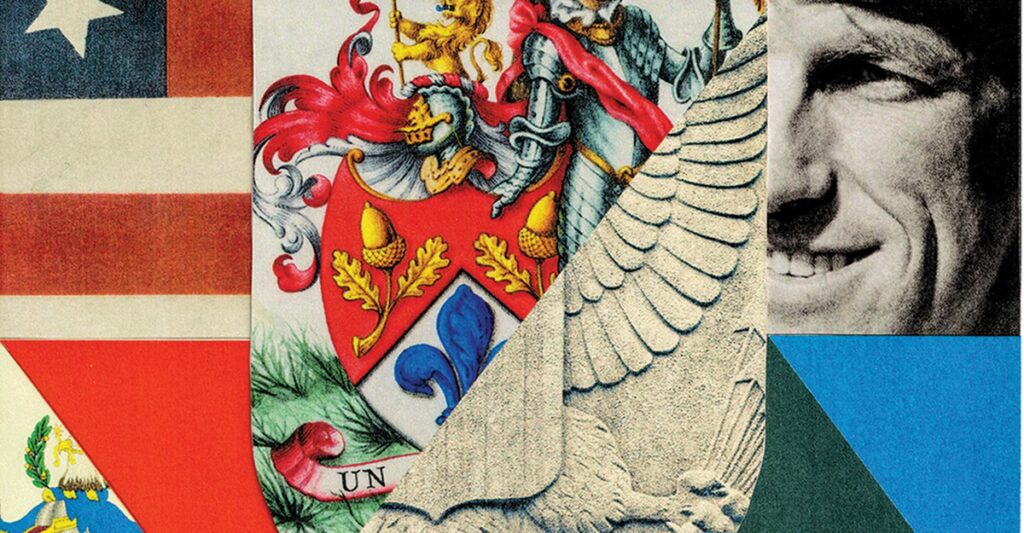
The demand for arms is so high that scammy companies have sprung up online, claiming to award arms and even titles. “I went to several different vendors on the internet only to be let down in the process,” Harry Rossander, a retired Army Corps of Engineers lieutenant colonel in Rapid City, South Dakota, told me. He eventually ended up with a design of a bald eagle perched on a tower, registered with a college of heraldry in America.
As a Briton, I sometimes find the American mania for our island’s history baffling. Then again, growing up in a place that’s lousy with old stuff will do that to you. One of the most important battles of the English Civil War was fought in what is now a park near my parents’ house in Worcester, England. In 1786, John Adams and Thomas Jefferson visited the site to see where, almost a century and a half earlier, their forebears had fought to dethrone a king, showing the world that another system of government was possible. “Tell your Neighbours and your Children that this is holy Ground, much holier than that on which your Churches stand,” Adams later wrote. “All England should come in Pilgrimage to this Hill, once a Year.” Sadly, it does not; instead, teenagers go there after school to smoke weed.
The college currently consists of 11 officers of arms, who undertake the genealogical research and act as custodians of the records. (They include kings of arms, heralds, and their apprentices, who are called pursuivants.) When I emailed the college to request an interview, the response came from Ingram, who was then the herald on call. I found this concept as amusing as the other Friends find Ross having a pager, given that he’s a paleontologist. (“Is it, like, for dinosaur emergencies?” Monica asks. “ ‘Help, come quick, they’re still extinct!’ ”) Ingram is 33; he joined the college after completing a doctorate in history at Oxford. Why did he choose this profession? I asked. “Lack of common sense?” he replied at first, but later acknowledged that “the main advantage is you don’t really answer to anyone—well, apart from the King, I guess.” The heralds operate like independent contractors, with their own caseloads. Most of their income is from research fees, but each herald also receives an annual salary of £18 ($24) from the King.
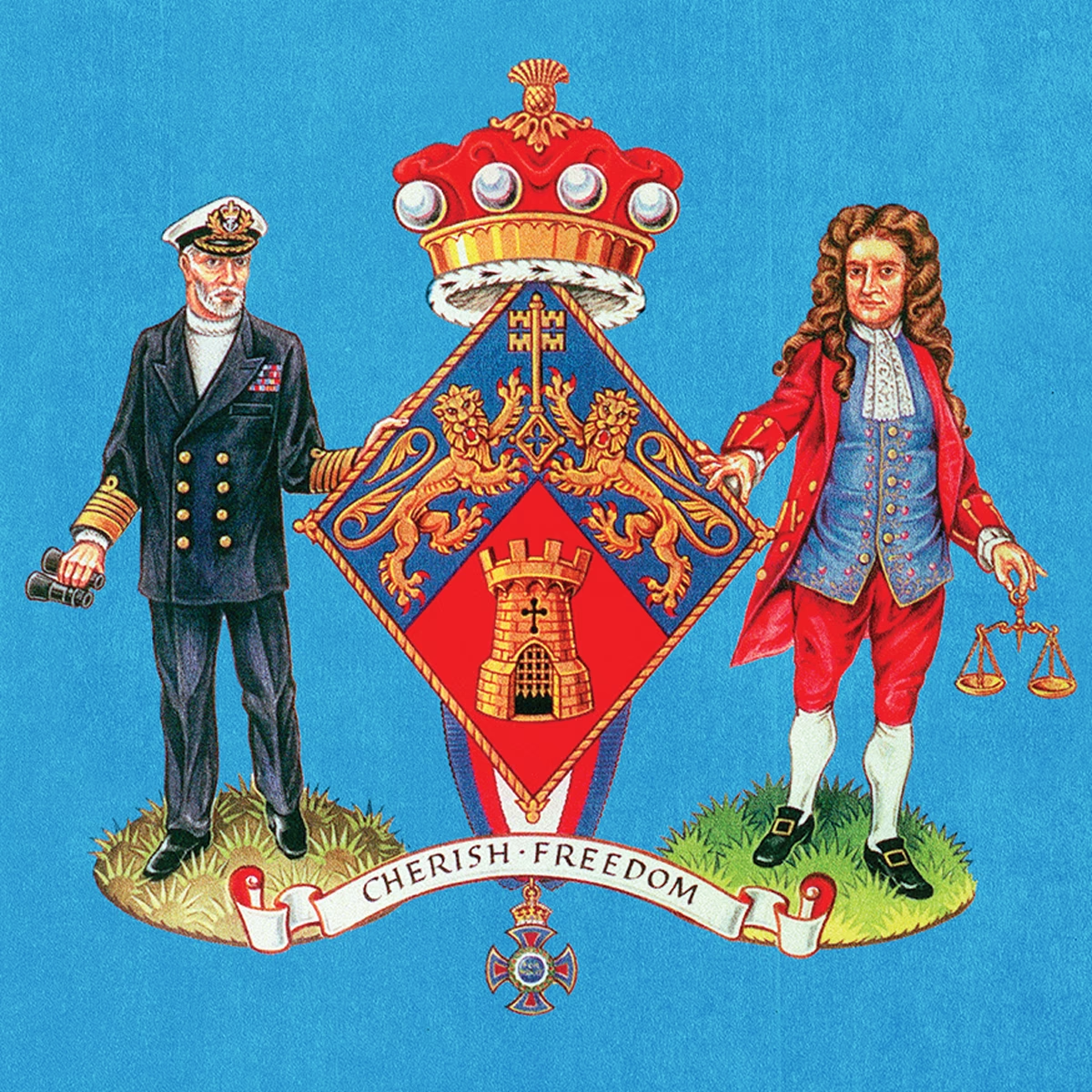
When the design process is complete, the precise form of the arms is recorded in giant leather-bound books. Turn to almost any page in the college’s records and an intriguing human story will jump out. Ingram showed me the legendary Admiral Horatio Nelson’s arms and family tree, which features his left-handed signature—his right arm having been lost in the Battle of Santa Cruz, in Tenerife. As a baroness, Margaret Thatcher was entitled to “supporters,” figures on either side of her design. She chose the scientist Isaac Newton and a generic Falklands War admiral, who bears a passing resemblance to Colonel Sanders.
The first American arms began to be drawn up hours after the signing of the Declaration of Independence. In a gesture reflecting the move from monarchical privilege to democratic consulting, a committee was convened in the new country to create the Great Seal of the United States. (Like most committees, it took ages to come to any decisions. A finalized version, involving an eagle, an olive branch, and stars, was presented for approval six years later.) Even after the unfortunate incidents of 1776, many Americans, including George Washington, still looked to the college back in London for validation. In 1791, it confirmed that the hero of the American Revolution could use the heraldic arms of the splendidly named de Hertburn family—three red mullets and two red bars on a silver background.
Ingram also showed me the arms of the Hollywood actor Douglas Fairbanks Jr., who was such an Anglophile that he trained with the Royal Navy during the Second World War and received an honorary knighthood in 1949. His blue-and-gold—sorry, azure-and-or—shield has a ribbon connecting its two halves, presumably to indicate his appeal on both sides of the Atlantic. Incidentally, in case you are ever quizzed on this, the other heraldic colors are purpure (purple), gules (red), sable (black), and vert (green). The entire language of heraldry is “a sort of pseudo-abstract, corrupted northern French,” Ingram said, reflecting its creation soon after the Norman Conquest of England. The drapery or scrollwork around a shield is called a lambrequin, a five-petaled flower is called a cinquefoil, and an emblem or animal that puns on the bearer’s name is called a rebus. Heralds are very into puns, which presumably provided endless amusement during cold medieval nights. The arms of the late Queen Mother’s family, the Bowes-Lyons, feature bows and lions. The royal arms of Princess Beatrice—the former Prince Andrew’s daughter—have three bees on them: Bee-thrice.
[From the June 2026 issue: Helen Lewis on the men who don’t want women to vote]
Until the mid-20th century, Ingram told me, the college took a relaxed attitude toward Americans who wanted arms, and typically trusted their claims to English ancestry. But the rules have gradually tightened. When Joe Rudé, from Atlanta, was granted arms in 1995, he had to prove direct male descent from a British citizen, including those who lived in the American colonies. He came up with one Thomas Rood, an attorney from Glastonbury, in the west of England. “We don’t know a great deal about him, except that he had an unfortunate end,” Rudé, 82, told me. “His wife died, and so he was left with several kids. After a long, hard winter, his oldest daughter turned up pregnant, and he was arrested.”
And Thomas was the father? “That’s what was decided by the very religious people back then,” Rudé said. “And he was hanged. He is the only person hanged for incest in the history of the United States.” Everyone wants to find an ancestor who’s remarkable, but they don’t tell you which flavor of remarkable you’re going to get.
In my experience, some Americans with an overly keen interest in English aristocratic traditions seem motivated by disdain for their fellow citizens who are not descended from white Europeans. In March, the White House anti-immigration czar, Stephen Miller, posted in disgust after Britain removed the remaining 92 hereditary peers from the House of Lords. Sir, I wanted to reply, your country rebelled against being governed by noblemen like the 12th earl of Dundee and the 24th earl of Erroll !
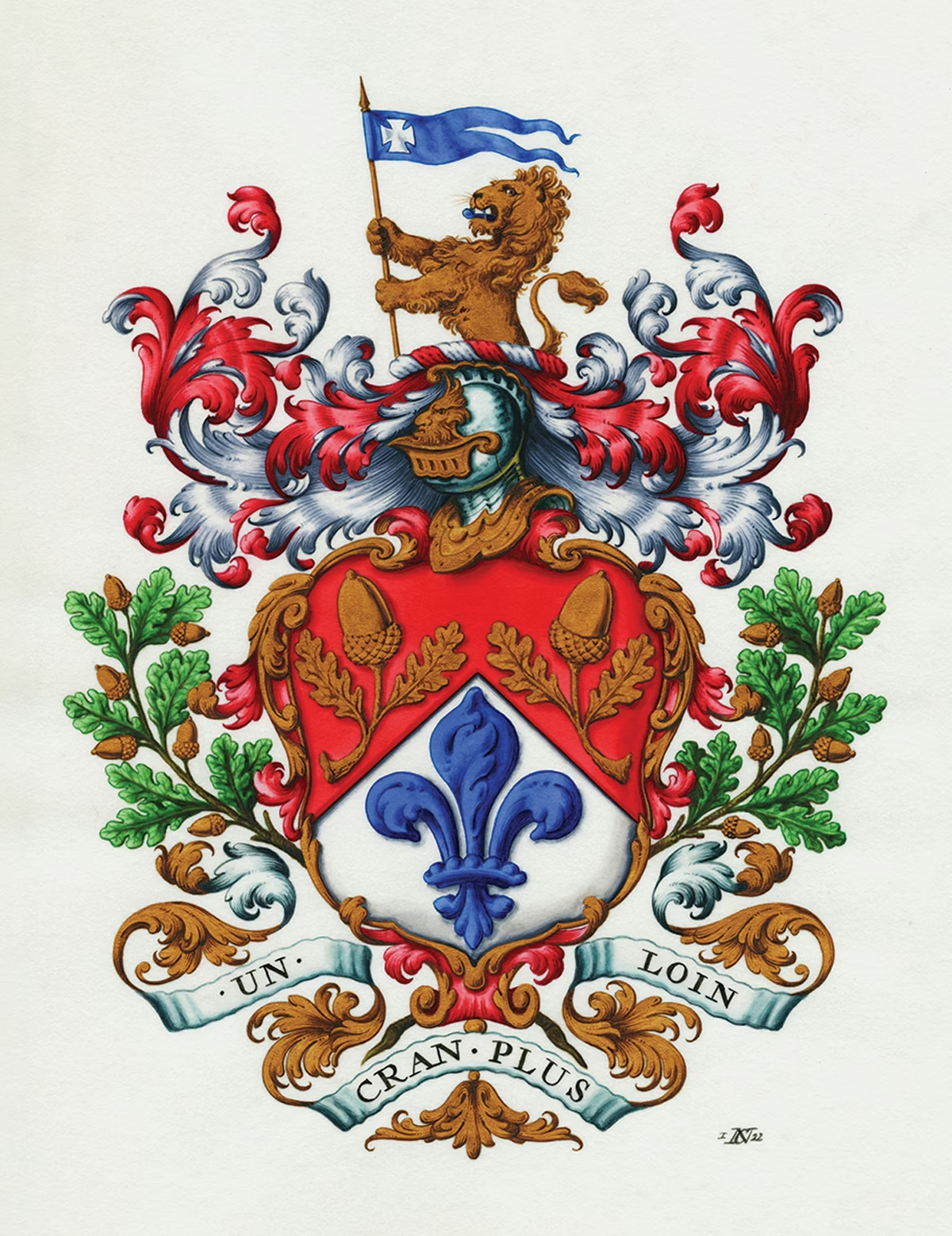
But the American arms holders I interviewed cited only a sincere and nerdy interest in history, plus a passion for graphic design. “My last Simons ancestor in England was a master of the horse for one of the dukes of Rutland,” Brenton Simons, from Boston, told me. He had blended the dolphin and scallop shells of the Simons arms with elements from the arms of his mother’s family, the Fitches: “three leopards’ heads and a chevron in gold against a green background.” He had also commissioned a heraldic badge, of a fox with a sprig of strawberries in its mouth. “Some people try to squeeze too many things into their arms,” said Simons, who used to be the president of the genealogical society American Ancestors. “Or create arms that look like steampunk designs. Simpler is better.”
George Cobb of Gastonia, North Carolina, told me that his arms represented ancestors from Scotland who had immigrated to Appalachia. He had chosen a green background to represent “the mountains of both Scotland and North Carolina, geologically the same mountain chain separated eons ago.” He also has a golden lion and the North Star beneath a flame, which symbolizes the search for truth. “My wife’s initial response was to ask where her family was represented, which led to an explanation that arms are granted to an individual rather than a couple—so now I know I will one day be designing arms for her as well,” Cobb told me, adding that his best friend immediately asked if Cobb would design arms for him. “He is of Mexican and Spanish descent, and the final arms became a beautiful representation of both Aztec and Spanish ancestry.”
The ancient traditions of heraldry evolve with the times. Women can bear arms, although unmarried ones traditionally display them on a diamond (known as a lozenge) or oval shape, rather than a shield. Before joining the Royal Family, Kate Middleton was granted her own lozenge, featuring three acorns (representing her and her two siblings) bisected by a gold chevron (for her mother’s maiden name, Goldsmith). Many married women squish their arms onto a shield alongside their husband’s, although this is not obligatory. Britain’s legalization of same-sex unions in 2013 did not faze the heralds; in fact, Ingram told me he is eager to do a joint design for a gay couple.
Once someone has been granted arms, what do they actually do with them? “I have a vast number of paintings of my arms, but I also display them in carvings on my gateposts, on custom ties, cuff links, my cars,” Brady Brim-DeForest told me. “Pretty much anywhere I can integrate them, I do!” He is such a heraldry obsessive that he petitioned for arms as a 15-year-old, only for the college to tell him to come back when he was 18. Brim-DeForest, who splits his time among Texas, Maine, and a castle in Scotland, now serves on the Committee on Heraldry at American Ancestors.
As I listened to stories of men searching for their roots, it occurred to me that even white Americans who can trace their forebears back to England are part of a diaspora. Irish Americans who have never set foot in Cork or Donegal may find themselves tearing up on St. Patrick’s Day, so why wouldn’t the descendants of an incestuous lawyer from Glastonbury or the duke of Rutland’s servant want some connection to the old country?
By the end of my time at the college, I had begun to wonder whether a coat of arms was just an extremely upmarket version of a social-media bio. We love to put labels on ourselves, to take personality quizzes, to ruminate on what it means to be an ENTJ or a Scorpio. Creating a coat of arms is an attempt to distill your heritage, hopes, and hobbies into a striking visual form: Here’s where I came from—and what I’ve made of myself.
* Illustration image sources: Andrew Holt / Getty; Heritage Art / Heritage Images / Getty; Courtesy of Brady Brim-DeForest; Roberto Machado Noa / Getty; Baron / Hulton Archive / Getty; College of Arms; John Springer Collection / Corbis / Getty
This article appears in the July 2026 print edition with the headline “So You Want a Coat of Arms.”
The post So You Want a Coat of Arms appeared first on The Atlantic.