STALIN’S APOSTLES: The Cambridge Five and the Making of the Soviet Empire, by Antonia Senior
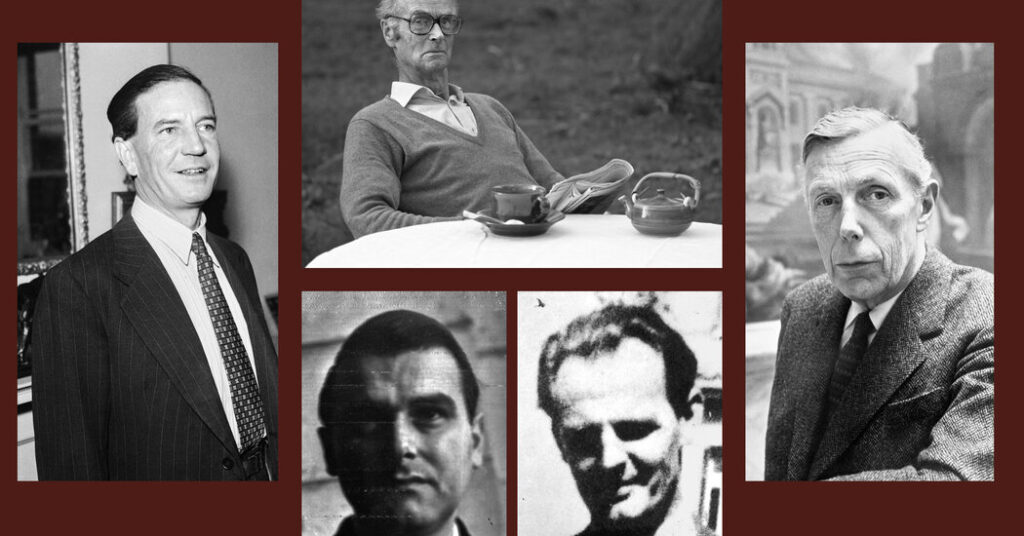
There seems to be an endless appetite for books about the Cambridge Five, the notorious double agents who passed British secrets to their Soviet handlers. The scandal of their duplicity is irresistibly intriguing: How did five students from Cambridge University — Kim Philby, Guy Burgess, Donald Maclean, Anthony Blunt and John Cairncross — betray their country for nearly 20 years, from the 1930s through the early years of the Cold War?
The literature on Philby, in particular, is especially voluminous. Having climbed the ranks of counterintelligence, he deployed a mix of charm and ruthlessness to deceive even the trained professionals who worked closely with him. Before he defected to the Soviet Union in 1963, one of the covers he blew was that of David Cornwell, later known as John le Carré, who included a fictionalized version of Philby in “Tinker, Tailor, Soldier, Spy.” “Just a naturally bent man,” le Carré said of Philby, in a 2010 television interview. “I wouldn’t have trusted him with my cat for the weekend.”
Philby inevitably takes up a good deal of room in Antonia Senior’s new book, “Stalin’s Apostles: The Cambridge Five and the Making of the Soviet Empire.” But Senior, an author of historical fiction, a book critic for The Times of London and the host of a podcast about espionage, intends to put Philby and his fellow traitors in their place. She argues that English accounts have been “very parochial,” with a particular fixation on the men’s privileged class backgrounds and political disillusionment, while the Russians have turned them into mythic exemplars for Putin’s authoritarian era.
Senior wants to draw attention instead to the hideous damage these men inflicted. Their victims include the people of Eastern and Central Europe, who were vying for independence from both communist and fascist regimes. As recently as 2025, intelligence archives were still being opened, and she makes special use of material from Albania and Lithuania. She depicts the Cambridge spies as both terrible and terribly effective: Their treachery was indispensable to realizing Stalin’s expansionist ambitions. His “Apostles” — the word refers to a secret society at Cambridge to which some of the men belonged — helped him “build a Red Empire.”
Not that the prospect of such success was necessarily obvious at the start. The early lives of these radicals were filled with bumbling and hubris. Maclean was drawn to the “simplicity” of communism’s rules. Blunt, who would later become an eminent art historian, exhibited a “dry, intellectual interest” in Marxist theory. Philby was a “mediocre” student whose socialist father, St. John, converted to Islam and later became an outspoken fascist. Cairncross was memorable mainly for being “very boring.” Burgess, for his part, was a fun-house mirror version of the dull Cairncross: so relentlessly sociable and proudly promiscuous that anyone he couldn’t seduce or entertain tended to find him intensely annoying.
These characters were eventually responsible for so much cruelty that Senior has to allow herself some moments of dry wit when she can. Recounting the early days of their careers in British government and intelligence agencies, she marvels at the Soviets’ curiously conspicuous code names. Britain was called the ISLAND. Philby, son of the larger-than-life St. John, was SONNY. Burgess, who was gay, was mockingly referred to as LITTLE GIRL. A photographer and communist agent named Edith Tudor-Hart was EDITH. Another agent was THE FAT ONE. “Yes,” Senior deadpans, “he was fat.”
This isn’t a book that dwells on why the Cambridge Five did what they did. Senior avers that as youthful utopians they found the prospect of revolution “intoxicating” — a word so useful in its vagueness that I was only mildly surprised to see her resort to it twice in the span of four short paragraphs. In the 1930s, with fascism on the march, the English double agents could think of themselves as morally superior.
After they learned that Stalin had entered a secret pact with Hitler, however, they could continue to work for the Soviets only by tying themselves into intellectual knots. Yes, they liked to portray themselves as anti-imperialists — though as Senior repeatedly points out, they were evidently untroubled by the Soviet Union’s “imperial bullying.” The spies minimized the pact as a shrewd play by Stalin on the path toward world revolution.
They exhibited a cold contempt for the anti-Soviet partisans they sent to their deaths. Senior detects in this a stubborn strain of Anglocentric colonialism. Philby, who later wrote an unrepentant and self-regarding autobiography from his new home in the Soviet Union, disdained the Albanian assets he delivered to Soviet traps. “Even in our more serious moments, we Anglo-Saxons never forgot that these agents were just down from the trees.” Any problems with the Soviet experiment, Senior adds, could be written off as the consequence of Russia being “peasanty and backward.” The real revolution, as Marx predicted, would happen in Britain and Germany.
During the first two-thirds of “Stalin’s Apostles,” Senior highlights the Cambridge spies’ hypocrisy and malevolence whenever she can — a hostile approach that’s justified, if occasionally repetitive. Sometimes she dials up the charges before having to walk bits of them back. She paints a particularly grotesque diptych of a woman being tortured by the Soviet secret police in the last years of World War II as the Apostles funneled secrets to the Soviets and enjoyed cushy pensions. Several pages later she concedes that the causal links between the Cambridge Five’s perfidy and this particular victim aren’t completely clear: “It is not always possible to draw a direct line.”
But the narrative picks up pace in the last third, after the war ends, when defectors from the Soviet Union threaten to blow the Apostles’ covers. The story moves briskly, as the spies play a hair-raising game of trying to serve their masters in Moscow while the walls start closing in. Senior, with her flair for the dramatic, can’t resist one final image of unadulterated villainy. She envisions “a gleeful Philby, with blood on his hands as he sipped pink gin.”
STALIN’S APOSTLES: The Cambridge Five and the Making of the Soviet Empire | By Antonia Senior | PublicAffairs | 462 pp. | $35
Jennifer Szalai is the nonfiction book critic for The Times.
The post This Infamous British Spy Ring Fed the Soviets Secrets for Years appeared first on New York Times.