As President Trump and regional diplomats began to herald the possibility of a deal with Iran that could end the war, the spokesman for the Iranian foreign ministry responded with his version of a history lesson.
Esmail Baghaei, the spokesman, posted an image on social media of a famous relief carved into an archaeological site in Iran that portrays a Roman emperor bowing in submission to a king of the Sassanians, an ancient Iranian empire.
“In the Roman mind, Rome was the undisputed center of the world,” Mr. Baghaei wrote, in an apparent reference to the political and military might of Washington today. “The Iranians shattered that illusion.”
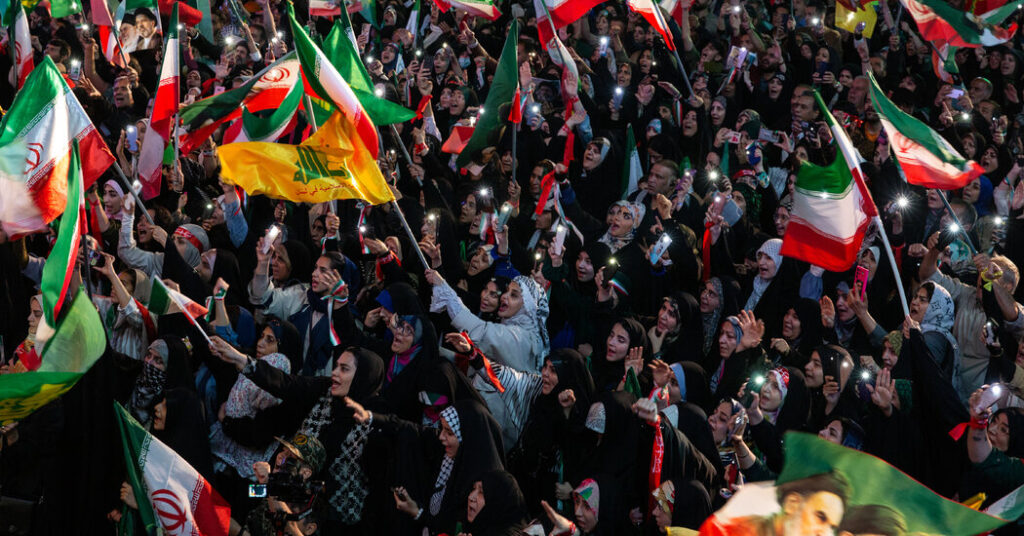
Despite the military and economic battering Iran has endured during its war with the United States and Israel, its leaders are casting the reported terms of a possible preliminary agreement with Washington as a victory.
On Saturday, American and Iranian officials announced that a preliminary framework for an agreement between the two countries had been largely negotiated, though not finalized. Details of what is in the proposal are unclear, though Mr. Trump wrote in a social media post that the Strait of Hormuz, a vital waterway for oil and gas shipments, would be reopened as part of the agreement.
How well Iran has fared through the negotiations can be determined only once the terms are known. But regional experts say the country will have a good chance of portraying the results as a win. Two months ago, Mr. Trump had vowed there would be no deal with Iran except “unconditional surrender.” Instead, Washington looks as if it has been forced to accept Iran’s oft-repeated position that the only way to end this standoff is through negotiation, not war.
“For their domestic and regional base, they proved themselves the underdog, capable of taking on two nuclear-armed powers,” said Ellie Geranmayeh, an analyst and the author of the European Council of Foreign Relations’ Iran Nuclear Monitor.
“They are now coming out with a stronger geopolitical hand than before given their dominance in the Strait of Hormuz. They also demonstrated that Trump’s nuclear dilemma with Iran won’t be resolved through military might.”
By comparison, the biggest American and Israeli ambitions against Iran seem to have been frustrated. The killing of Iran’s supreme leader and top military commanders has not toppled the country’s autocratic system of clerical rule.
Any terms for curbing Iran’s ballistic missiles or its regional network of allied militias, according to what has been reported about the preliminary agreement, do not appear to be included.
And it remains unclear what commitments Iran would have, and under what time frame, to suspend its nuclear program or remove its stockpile of highly enriched uranium, which could be turned into a nuclear weapon.
Discussion about those commitments may be pushed into a second phase of negotiations.
Claiming victory is in some ways easier for Iran than for the United States because “the definitions of victory are so lopsided,” said Mohammad Ali Shabani, an Iran analyst and editor of the regional news website, Amwaj.media.
But when it comes to projecting strategic deterrence, he said, Iran does have reasons for renewed confidence.
For years, Iran’s previous supreme leader, Ayatollah Ali Khamenei, who was killed in the opening salvos of the U.S.-Israeli attack, had become cautious in confronting Washington, Mr. Shabani said.
In the current war, Iran’s new leaders showed a willingness to take an aggressive approach that Ayatollah Khamenei had seemed reluctant to take. Iran closed the strait, even though it meant Iran’s vessels were also blocked, and it bombarded its neighbors, the Gulf Arab states that are key regional U.S. allies but with whom Tehran had previously sought to foster closer ties.
Iran’s new leaders — among them the deceased supreme leader’s own son and successor, Mojtaba, “have done away with that predictable nature,” Mr. Shabani said.
Instead, they have shown that “you can enter a war with the United States and you will not be completely eliminated. In fact, you could resist. You can resist and impose so much damage on the world economy, so much disruption, that you can compel them to make a deal with you,” he said.
None of this negates the serious challenges that Iran faces.
The country is in the throes of a devastating economic crisis. Critical industries with both military and civilian uses have been badly bombarded — from steel factories to petrochemical plants.
If the negotiations offer Iran either temporary sanctions waivers to sell its oil, or an unfreezing of some of its economic assets abroad, Iranian leaders can sell that domestically as another significant win, said Farzan Sabet, an analyst of Iran and weapons systems at the Geneva Graduate Institute in Switzerland.
Yet, perhaps most important for Iran’s leaders, Tehran will apparently retain its newfound ability to close the Strait of Hormuz through the threat of renewed drone or rocket attacks on shipping, he added.
“In the short to medium term, that’s the sort of deterrence they’re going to be able to maintain,” Mr. Sabet said.
In the longer term, he said, countries like Saudi Arabia, the United Arab Emirates and Qatar will probably bolster pipeline networks to transport their oil and gas without reliance on the strait — potentially lessening the potency of Iran’s newfound geopolitical leverage.
Much of the outlook on an agreement depends on its moving beyond just an understanding to end hostilities, said Ali Vaez, the Iran project director at the International Crisis Group. He was skeptical that the two sides would actually be able to move to a second phase of negotiations, when a tentative plan to halt the war would be transformed into a substantive deal.
“I don’t like the framing a lot of people use to say this is just a defeat for the U.S., or a win for Iran,” he said. “This had really turned into a lose-lose dynamic for both sides, and I don’t believe either side will be really winning as a result of this understanding.”
Sanam Mahoozi contributed reporting.
Erika Solomon is The Times’s bureau chief for Iran and Iraq.
The post Iran Projects Victory in Potential Deal With Washington appeared first on New York Times.