In “Toy Story 5,” beloved dolls from previous chapters — Buzz Lightyear, the cowgirl Jessie and others — encounter Lilypad, the latest rival for their latest child’s affections. A bright green, kid-friendly computer tablet, Lilypad can rap, translate conversations into Spanish and send messages to your friends.
“Extinction,” moans Rex, the team’s plastic T-Rex who, even under the best of circumstances, struggles with fears of abandonment. “Not again.”
In the coming weeks, toys will be at the core of new chapters of decades-old franchises that have transformed how filmmakers and animators have used their productions to sell toys, and vice versa.
There’s the “Star Wars” spinoff “The Mandalorian and Grogu” (May 22), whose spiritual overlord, George Lucas, became one of the richest filmmakers on the planet when he chose to swap some of his directing fees for the original film in favor of licensing and merchandising rights to all related toys.
Two weeks later, there’s “Masters of the Universe,” part of a franchise that flipped the usual order of things for children-focused IP, releasing toys two years before the 1980s Saturday-morning cartoon. And on June 19, there’s “Toy Story 5,” the newest sequel in a series that reignited sales of once-popular products like Mr. Potato Head.
While vastly different in many ways, each franchise has become inseparable from the toys created to market them. Consider “Masters of the Universe.” When fans think of its sword-wielding hero, He-Man, they’re just as likely to picture the improbably musclebound Mattel action figure as the animated cartoon or the 1987 feature starring Dolph Lundgren.
Such products have understandable appeal to children, said Meredith Bak, an associate professor in the childhood studies department at Rutgers University-Camden and the author of “Playful Visions: Optical Toys and the Emergence of Children’s Media Culture.”
She explained, “If they’re watching shows or reading books or comics, any opportunity they have to extend that universe has exciting potential. Toys let you re-enact scenes and story lines, but they also let you adapt them and make them your own in really interesting ways.”
Here’s how each of the new films has changed the toy-movie equation.
‘The Mandalorian and Grogu’
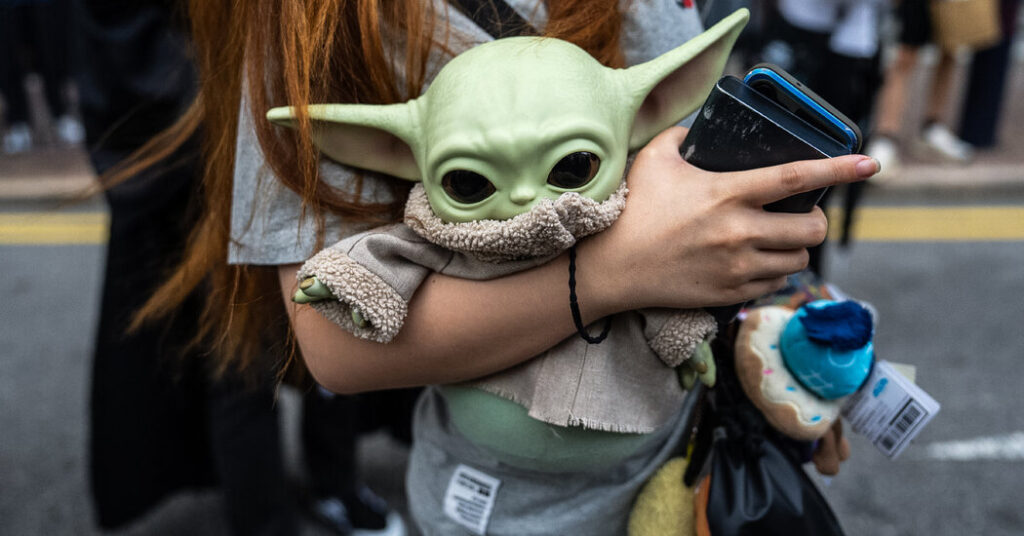
Inspired by the long-running manga series “Lone Wolf and Cub,” about an assassin for hire who takes his toddler son with him, the Disney+ series “The Mandalorian” features Grogu (popularly known as Baby Yoda) as the infant ward and sometime fighting companion of the bounty hunter hero. Even those who have never seen an episode have certainly seen one of the millions of Grogu-themed plush dolls, key chains and collectible figures that have generated hundreds of millions of dollars in sales for the Walt Disney Company.
But before the series debuted in 2019, producers kept Grogu a secret to heighten the drama of the ultimate reveal. Even toy manufacturers were left in the dark, which resulted in a dearth of Grogu toys that Christmas, a major downer for fans clamoring for a Baby Yoda plushie.
That won’t happen with the big-screen spinoff “The Mandalorian and Grogu.” In addition to costumes, pins, Lego sets and, for the deep-pocketed, a cargo-carrying robot fashioned after Grogu’s pram ($2,875), there is an entire line of plush dolls featuring Grogu in various states of “action” and repose. There’s a “Pick-Me-Up Grogu” whose eyes pop open when you lift him; a “Sleepy Grogu” who doesn’t do much of anything except nap; and so on.
Despite the dolls’ appearance, Grogu is a baby who isn’t quite a baby (he’s in his 50s) and isn’t Yoda, despite his nickname. But Grogu is cute, in a weird reptilian sort of way.
Bak attributes some of his appeal to Chibi, a popular manga and anime style in which characters are drawn with enormous heads and eyes and relatively tiny bodies. “The original Yoda is this elderly sage, so the baby version is always the cute version,” she said.
‘Masters of the Universe’
The plan to use the animated series “Masters of the Universe” to increase sales for the already popular line of Mattel action figures was wildly successful on both ends: The show became one of the highest-rated children’s programs on TV at the time, while the toys became one of Mattel’s hottest doll lines, at one point surpassing Barbie.
The series, however, was controversial from the start. Critics groused about a show dreamed up to sell toys, while parents worried that the violence — notably high for cartoons of the era — might promote similar violence in young viewers. “If you look through the New York Times archives, you can find people writing in and saying, ‘What do we do about this ‘He-Man’ show?’” Bak said.
The related action figures were not only popular, they were legion. Mattel was able to churn out a vast army of characters — Mer-Man! Zodac! Stinkor! — thanks to inexpensive overseas production and the creation of a modular system in which nearly all of the figures shared the same arms, legs and torsos.
Those dolls had six points of articulation (action figure-speak for the joints), so children could make them look like they were running, leaping, or whacking each other with swords. In a sign of just how far these bendable toys have come, some of the fancier collectible versions produced to promote the 2026 feature film boast 30 joints.
In addition to the action figures, Mattel has also unveiled a Skeletor mask that allows children to imagine they’re the movie’s cackling, skull-faced villain. “When you put it on your face and move the jaw, it talks in Skeletor’s voice,” said Nick Karamanos, senior vice president of entertainment partnerships at Mattel.
The new film pokes good-hearted fun at the original series, like the corniness of the character names — including He-Man — and He-Man’s obsessive attachment to his Power Sword. For fans who love the sword as much as he does, there’s an electronic version that lights up, vibrates and makes swooshing sounds when you wave it around. Ostensibly, it’s intended for children 6 and older, though early excited users on TikTok primarily seemed to be men in their 30s and 40s.
Karamanos, who had the original toys growing up, has played with many in the latest crop. “They’re fun,” he said. “That’s one of the pleasures of working here.”
‘Toy Story 5’
Toy-wise, the “Toy Story” movies have long seemed several decades behind the times. In 1995, when the first film was released, how many children were still playing with cowboy and astronaut dolls, let alone Slinky Dogs, which debuted in 1952, or green plastic soldiers?
“The ‘Toy Story’ films have always told this romanticized story of childhood play,” Bak said. “There’s this kind of projection of a generic childhood that would have settled more in the 1960s.”
A similar theme continues in “Toy Story 5” with the addition of Lilypad, a tablet “toy” inspired by LeapPad tablets, which debuted in 1999. In this latest chapter, Lilypad represents the conflict between playing on screens (bad) vs. playing with actual toys like Woody (good). In one scene, an alarmed Jessie scans the neighborhood and sees home after home filled with children mesmerized by glowing screens.
But is Lilypad really bad? Sure, she’s incredibly addictive, as screens can be, and not above a little online deception to get her way. In the end, however, she just wants the film’s main child, Bonnie, to have friends, and what better way than to help her bond online with the other kids and get her to stop playing with all those stupid dolls?
Several toymakers are releasing Lilypad products, including LeapFrog, makers of the original LeapPad, and Mattel. Some are actual functioning tablets; there are also figurines and dry-erase sets.
The fact that LilyPad is the seeming villain of the piece isn’t slowing production. As a precedent, Karamanos pointed to Lotso from “Toy Story 3,” a.k.a. Lots-o’-Huggin’ Bear.
In “Toy Story 3,” Lotso devolved from a lovable, strawberry-scented teddy bear to a rage-filled, sadistic jerk after being spurned by Daisy, his previous owner. And yet toys based on him sold well. “Lotso brought a different kind of personality to the pantheon of Toy Story toys, and he was an amazing success,” Karamanos said.
Bak said that parents should be less concerned about specific toys or how children play with them (trade them with friends? Obsessively collect each one?), and think more about the simple value of play itself.
“We’re always trying to attribute some kind of meaning to play experiences,” she said. “What’s particularly drawn me to studying toys that have sort of a negligible formal educational value is that they still have value, even if the child isn’t learning anything per se. The child has this affective connection to these things, and they make up the child’s material world in a really profound way.”
The post How Movies and Their Toy Tie-Ins Are Changing This Summer appeared first on New York Times.