Richard Thaler’s research has changed people’s understanding of human decision making. He has recently been thinking about the process that the Democratic Party uses for selecting its presidential nominee, given that he considers the 2028 election to be unusually important. Mr. Thaler spoke with David Leonhardt, an editorial director in Times Opinion.
David Leonhardt: You have documented many ways our decisions are less than optimal. Can you describe the most common mistakes that organizations make when hiring people? After all, when a political party nominates a candidate, it is effectively hiring somebody to do a job — namely, to win an election.
Richard Thaler: Hiring decisions are difficult in general, and getting it right becomes harder as you move up the organizational hierarchy. The most reliable predictions about job performance come from what are essentially tests. If you are hiring a chef, ask her to cook something. Predicting whether she can also keep everyone in a large restaurant working together is harder. What test can you give to measure that ability?
In the absence of a suitable proxy for observing someone doing the actual job, many employers resort to some sort of interview. This is problematic, because unstructured interviews provide surprisingly little useful information about future job performance.
One illustration of how hard it is to pick and evaluate successful leaders comes from the dismal record of hiring head coaches in major sports. This past year, nine of the 32 National Football League teams fired their head coaches, and a 10th resigned. All these coaches had gone through rigorous selection processes and had track records. Yet the turnover rate was more than 30 percent in a single year.
Given the stakes, getting the process right for selecting a presidential candidate is crucial. The Democrats are looking for someone who will be successful in the toughest job in the world, but also win what amounts to a popularity contest that will not happen until 2028. Many candidates have not run in a national election before, and none have experience in the full range of a president’s responsibilities, so a true “test” is impossible. That said, I think it’s possible to improve the process in meaningful ways.
Leonhardt: What do you think is the most likely mistake that Democrats would make in 2028?
Thaler: Choosing the candidate that Democrats like best rather than the one who has the best chance to get elected.
Leonhardt: What would you say to someone who argues that electability is unknowable — and so Democrats should pick the candidate they like most and hope for the best?
Thaler: To be clear, I don’t think that the mistake we are talking about is any more common among Democrats than Republicans. It is simply human nature to think that other people share our views. Lovers of cilantro don’t understand why others can’t stand the stuff. And vice versa.
Both parties have made the mistake of nominating a candidate that was ideologically unacceptable to most voters: Barry Goldwater for Republicans in 1964, George McGovern for Democrats in 1972. Both suffered gigantic losses. Today, neither party has close to a majority of the voters, so the next President will be someone who can attract votes from both independents and members of the opposing party. Rather than deciding which candidate they and their friends think is most exciting, Democrats need to decide who will be best able to get some support from folks who voted for Trump, possibly three times.
Leonhardt: I think some people in politics would argue that the current system is just fine. Over the last few decades on the Democratic side, it produced Barack Obama and Bill Clinton, who both started as underdogs. So what’s the problem?
Thaler: That is a good point. But you’re overlooking the role of luck. Clinton became the nominee in 1992 because more prominent Democrats passed on the race, believing that George H.W. Bush was unbeatable. As for Obama, he lost in his first attempt at running for Congress and then had a lot of good fortune in his Senate campaign. So neither was an inevitable success. And who knows how many candidates who had the potential to become transformative politicians dropped out after an early loss?
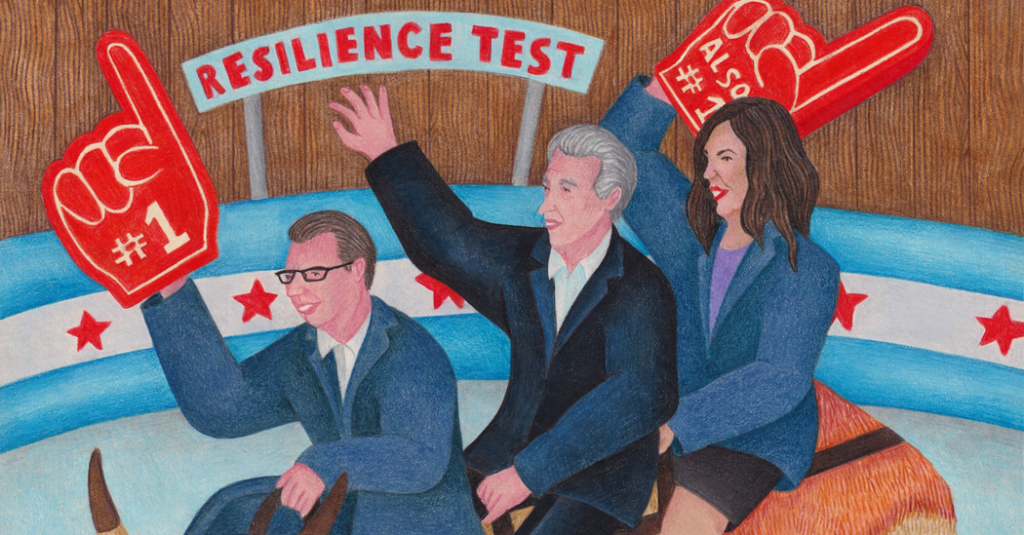
The deep field of candidates this time around might include one or more superstars, but if Democrats want to increase their chances of winning in 2028, they should improve the three components of the process: first, the time between now and the 2028 campaign; second, the structure of the primaries; and third, the televised debates during the primaries.
Leonhardt: What can Democrats do in 2026 to help themselves in 2028?
Thaler: During the midterm campaigns, presidential candidates traditionally remain awkwardly coy about their ambitions. Nevertheless, they do campaign in various ways.
One common component is publicizing the book that many happen to have completed just in time for the election, a tradition that goes back at least to John Kennedy’s “Profiles in Courage.” Of the current crop of potential candidates, Gavin Newsom, Kamala Harris, Gretchen Whitmer, Josh Shapiro and Pete Buttigieg have all written books. As an author, I can have no complaints about book talks per se, but let’s face it, these are mostly excuses for the candidates to get some airtime and sell some books.
Given the times we are in, there are other public-facing events that could be more productive. Specifically, the upcoming midterm elections should be the focus of everyone’s attention from now until November. Control of both the House and Senate is up for grabs, as well as many vital races at the state level.
There are many upsides to this approach. The presidential hopefuls include some of the party’s best spokespersons, and each will have consultants helping them with their messages. Some will have money to spend. Let’s put them to work helping Democrats’ candidates win the midterms. Where they have been invited by a midterm candidate — an essential condition — they could go to town halls, help design ads, offer briefings on issues and meet voters directly.
This can serve several purposes. It can help the party win the midterms, constraining the Trump administration, and at the state level, help ensure a fair and safe election in 2028. At the same time, it can also provide a testing ground for evaluating candidates in the very places where the 2028 race will be determined. And it can educate the candidates about the issues that voters in swing districts care about.
Some candidates are already active in this way, but I suggest that the Democratic National Committee devise procedures to reward presidential hopefuls who get themselves invited to campaign in the midterms. One way would be for such activity to count toward determining who participates in the televised debates.
Leonhardt: Let’s move to the primaries themselves. I’m going to guess that you do not think it’s rational for Iowa and New Hampshire — two small, unrepresentative states — to play the prominent role in the nomination process that they long did.
Thaler: That is a good guess, David. Allowing them to retain their primacy for so long is a nice illustration of what we behavioral economists call status quo bias: People have an excessive tendency to stick with the way they have previously done things, even when a change is long overdue. Why do some retail transactions via credit cards still require a “signature” that amounts to a random scribble with a finger?
In 2024, the Democratic National Committee finally tried to alter the primary calendar by scheduling South Carolina before New Hampshire. The motive looked suspect because President Biden, who was still running at the time, had won the Democratic primary in South Carolina in 2020. Nonetheless, the instinct was right. The data do not support the argument that Iowa and New Hampshire voters have any special skill at choosing candidates. Nominees who did well in those states have not done especially well in general elections.
For 2028, the D.N.C. is once again thinking about a new primary calendar. Given that this time the reforms will take place in the absence of either an incumbent or an overwhelming favorite, it’s a good time to construct the calendar in a way that gives the party the best chance of picking a strong candidate. Scheduling their states’ elections so early gave the voters in Iowa and New Hampshire greater influence than other states. Is maintaining a long tradition worth risking an election as vital as this one?
The D.N.C. should shift the emphasis to the states that will determine the election — the swing states. One way to do this would be to arrange two early, smaller versions of Super Tuesday, each with a geographic focus to hold down campaign costs. There could be a Rust Belt day, when Michigan, Pennsylvania, Wisconsin and perhaps Minnesota hold primaries, followed by a Sun Belt day, including Georgia, North Carolina, Nevada and Arizona. It would also be fine to choose only two of these states, and let the candidates focus on them.
The goal would be to put the candidates in front of the types of voters that will end up deciding any close election. To an economist like me, this would be a straightforward way to redesign a system to improve the party’s chances of success.
Leonhardt: Rahm Emanuel, who appears to be running himself, recently told me that he thinks all states should follow New Hampshire’s history and allow independents to vote in Democratic primaries. Americans identifying as independents now far outnumber those who consider themselves Democrats or Republicans, and allowing them to vote in Democratic primaries would invite them to be part of the party’s process. What do you think of that idea?
Thaler: Yes, Rahm is an exception to the rule that politicians are coy about their presidential aspirations. Being coy is not in his repertoire, and his candor is one of many things I admire about him. As usual, he is a perceptive observer. I agree with him that giving independents — and perhaps Republicans — a way to vote in the Democratic primary is a good way to begin broadening the Democrats’ appeal and help select a candidate who can win in swing states.
Leonhardt: The lead-up to the primaries would certainly involve debates, and modern debates have come to be a bit ridiculous, with a large number of candidates and questionable selection rules. How would you improve them?
Thaler: Let’s go back to thinking about the problem of hiring a C.E.O. for a large corporation. Does any firm bring in a dozen of their top prospects for a debate before a live audience? There are many processes that would be better.
Alas, we probably can’t get rid of political debates, but we can improve them. One reform would be for the D.N.C. to use objective criteria, decided in advance, and then have the courage to stick to the formula regardless of who does and doesn’t make it. It should include more than the usual criteria of early polls and the number of donors. Playing a helpful role to candidates in the midterms could be another, as I mentioned. Yet another could be electoral history. A candidate who has established a record of doing well in prior elections and holding important administrative positions should be included before a reality TV star or a sports commentator. We do not want to give airtime to folks who are just trying to increase their media presence.
Leonhardt: What about the format of the debates?
Thaler: The current rules give candidates an incentive to hog the microphone. I would instead use the timing rules of chess matches, in which each participant would get a fixed total amount of time for the entire debate. When their time is used up, the microphone would be turned off.
Notice that this rule would encourage candidates to think strategically about their time usage. An ability to think at least one step ahead would be a welcome attribute in our next president.
Richard Thaler, a professor at the University of Chicago, was the 2017 recipient of the Nobel Memorial Prize in Economic Sciences for his contributions to behavioral economics. He is the author of “Misbehaving” and a co-author of “Nudge” and mostly recently “The Winner’s Curse.”
The Times is committed to publishing a diversity of letters to the editor. We’d like to hear what you think about this or any of our articles. Here are some tips. And here’s our email: [email protected].
Follow the New York Times Opinion section on Facebook, Instagram, TikTok, Bluesky, WhatsApp and Threads.
The post How Democrats Can Improve Their Odds, According to a Nobel Economist appeared first on New York Times.