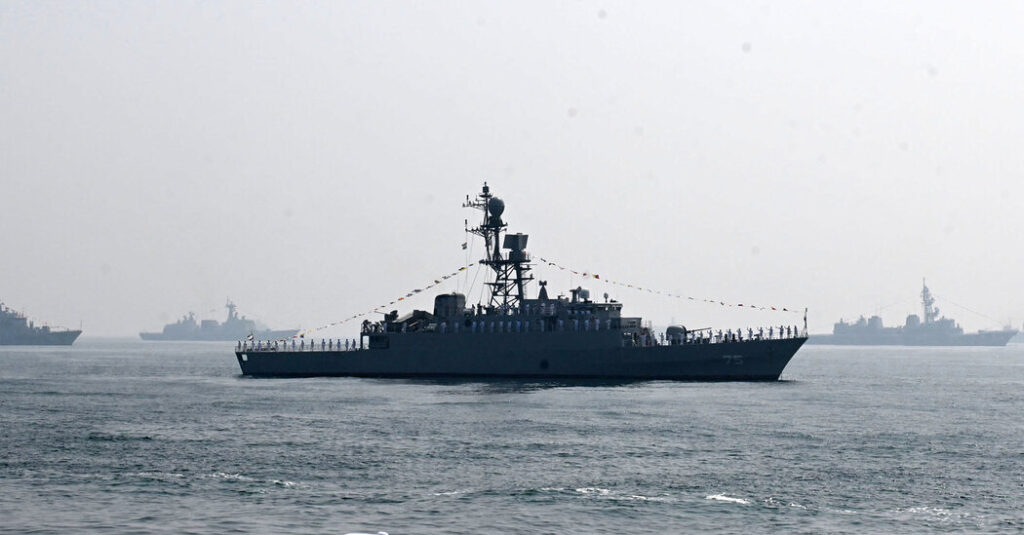
Hours after an American torpedo sank an Iranian warship off the coast of Sri Lanka, the largest hospital in Galle, the port city closest to the disaster, began filling up. White ambulances with red crosses whizzed back and forth between the harbor and the hospital carrying the injured, while the dead were brought in later on trucks..
By day’s end, the mortuary had run out of space. Hospital workers had to place body bags in a mixture of sawdust and dry ice — a technique fishermen use to keep their catch from spoiling — as they waited for two refrigerated vehicles to arrive.
Sri Lanka, an island nation in the Indian Ocean more than 2,000 miles from the Persian Gulf, found itself sucked into a faraway war — and an unexpected diplomatic skirmish with Iran. Iranian diplomats were upset that Sri Lanka had not allowed the Dena, one of Iran’s most prized warships, into its territorial waters, even though the country had earlier invited the Iranian Navy to visit.
Sri Lankan officials said they were surprised when the Dena and two other Iranian ships asked in late February to drop in at short notice. After the United States and Israel attacked Iran on Feb. 28, Sri Lanka stalled, fearing that admitting them would affect its neutrality on the U.S.-Israeli war on Iran and threaten its security.
Even as its boats and helicopters rescued stricken sailors from the Dena, the government took another day before deciding to shelter the Bushehr, an aging fleet-supply vessel that was requesting safe haven. By then the third, an Iranian landing ship called the Lavan, was already docked in a port in neighboring India.
Sri Lanka and Iran share friendly ties, but the former’s wariness upset Iranian officials, who felt that it left the Bushehr exposed to a follow-up attack, according to two people with direct knowledge of the diplomatic conversations. They asked not to be identified because they were not authorized to speak publicly.
The Sri Lankan government was unable to reach a quick decision, weighing its national interests against its obligations under international law to help a vessel in distress.
The government’s trepidation illustrated the challenge many countries face as they try to avoid incurring the Trump administration’s wrath.
Iran called the attack on the Dena an “atrocity.” Pete Hegseth, the U.S. secretary of defense, reveled in the torpedoing of an Iranian warship that “thought it was safe in international waters,” one of more than 50 Iranian warships the U.S. said it has destroyed.
For Sri Lanka — a small country of 22 million people that has endured political corruption and strife, crushing national debt and a devastating cyclone last year — a geopolitical misstep could cause further economic damage.
It now must decide what to do with the 32 sailors it rescued from Dena and more than 200 taken ashore from the Bushehr. Sri Lanka’s defense ministry said it had sent a communiqué to Tehran and was waiting to hear back. In the meantime, the sailors have been given 30-day visas.
Galle’s chief magistrate has directed the hospital to move the 84 bodies it recovered to the Iranian embassy.
India, too, finds itself wedged between Iran and the United States as it harbors the Lavan, docked in a busy commercial hub in Kochi, and houses its crew of 183 — mostly young cadets — in nearby naval facilities.
A Surprise Visit
Around two weeks before the Dena was torpedoed, the three Iranian ships were among dozens of vessels and naval personnel from more than 70 countries that took part in peacetime naval exercises off the southeastern Indian city of Visakhapatnam.
Vessels from several European countries, including Russia, and even a reconnaissance aircraft from the United States participated in the drills, held under the motto “Camaraderie, Cooperation, Collaboration.”
Iranian sailors stood at attention on board the Dena as President Droupadi Murmu of India presided over a fleet review during the 10-day extravaganza, hosted by the Indian Navy.
The commander of the Sri Lankan contingent met with a senior Iranian Navy officer in India and invited his navy to visit Sri Lanka — the kind of routine courtesy often extended to other countries, according to Sri Lankan officials.
The day after the drills ended on Feb. 25 and ships began making their way home, U.S. forces were mounting in the Gulf. Iranian officials asked the Sri Lankan government if their three ships could pay a four-day visit to “enhance cooperation” starting March 9, according to Sri Lankan officials.
The request caught Sri Lanka by surprise, especially when they discovered that the flotilla was already close to Galle, an old port city toward the southern part of the island, about 800 nautical miles from Visakhapatnam.
As Sri Lanka pulled together the paperwork, the United States and Israel started airstrikes on Iran on Feb. 28. That gave Sri Lanka pause. Government officials said they were worried that letting in the vessels might bring the conflict to its shores, even though they recognized that the Iranian ships were easier targets if they remained in international waters.
Iranian officials had also reached out to India on Feb. 28 seeking safe haven. India gave permission the following day, according to government officials in New Delhi. But only the Lavan reached India, “presumably” because it was closest, S. Jaishankar, India’s external affairs minister, said on Saturday.
Fury, Confusion and Dismay
The distress signals started coming in at 5:08 a.m. on March 4, originating about 19 nautical miles from Galle. The Dena had been struck by a Mark-48 heavyweight torpedo — designed to snap a ship from underneath.
Sri Lanka’s navy and air force rushed to mount a rescue, with India sending assistance later. They found bodies and life rafts amid oil slicks in the sea, but no sign of the warship. The first victims reached Galle later that morning. Rescue teams — some of them in hazmat suits — lifted bodies from navy vessels and lifeboats onto stretchers and rushed them to the hospital.
Surviving Iranian crew members, many of them young cadets, came in with broken bones and head and chest injuries. Some had spinal fractures — a doctor examining them said that was probably because the blast propelled them upward before they landed heavily.
On Tuesday, Sri Lanka called off its search with around 20 people still missing.
The United States hasn’t said whether it gave the Iranian sailors any warnings before the strike, but Iranian and Sri Lankan officials said they were not given any. The Iranian government said that the Dena was unarmed and defenseless. The U.S. Indo-Pacific Command disputed that claim in a social media post.
But the Dena wasn’t the only ship out there.
The Bushehr, a smaller naval vessel sometimes used as a training ship, was also waiting for Sri Lanka to let it in. Less than a week earlier, on Feb. 27, Sri Lanka had brought ashore an injured Iranian sailor from the ship for treatment, determining that it had an obligation to provide humanitarian assistance under international maritime laws.
But the Bushehr itself, with more than 200 crew, remained in international waters to Sri Lanka’s west, closest to Colombo, the capital and a busy commercial port. Officials from Sri Lanka’s foreign ministry held extensive discussions with their Iranian counterparts when the Bushehr reported that one of its engines was damaged, which strengthened its case for safe harbor on humanitarian grounds.
On March 5, Sri Lanka took the Bushehr into custody. . The two sides agreed the crew would disembark in Colombo that day and the ship would sail to a smaller port in Trincomalee, to the country’s northeast.
That night, President Anura Kumara Dissanayake of Sri Lanka said his government had been caught in a quandary. In a televised address, he said that the country’s neutrality, particularly in the context “of the Middle East conflict,” dictated that it could not “permit our land territory, maritime zones or airspace to be utilized in a biased manner by any nation engaged in a conflict.”
But he said they also had to abide by international laws, including the 1982 United Nations Convention on the Law of the Sea, which has guidelines about helping ships in distress.
Alireza Delkhosh, Iran’s ambassador to Sri Lanka, told reporters in Colombo the day after that being neutral did not mean taking no action. “Neutrality is saying, everybody should care about international law and international regulations,” he said.
India has not commented on what its next steps are. Mr. Jaishankar said India had offered the ships safe haven on humanitarian grounds. The flotilla had “got caught on the wrong side of events,” he said.
Anupreeta Das covers India and South Asia for The Times. She is based in New Delhi.
The post Iran’s Frantic Attempt to Save Its Ships Before Torpedo Attack appeared first on New York Times.