The Lebanese are exhausted.
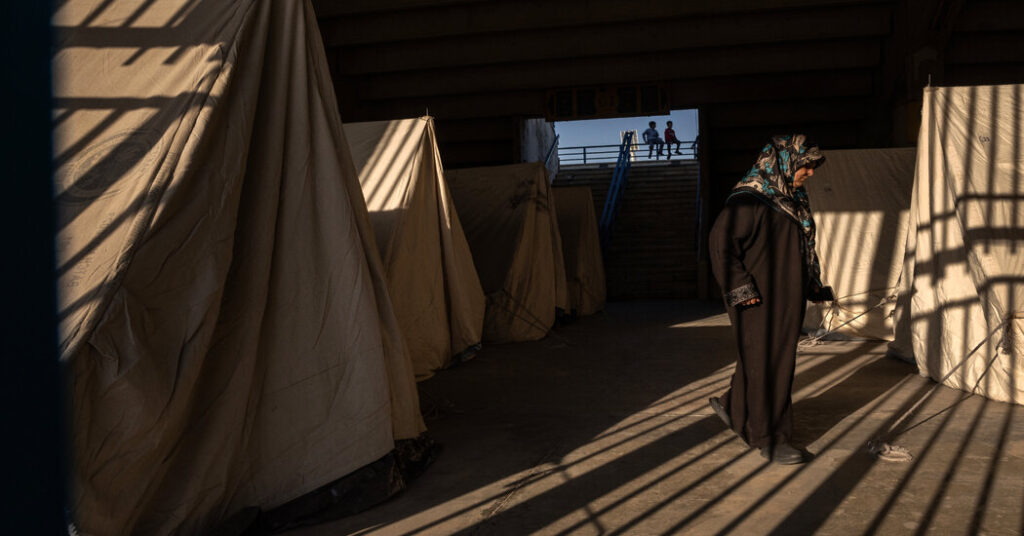
They are tired of frantically evacuating their homes and living in makeshift shelters for months on end. Tired of the thunderous booms of explosions echoing across the capital day and night. Tired of homes in the south being bombed and towns flattened. Tired of Hezbollah dragging Lebanon into wars on behalf of others — and of a government too weak to stop it.
“Our people are tired,” said Leila Safa, 65, who had fled her home in southern Lebanon twice in the past year and a half because of wars between Hezbollah and Israel.
“We just want to live peacefully,” said Hassan Kuaik, a 64-year-old farmer whose home near Lebanon’s border with Israel was badly damaged in the previous escalation between the two sides. Now he fears it will be destroyed.
“Tired? We’re beyond tired,” said Hind, 43, sitting on Beirut’s seaside corniche, where she had slept the night before after evacuating her home in the southern suburbs, where Hezbollah, an Iran-backed militant group, holds sway. She declined to give her full name for security reasons.
Even in Lebanon, where new crises tend to erupt before the country recovers from the last one, the latest outbreak of war caught people off guard. Few in the country — government officials, foreign diplomats, even Hezbollah’s supporters — expected that the group would fire on Israel in support of Iran after being battered by its escalation of hostilities with Israel in 2024.
Now, Lebanon is engulfed in its second major war in less than two years, and the loyalty of Hezbollah’s base is being tested as never before. Once fervent ideological zeal for resisting Israel at any cost has given way to the brutal reality of what Hezbollah has brought on Lebanon in recent years: two wars with Israel, each fought on behalf of others, but with the costs felt at home.
The first war began after Hezbollah launched rockets at Israeli positions in October 2023 in solidarity with Hamas, the Iranian-backed militant group that had just led an attack on southern Israel, killing about 1,200 people. That prompted Israel to launch a blistering yearlong assault that left much of Lebanon and Hezbollah battered.
Since Israel and Hezbollah reached a cease-fire in 2024, the militant group has largely remained on the sidelines. It did not respond militarily as Israel launched near-daily strikes in Lebanon in response to what Israeli officials said were Hezbollah’s violations of the cease-fire. And it did not confront the Lebanese government or its army as it moved to disarm the group, which has long been Lebanon’s dominant political and military force.
To many, Hezbollah appeared to be a shadow of its former self, its arsenal depleted, its ranks decimated and its new leader, Sheikh Naim Qassem, unable to command the same unwavering faith in the movement as his predecessor, Hassan Nasrallah.
Under Mr. Nasrallah’s three-decade-long tenure, the group masterfully walked the tightrope of being both the strongest of Iran’s proxy forces and a distinctly Lebanese movement.
To its supporters, Hezbollah was a protector of the Shiite Muslims of Lebanon from Israel, which occupied southern Lebanon for nearly 20 years, as well as from other sects’ powerful militias within the fractious state. It also ran a vast network of social services like schools, clinics and hospitals — and it was easy to forget that Iran was paying for them.
But with Hezbollah’s decision to fire on Israel after the recent U.S.-Israel attack on Iran killed its supreme leader, Ayatollah Ali Khamenei, the trade-offs of relying on a foreign patron came to the fore. In the week since, Hezbollah has struggled to pitch that decision to its supporters as anything but one made at the behest of Tehran. But its Lebanese supporters will also bear the war’s devastating costs.
“Why were the rockets only launched after Khamenei’s assassination? Why weren’t they launched before?” asked Fatima Daoud, who fled her home in the Dahiya, densely packed neighborhoods south of Beirut that have long supported Hezbollah, which is the dominant force there. She left last week, after the Israeli military issued a sweeping evacuation order for the entire area.
“The war was between Israel and Iran, and we had no part in it,” Ms. Daoud said. “Why did Hezbollah intervene? They shouldn’t have. Look at the situation we’re in now.”
The attack by Hezbollah came as frustration with its patron, Iran, was already boiling over among supporters of the militant group. Many said they felt that Iran had abandoned its Lebanese allies during the group’s last war with Israel, providing little visible military support even when Mr. Nasrallah was killed and Israeli airstrikes pummeled Lebanon, leaving around 4,000 people dead.
After Hezbollah and Israel reached a cease-fire, Iran did not provide the same flood of financial aid for reconstruction that it had after Hezbollah’s war with Israel in 2006 — further frustrating Hezbollah’s base.
Mr. Kuaik, the farmer, said he received only $3,400 from Hezbollah to help rebuild his house when it was badly damaged in the village of Yatar in 2024 — a small fraction of what he had expected. He spent $23,000 of his savings to make his house inhabitable again, he said, and lived in a flimsy blue tent beside the rubble of his home while he rebuilt.
“We just want to be back in our homes,” he said, standing in a parking lot in Beirut, where he fled last week as war began anew. His tent was now pitched on the concrete beside him. He and seven relatives who also fled their village had slept there.
“We accepted whatever support we got; we could not press for more,” he said. “Who could we press?”
“The government,” his neighbor in the parking lot, Omar Muhammad, 56, interjected. “The government should be supporting us.”
That is a line that Hezbollah has used on its supporters over the past year as the Lebanese government has sought to exert its control. When the government — long crippled by dysfunction, corruption and political paralysis — moved to reclaim a monopoly on arms and curb Hezbollah’s political power, the group largely stepped back, as if acquiescing to the idea of a Lebanon in which the state was firmly in control.
But what looked like openness to state authority was widely interpreted as a calculated gamble: A battered Hezbollah could not handle the fallout from a war it had dragged the country into alone. By stepping aside, the thinking went, it was setting up the government to take on the almost impossible task — and almost inevitably fail.
Since the outbreak of the latest war, the Lebanese government has doubled down, pushing even harder to seize military and political control from Hezbollah once and for all. And now, that is resonating even among some in Hezbollah’s support base.
“Whatever the state decides, I support it,” said Ms. Safa, who had fled her home in the countryside of the southern city of Nabatieh, where Hezbollah holds sway.
She and her relatives are now sleeping on the floor of a classroom at the Institute of Tourism in Beirut, which the government has turned into a shelter to handle the more than 600,000 Lebanese displaced by the war.
“People need to live — the party is exhausting people,” Ms. Safa said, referring to Hezbollah, which she has long supported. “The situation is unbearable.”
Still, with the state mired in dysfunction, many Lebanese have little reason to trust it.
Lebanon’s fractious political and social mix includes Shiite and Sunni Muslims, Christians of various denominations and Druse, who battled one another in a blood-soaked, 15-year civil war and now jockey for power and influence.
Within that system, Hezbollah remains the strongest defender of Shiite Lebanese, many of whom feel more vulnerable now than ever. They fear that any backlash from Lebanese against Hezbollah for the latest outbreak of war could hit them all.
Iran, the vanguard for Shiites in an otherwise Sunni Muslim-dominated region, is under attack. The government of neighboring Syria, an Iranian ally under the ousted Assad government, is now run by a majority-Sunni Muslim government. And many worry that this war could lead to another Israeli occupation of southern Lebanon and the mass displacement of Shiite Lebanese living in the south.
“The Israelis invaded and the party is the only one protecting us,” Ms. Safa’s brother-in-law, Mohammad Safa, 64, said referring to Hezbollah.
A relative, Dunia Safa, 24, scoffed.
“And now,” she said, “they are going to destroy us.”
Hwaida Saad and Dayana Iwaza contributed reporting.
Christina Goldbaum is The Times’s bureau chief in Beirut, leading coverage of Lebanon and Syria.
The post Ground Down by War, Hezbollah’s Loyal Base Shows Cracks appeared first on New York Times.