Shortly after Russia attacked a critical substation supplying power to the Ukrainian capital, Kyiv, Oleksiy Brecht rushed to the scene on an urgent mission.
Mr. Brecht, then the head of operations at Ukrenergo, the national grid operator, had spent all winter trying to keep the country’s power system from collapsing under an assault from Russian forces unlike anything Ukraine had seen before.
In late January, he was walking through the debris-strewn substation site, directing repairs that would be crucial for Kyiv’s 3.5 million residents, when he was electrocuted and died, according to a former head of Ukrenergo, Volodymyr Kudrytskyi.
Mr. Brecht’s death is a stark measure of Ukraine’s fight to keep its energy system running during its coldest winter in a decade. From December to February, Ukraine endured 15 large-scale attacks on its energy facilities involving swarms of drones and missiles, more than three times the average number of attacks over the past three winters of war, according to data from Dixi Group, a Ukrainian energy research group.
Still, thanks to round-the-clock repairs and emergency deliveries of equipment from Western partners, Ukraine pulled its energy grid back from the brink of total breakdown. As temperatures rise and the strain on the grid eases, Ukrainians can now say they have survived their harshest winter at war and look back on weeks spent in dark and cold homes, sometimes without running water for days.
“It was infrastructure warfare designed to make civilian life fail and to trigger a humanitarian crisis,” said Vladyslav Mikhnych, director of the Kyiv Energy and Climate Lab, another research group. “Russia was deliberately testing how to freeze cities by striking the most sensitive links of urban systems at the worst possible moment.”
Earlier Russian campaigns to plunge Ukrainians into cold and darkness caused widespread damage. But they failed to bring down the grid because Moscow spread its strikes across the country, knocking no facilities completely out of service, said Mariia Tsaturian, an analyst at the energy research group Ukraine Facility Platform.
What changed this winter was both the weather — temperatures plunged well below freezing for weeks — and the tactics.
Energy experts say the Russian campaign followed a scorched-earth approach. Russia repeatedly struck the same facilities to obliterate them, targeting every link in the energy chain: power plants, substations transmitting electricity, gas pipelines and boiler houses.
Instead of attacking the grid broadly as it had done in previous years, Ms. Tsaturian said, Russia sought to break it into isolated pockets that could be crushed one by one. It targeted transmission lines to stop electricity from being redistributed between regions, then systematically battered power facilities within each cutoff zone.
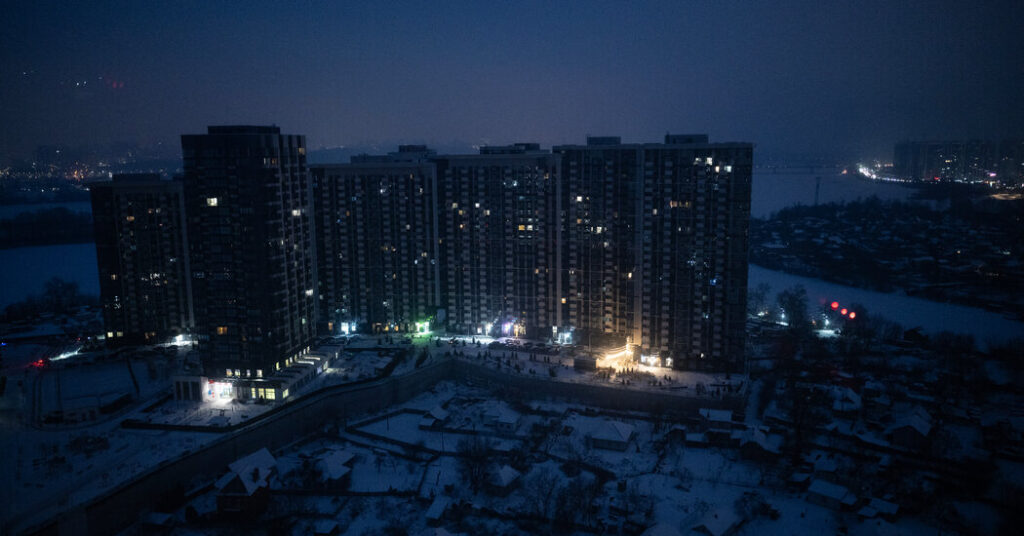
On several occasions, Ukraine’s grid appeared close to collapse. On the last day of January, virtually all of Kyiv went dark for a few hours, according to data shared by DTEK, the country’s largest private energy company and the capital’s electricity distributor. That month, Kyiv residents spent half of every day without power on average.
Dmytro Zubal, a 32-year-old sales manager who lives in a district of Kyiv that was left without heat after a nearby power plant was destroyed, said he had not bothered buying a thermometer to measure how cold his apartment had gotten.
“When I was talking, you could see steam coming out from my mouth,” he recalled.
Moscow began its energy infrastructure campaign in eastern Ukraine. The region’s grid is particularly vulnerable because it cannot draw power from the shuttered Zaporizhzhia nuclear plant in southeastern Ukraine. The plant has been under Russian occupation since the war’s early days.
Eastern Ukraine has since become largely dependent on smaller power plants, and Russia bombed them relentlessly. Maksym Tymchenko, the chief executive of DTEK, which owns two thermal power plants in the eastern Dnipropetrovsk region, compared the situation to living in a “circle” of destruction and repair.
By December, Russia turned its sights on Kyiv. The capital largely relies on three combined heat-and-power plants, known as CHPPs, and a thermal power plant. Additional supplies flow from nuclear plants in western Ukraine through the Kyivska substation, the one that was damaged in late January.
All those facilities have sustained direct hits this winter, according to public statements and interviews with Ukrainian lawmakers and energy industry executives.
One of the most frequently attacked sites is known as CHPP-4, which supplies heat to about 1,100 multistory buildings and dozens of schools and hospitals in Kyiv. After five missiles slammed into the facility in early February, the plant was forced to halt heat supplies indefinitely, the government said. Half a million residents were left with stone-cold radiators as outdoor temperatures plunged to as low as 5 degrees Fahrenheit.
“The scariest thing is to get sick and lie in this cold apartment,” Olha Kobylianska, a 60-year-old pharmacist who lives in a building opposite the damaged plant, said a few days after the attack. “Because what if I didn’t wake up?”
The attack left the plant so battered that Mayor Vitali Klitschko said that repairs would take at least two months. With the facility’s strategic value largely gone, the Ukrainian authorities turned the plant into a showcase of damage from Russia’s strike campaign for visiting foreign delegations, leading them past twisted, blackened pipes as welders patched holes in them.
Russia also repeatedly hit infrastructure connected with the three operating nuclear plants in western Ukraine, which provided much of the country’s power. A report by the International Atomic Energy Agency noted that, from mid-November to mid-February, at least seven attacks severed power lines linked to the plants, forcing them to reduce output.
At a recent news conference, the Ukrainian government said the country had faced a shortfall of 5 to 6 gigawatts this winter, roughly a third of what it needs during peak consumption.
The intensity of the crisis was reflected in Ukraine’s response. In past winters, Kyiv urged its international partners to provide it with spare equipment to repair damaged power plants. But Russia’s attacks were so relentless this time that facilities often came under fire again soon after being restored, nullifying the benefit of the repairs.
So rather than focusing only on repairs, Ukrainian officials also strove to secure backup power in the form of diesel generators and boiler units sent by Western nations. Trucks carrying the equipment crossed into the country roughly every other day.
A full-blown humanitarian crisis was also averted in part thanks to the patchwork of small power stations that households and businesses had installed ahead of the winter, as they braced for blackouts.
By late January, Ukrainians had amassed enough portable power stations to generate more than 3 gigawatts of electricity, according to DroneUA, the company behind the most widely installed models. That is roughly half of the generation capacity Ukraine lost when the Zaporizhzhia nuclear plant fell under Russian occupation.
Energy experts say that the authorities mostly reacted to this winter’s attacks instead of anticipating them. To avoid a repeat next winter, they say, Ukraine must decentralize its grid by building smaller facilities that are harder for Russia to target, stockpile spare equipment and better protect critical energy infrastructure with more bunkers and air defenses.
“Worst-case planning is not optional for Ukraine; it is a necessity,” Mr. Mikhnych, the energy researcher, said. “Any hope that Russia would not cross certain limits, or that some red lines would hold, should be gone after what Ukrainians went through this winter.”
Olha Konovalova, Josh Holder, Maria Varenikova and Jeanna Smialek contributed reporting.
Constant Méheut reports on the war in Ukraine, including battlefield developments, attacks on civilian centers and how the war is affecting its people.
The post How Russia’s Scorched-Earth Attacks Put Ukraine’s Power Grid Near Collapse appeared first on New York Times.